Key Findings
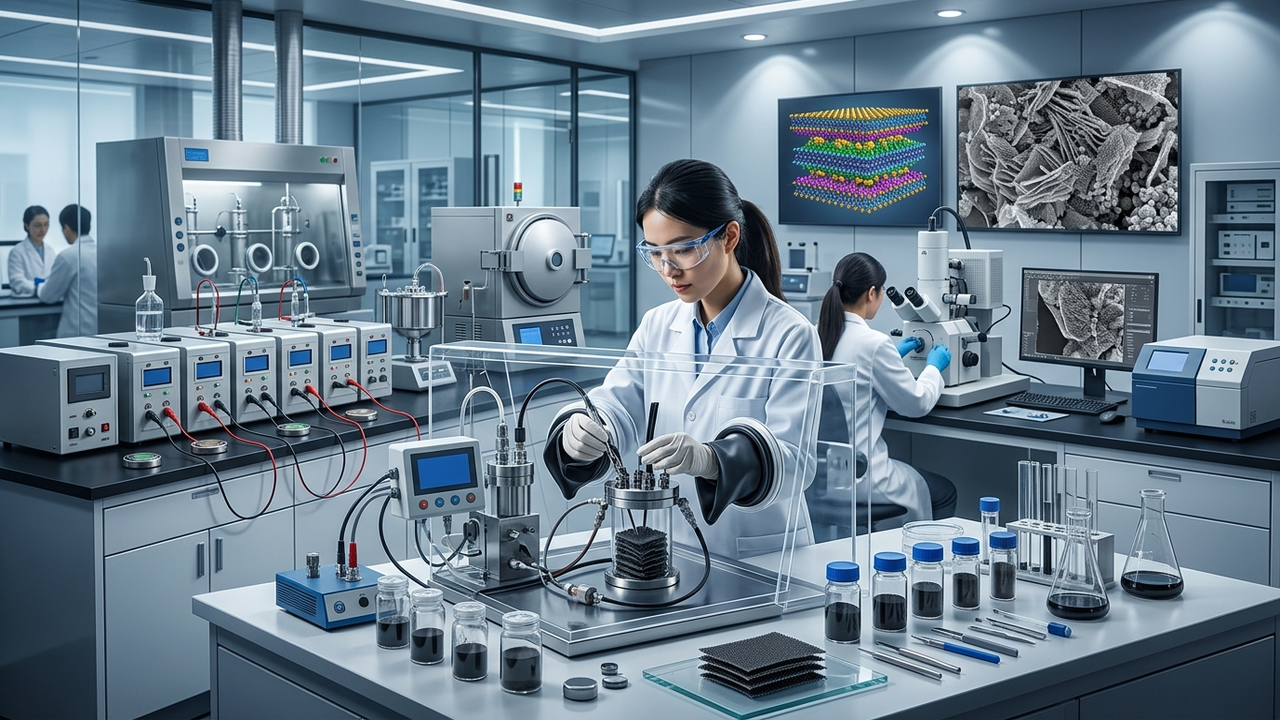
A Chinese research team has successfully synthesized MXene/Fe3S4@FeSe2 multi-heterojunction materials using an innovative “MOFs-derived-sulfidation-selenidation” strategy. This groundbreaking material demonstrates promising characteristics as a high-performance electrode for sodium-ion batteries (SIBs), achieving an impressive initial specific capacity of approximately 450 mAh/g at 0.1 A/g and maintaining 400 mAh/g even at a high current density of 2 A/g.
Technical / Clinical Details
The developed MXene/Fe3S4@FeSe2 multi-heterojunction possesses a unique “hollow tubular flower cluster structure.” This architecture maximizes the reactive surface area and shortens ion diffusion pathways, enabling rapid insertion and extraction of sodium ions. By utilizing MOFs (metal-organic frameworks) as precursors, the team achieved precise structural control and uniform compositional distribution. The heterogeneous interfaces between Fe3S4 and FeSe2 contribute to reducing charge transfer resistance, leading to stable cycling performance. This composite material shows significant improvements in specific capacity and rate capability compared to conventional electrode materials, making it particularly promising for high-power and high-energy-density sodium-ion batteries.
Background & Context
While lithium-ion batteries are widely adopted, their reliance on scarce and geopolitically sensitive lithium resources presents challenges. Sodium-ion batteries (SIBs), leveraging abundant and inexpensive sodium resources, are garnering significant attention as a next-generation large-scale energy storage system. However, the larger size of sodium ions compared to lithium ions has posed a technical bottleneck in developing electrode materials capable of efficient insertion and extraction. Two-dimensional materials like MXenes and transition metal chalcogenides are considered promising electrode materials for SIBs due to their excellent electrochemical properties, and this research accelerates their development.
Strategic Significance & Outlook
The development of this MXene/Fe3S4@FeSe2 multi-heterojunction material represents a critical step towards the practical commercialization of sodium-ion batteries. Future efforts will focus on further optimizing the material’s stability, cycle life, and the scalability of its manufacturing process. If commercialized, this technology could accelerate the widespread adoption of SIBs in electric vehicles, stationary energy storage systems, and smart grids, contributing to a sustainable energy society. Researchers and investors hold high expectations for the potential of this high-performance electrode material.
Source: https://www.gncl.cn/EN/10.3969/j.issn.1001-9731.2026.08.002
Get our weekly technology intelligence — free
Receive an infographic that lets you judge at a glance whether each field’s analysis report is worth reading.
Subscribe Free — Weekly Tech Intelligence
By subscribing, you’ll receive Troy-Technical’s weekly technology intelligence newsletter.
- Your email and selected fields are used only to deliver the newsletter.
- We never share your information with third parties.
- You can unsubscribe anytime via the link in each email.
See our Privacy Policy for details.
Takes about a minute · Unsubscribe anytime

Comments