Background
Fuel cells are recognized as a critical clean energy technology for applications ranging from electric vehicles to stationary power generation. However, their widespread adoption has been significantly hampered by the high cost associated with expensive platinum-group metal catalysts, particularly for the oxygen reduction reaction (ORR). High-entropy alloys (HEAs), which combine multiple elements in high concentrations, offer a promising alternative due to their potential for superior catalytic activity and durability, often surpassing traditional alloys. Despite their promise, the vast compositional space of HEAs necessitates extensive combinatorial exploration, making traditional trial-and-error discovery methods prohibitively slow. Integrating artificial intelligence (AI) with experimental approaches, as exemplified by ChatHEA, represents a new paradigm to dramatically streamline this exploration and accelerate the development of next-generation catalysts.
Key Findings
The Advanced Institute for Materials Research (AIMR) at Tohoku University, in collaboration with an international research team, has developed ‘ChatHEA,’ a groundbreaking cooperative framework that fuses large language models (LLMs) with experimental methodologies. This innovation has significantly accelerated the discovery of high-entropy alloy (HEA) catalysts for fuel cell oxygen reduction reactions (ORR). Through this AI-driven approach, an HEA catalyst with the specific composition ‘FeCoCuPtIr’ was experimentally verified to demonstrate superior performance compared to current commercial platinum/carbon (Pt/C) catalysts. This marks a crucial breakthrough for reducing costs and enhancing the performance of fuel cells, paving the way for their broader commercialization.
Technical Details
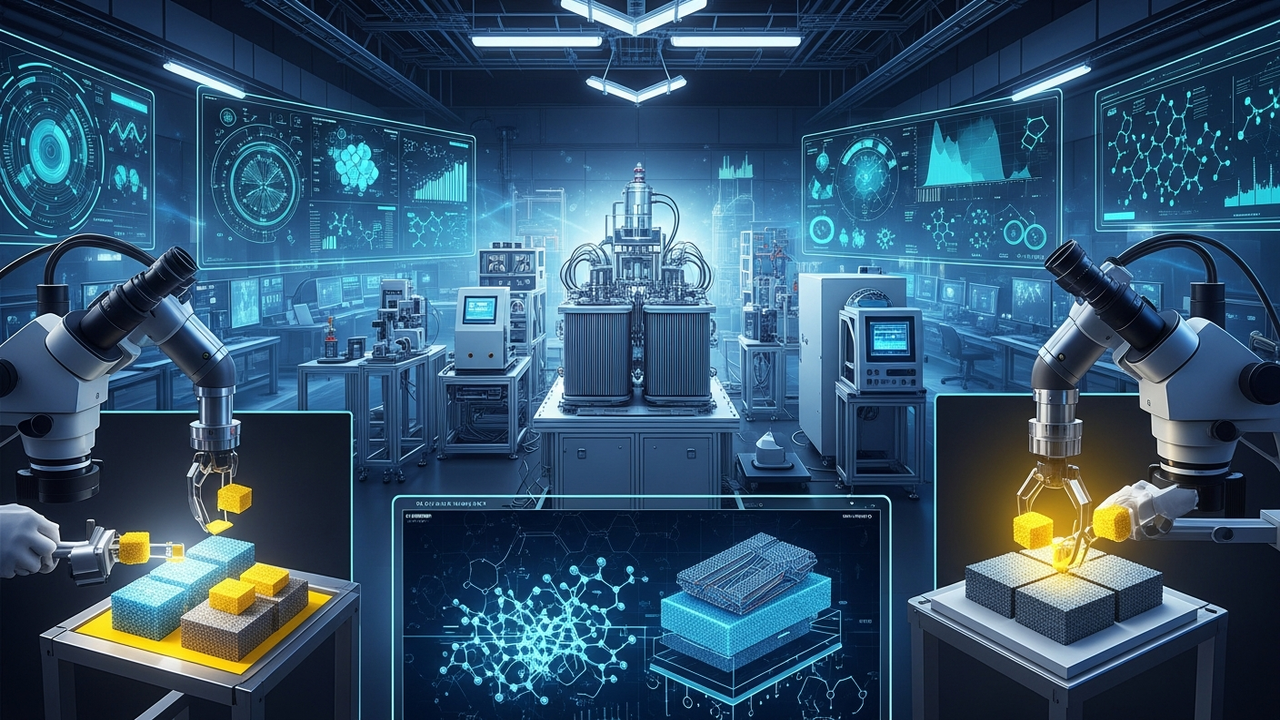
ChatHEA functions as a specialized AI platform for materials discovery, harnessing LLMs’ natural language processing and generative capabilities. Its workflow operates in a multi-staged, closed-loop process. Initially, ChatHEA automatically extracts and organizes critical data—including compositions, synthesis conditions, and performance metrics—related to existing HEA catalysts from extensive scientific literature, patent repositories, and materials databases. Subsequently, leveraging this vast knowledge base, it enumerates promising elemental combinations (e.g., ratios of transition metals and noble metals) for fuel cell ORR and proposes novel HEA candidates. Human researchers then validate ChatHEA’s proposals, augmenting experimental designs with expert physicochemical insights. The proposed HEA compositions are then synthesized in the laboratory, and their ORR activity and durability are rigorously measured in electrochemical cells. This experimental data is fed back into ChatHEA, enabling the LLM to refine its predictive models and optimize future proposals in a continuous learning loop. Through this iterative process, ChatHEA identified the previously unexplored FeCoCuPtIr composition, which demonstrates higher current density and stability than conventional Pt/C catalysts, underscoring AI’s transformative role beyond data processing to direct scientific discovery.
Strategic Significance and Outlook
The FeCoCuPtIr catalyst discovered by ChatHEA holds immense potential to accelerate the commercial viability of fuel cells. The research team will now focus on further optimizing the catalyst’s performance and assessing its scalability to pave the way for practical application. Furthermore, the ChatHEA framework itself is expected to extend its applicability to a broader range of catalytic reactions and the discovery of novel functional materials. By enabling LLMs to act as ‘AI-driven research assistants’ in scientific inquiry, the speed and efficiency of R&D can be dramatically improved, accelerating material innovations essential for realizing a more sustainable and energy-efficient society. This serves as a successful example of the paradigm of human-AI collaboration in advanced materials science research.
Source: #
Get our weekly technology intelligence — free
Receive an infographic that lets you judge at a glance whether each field’s analysis report is worth reading.
Subscribe Free — Weekly Tech Intelligence
By subscribing, you’ll receive Troy-Technical’s weekly technology intelligence newsletter.
- Your email and selected fields are used only to deliver the newsletter.
- We never share your information with third parties.
- You can unsubscribe anytime via the link in each email.
See our Privacy Policy for details.
Takes about a minute · Unsubscribe anytime






Comments