Key Findings
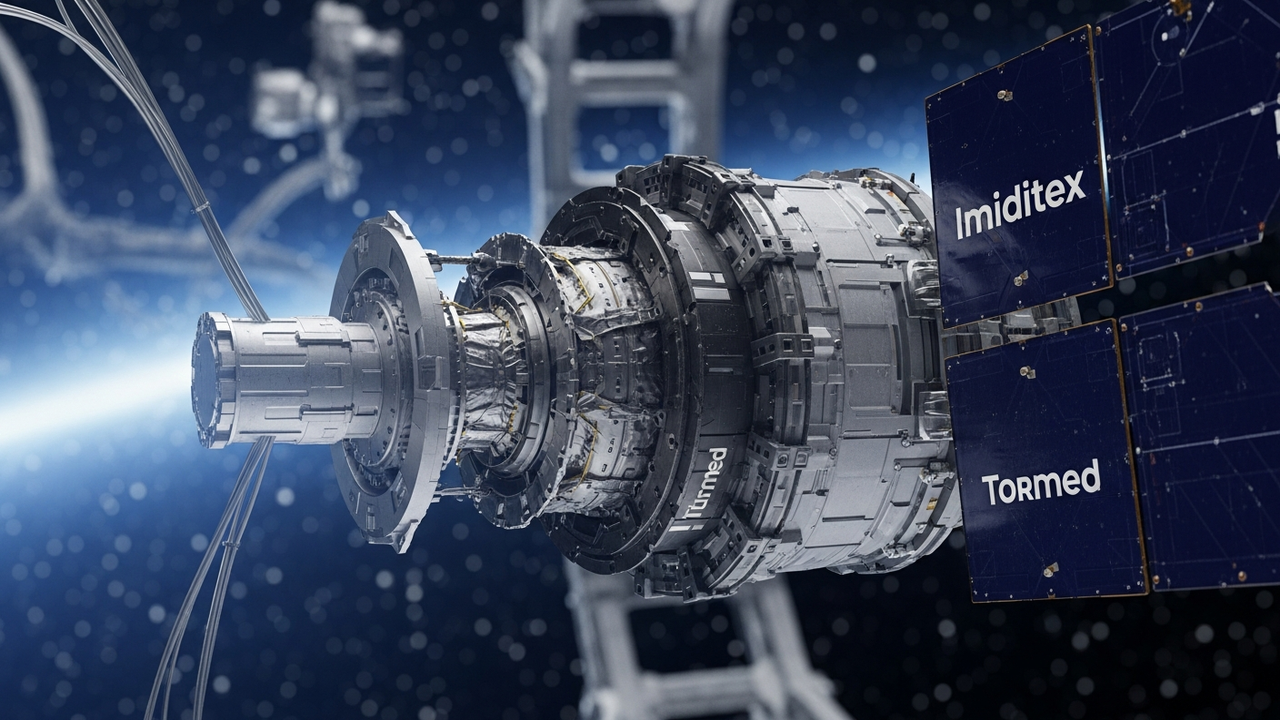
Advanced polyimide materials are pioneering new application domains within space systems, garnering significant attention for their ability to meet stringent requirements such as lightweight construction, thermal stability, and resistance to radiation and UV exposure. Specifically, products like Imiditex and Tormed are opening novel possibilities in areas previously challenging to address, including satellite thermal control and solar energy systems.
Technical Details
Polyimides have long been utilized in aerospace for their exceptional thermal stability, mechanical strength, and chemical resistance. However, next-generation space missions, particularly long-duration deep-space exploration and operations in extreme environments, demand even higher performance. Advanced polyimide materials address these challenges through precise molecular structure design and the incorporation of nano-composite technologies. For instance, Imiditex achieves high resistance to the harsh radiation (especially high-energy particles) and intense ultraviolet (UV) exposure of space, despite its lightweight nature. This enables its application in spacecraft structural components, electronic packaging, or as composite layers in spacesuits. Meanwhile, Tormed is being developed as a highly transparent film with intrinsic thermal control properties, holding the potential to enable more efficient thermal management and propulsion systems when applied to satellite thermo-optical surfaces or solar sails. These materials are undergoing rigorous performance validation against space-specific harsh conditions, including vacuum, extreme temperature cycles, vibration, and micro-debris impacts.
Background & Industry Context
The space industry is entering a new phase marked by the proliferation of small satellites, increased deep-space exploration, and the conceptualization of in-orbit manufacturing. These evolutions impose new demands on materials science. Conventional materials face limitations in terms of weight, durability, and cost, constraining mission scope and sustainability. The development of advanced polyimide materials aims to break these constraints, enabling the design of higher-performance, longer-lasting, and more cost-efficient space systems. Lightweighting directly translates to reduced launch costs, while enhanced environmental resistance extends mission success rates and operational periods. These materials are poised to become foundational technologies supporting the expansion of the space economy.
Strategic Significance & Outlook
Advanced polyimide materials are expected to see accelerated adoption in space systems over the next few years. Anticipated applications include thermal control systems for small satellite constellations, insulation for deep-space probes, and precise optical components for next-generation space telescopes and sensor arrays. In the long term, these material technologies hold the potential to provide solutions for more complex challenges, such as the construction of lunar and Martian habitation modules, the realization of self-assembling structures in space, and even space debris mitigation. Continued research and development in this area will be key to unlocking further frontiers in the space industry.
Get our weekly technology intelligence — free
Receive an infographic that lets you judge at a glance whether each field’s analysis report is worth reading.
Subscribe Free — Weekly Tech Intelligence
By subscribing, you’ll receive Troy-Technical’s weekly technology intelligence newsletter.
- Your email and selected fields are used only to deliver the newsletter.
- We never share your information with third parties.
- You can unsubscribe anytime via the link in each email.
See our Privacy Policy for details.
Takes about a minute · Unsubscribe anytime






Comments