Key Findings
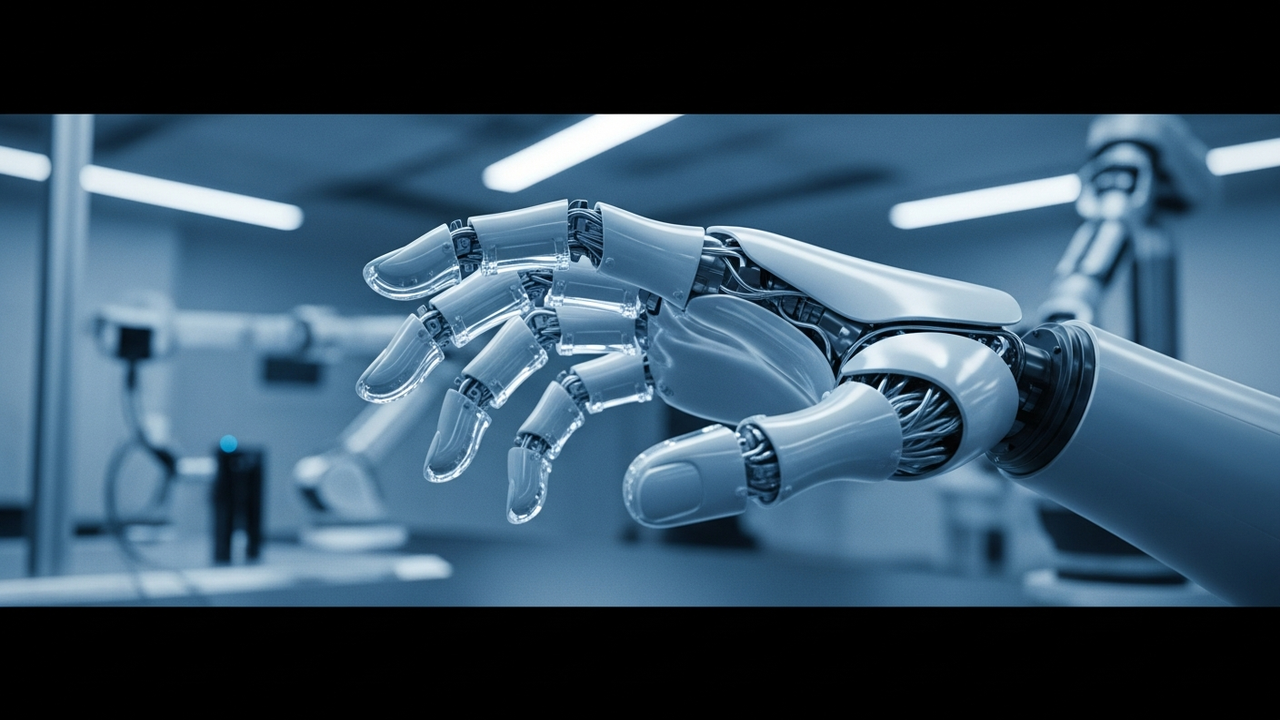
Researchers led by Danqing Liu at Eindhoven University of Technology have successfully endowed light-responsive liquid crystal polymers (LCPs) with ‘memory’ capabilities, demonstrating control over an artificial hand that replicates human-like gestures. This groundbreaking achievement opens new avenues for the development of autonomous soft robotics and self-regulating materials.
Technical / Clinical Details
The research team developed an LCP device integrated with azobenzene groups, which are responsive to light. The core of this device lies in the azobenzene groups’ ability to isomerize upon exposure to specific wavelengths of light, propagating structural changes throughout the polymer network to alter the material’s shape. Crucially, this research demonstrated that this shape change ‘memory’ could be written into the device via light exposure, and subsequently, an electrical signal could trigger and reproduce the stored shape change. This allows the artificial hand to smoothly and precisely mimic complex human hand movements, such as finger bending or grasping specific objects. This technology offers a lightweight, flexible, quiet, and energy-efficient operation compared to conventional motor-driven robots.
Background & Context
Soft robotics is a rapidly expanding field aiming for flexible, adaptive robotic systems that can safely interact with humans. However, one of its greatest challenges has been finding suitable materials and mechanisms to generate and control complex motions. While traditional LCPs are known to change shape in response to light or heat, integrating ‘memory’ and electrical triggering capabilities has been difficult. The work by Danqing Liu’s team bridges this gap, showing that smart materials can achieve not just passive responses but programmable, active movements. This has significant implications for various sectors, including medical applications, wearable devices, and human-machine interaction.
Strategic Significance & Outlook
The combination of memory function and electrical triggering in these light-responsive liquid crystal polymers holds the potential to revolutionize the design of autonomous soft robots and self-regulating materials. The artificial hand demonstration suggests applications extending to prosthetics, medical implants, industrial robots requiring precise manipulation, and even entertainment. In the future, these materials are expected to form the basis of ‘biomimetic’ smart devices that seamlessly integrate into human environments, enabling more natural and intuitive interactions. This technology is more than just an evolution in functional materials; it is an ‘interesting’ breakthrough that could redefine the relationship between humans and machines.
Source: https://www.myscience.org/news/wire/teaching_smart_materials_to_move_like_humans-2026-myscience
Get our weekly technology intelligence — free
Receive an infographic that lets you judge at a glance whether each field’s analysis report is worth reading.
Subscribe Free — Weekly Tech Intelligence
By subscribing, you’ll receive Troy-Technical’s weekly technology intelligence newsletter.
- Your email and selected fields are used only to deliver the newsletter.
- We never share your information with third parties.
- You can unsubscribe anytime via the link in each email.
See our Privacy Policy for details.
Takes about a minute · Unsubscribe anytime





Comments