Key Findings
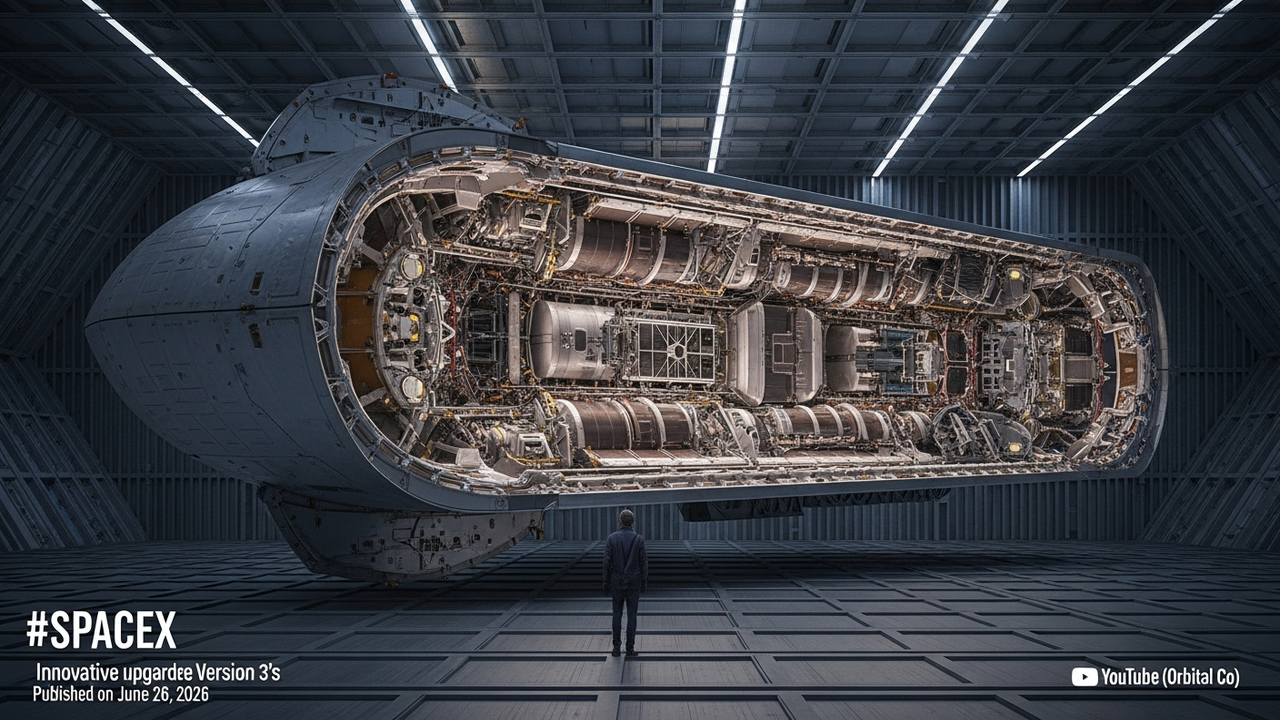
SpaceX’s Starship Version 3, despite appearing largely similar to its predecessors externally, incorporates critical engineering upgrades to its internal load-bearing geometry. This innovative structural redesign significantly enhances the overall strength of the vehicle while simultaneously achieving weight reduction. This represents a crucial advancement for Starship to operate reliably as a frequently reusable spacecraft.
Technical & Design Details
- Optimized Internal Load-Bearing Geometry: The core improvement in Starship Version 3 involves a redesign of the internal structure to more efficiently and uniformly distribute the various loads (thrust, differential pressure, G-forces, etc.) acting on the rocket. While earlier designs tended to rely on specific thick steel sections, V3 optimizes load paths, allowing for more efficient material usage without compromising overall structural integrity.
- Simultaneous Achievement of Strength and Weight Reduction: The primary objective of this design modification was to reduce unnecessary mass while maintaining structural integrity. Weight reduction directly translates to increased launch capability (allowing for more payload or propellant) and reduced stress during re-entry and landing. Concurrently, high durability is ensured to withstand repeated use.
- Contribution to Reusability: Starship’s vision is to be rapidly and frequently reusable, much like an aircraft. Structural weight reduction and strength enhancement are critically important for cutting maintenance costs and time during reuse, and for increasing operational reliability throughout its lifespan. This contributes to SpaceX’s goal of drastically lowering the cost of spaceflight and democratizing access to space.
- Leveraging Materials Science and Simulation: Such complex structural optimization is believed to have been achieved through advanced simulation technologies, including cutting-edge materials science, Computational Fluid Dynamics (CFD), and Finite Element Analysis (FEA). These tools accelerated the design iteration and validation processes.
Background & Industry Context
Rocket structural design is a decisive factor influencing numerous aspects, including payload capacity, fuel efficiency, reusability, and manufacturing costs. Especially for a massive, fully reusable system like Starship, even small weight reductions can significantly impact performance. SpaceX continues to challenge conventional aerospace industry norms by combining innovative manufacturing techniques (e.g., use of stainless steel) with novel design methodologies.
Future Outlook
The structural design upgrades in Starship Version 3 strengthen the technical foundation for Starship to achieve its ambitious goals, such as human missions to the Moon and Mars, large-scale Starlink satellite deployment, and Earth-to-Earth transportation. The success of this design will set a new benchmark for structural optimization in future spacecraft development, contributing to the realization of more efficient and reliable space transportation systems. This evolution is an indispensable element in further facilitating access to space and accelerating the expansion of the space economy.
Source: https://www.youtube.com/shorts/YIqvJr6lwh8
Get our weekly technology intelligence — free
Receive an infographic that lets you judge at a glance whether each field’s analysis report is worth reading.
Subscribe Free — Weekly Tech Intelligence
By subscribing, you’ll receive Troy-Technical’s weekly technology intelligence newsletter.
- Your email and selected fields are used only to deliver the newsletter.
- We never share your information with third parties.
- You can unsubscribe anytime via the link in each email.
See our Privacy Policy for details.
Takes about a minute · Unsubscribe anytime








Comments