Background
The explosive growth of artificial intelligence has driven high-performance computing demand in data centers to unprecedented levels, positioning AI accelerators as the semiconductor industry’s fastest-growing segment. NVIDIA has long held market dominance, anchored by its powerful GPU performance and extensive CUDA ecosystem. However, AMD and Intel are now aggressively challenging this stronghold, leveraging open-source strategies and deeper integration into the x86 ecosystem. Cloud service providers and major enterprises are actively seeking to diversify their AI chip procurement to mitigate supply chain risks and optimize costs, further intensifying the competitive landscape.
Key Findings
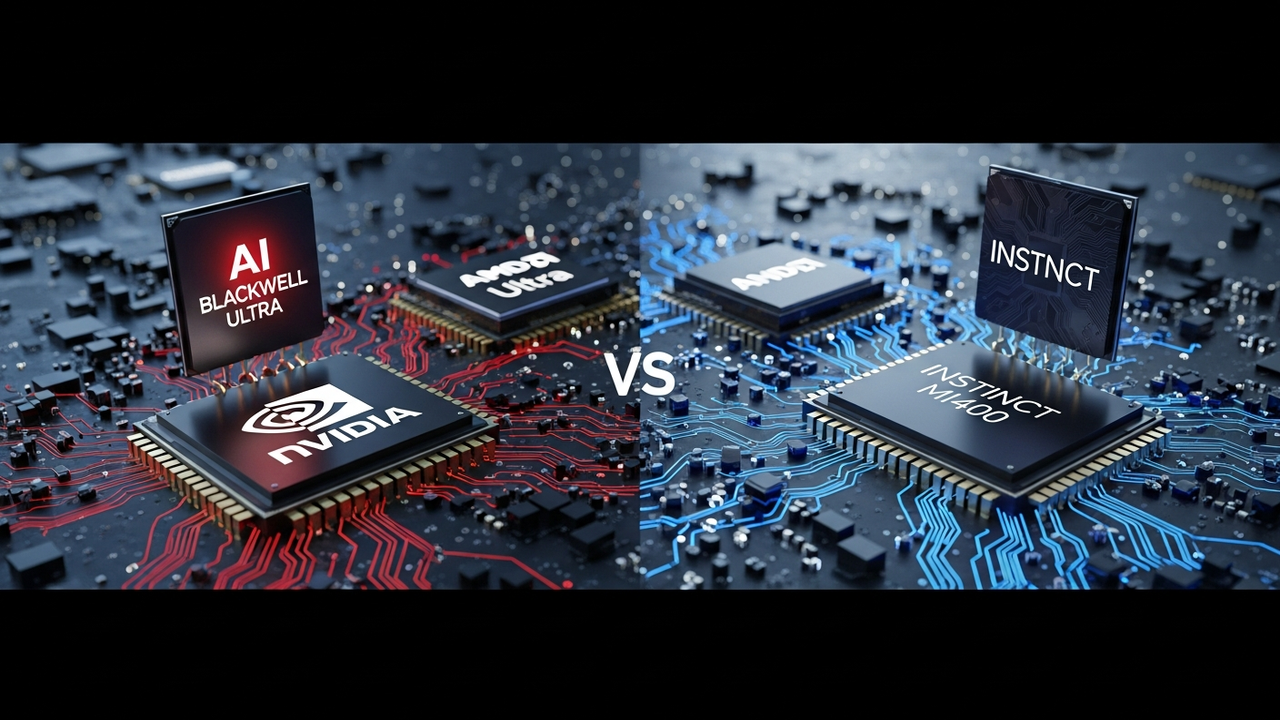
In 2026, the AI chip market competition among NVIDIA, AMD, and Intel is poised to enter a new and significantly more intense phase, driven by the anticipated introduction of each company’s next-generation products. The forthcoming debut of NVIDIA’s ‘Blackwell Ultra’ and AMD’s Instinct MI400 series, in particular, is expected to redefine the benchmarks for performance and efficiency in data center AI accelerators.
Technical Details
NVIDIA is set to maintain its industry-leading performance in both AI training and inference with ‘Blackwell Ultra,’ an enhanced iteration of its foundational Blackwell architecture. This advancement is expected to leverage improved GPU cores, next-generation High Bandwidth Memory (HBM) stacks, and seamless scaling capabilities facilitated by NVLink. AMD, with its Instinct MI400 series, aims to significantly expand its market share by offering a more open software stack (ROCm) and HBM-based accelerators designed to deliver superior price-performance ratios. Intel distinguishes its strategy by providing a broader spectrum of options for diverse AI workloads, evolving its Gaudi series, and developing integrated CPU-GPU solutions such as Falcon Shores. All three companies are making substantial investments in advanced chip design, pushing memory bandwidth limits, and innovating interconnect technologies, with a particular emphasis on the efficient processing of large language models (LLMs). For instance, the MI400 is reportedly targeting an approximate XX% improvement in LLM inference throughput compared to its predecessor, the MI300X (while specific figures remain officially unreleased, early reports suggest significant gains).
Strategic Significance & Outlook
This intensified three-way competition is expected to significantly accelerate technological innovation in AI chips, ultimately benefiting end-users through reduced AI computing costs and enhanced performance. While NVIDIA is anticipated to maintain its leadership position, leveraging its superior performance and robust ecosystem, AMD and Intel are projected to carve out substantial market shares through their distinct strategies. For investors, each company’s technology roadmap, production capacity, and strategic relationships with key customers will be pivotal factors influencing future stock performance. The continuous evolution of AI chips will enable the practical implementation of increasingly larger and more complex AI models, further accelerating digital transformation across all industries.
Source: https://cryptobriefing.com/nvidia-amd-intel-ai-chip-race-2026/
Get our weekly technology intelligence — free
Receive an infographic that lets you judge at a glance whether each field’s analysis report is worth reading.
Subscribe Free — Weekly Tech Intelligence
By subscribing, you’ll receive Troy-Technical’s weekly technology intelligence newsletter.
- Your email and selected fields are used only to deliver the newsletter.
- We never share your information with third parties.
- You can unsubscribe anytime via the link in each email.
See our Privacy Policy for details.
Takes about a minute · Unsubscribe anytime