Key Findings
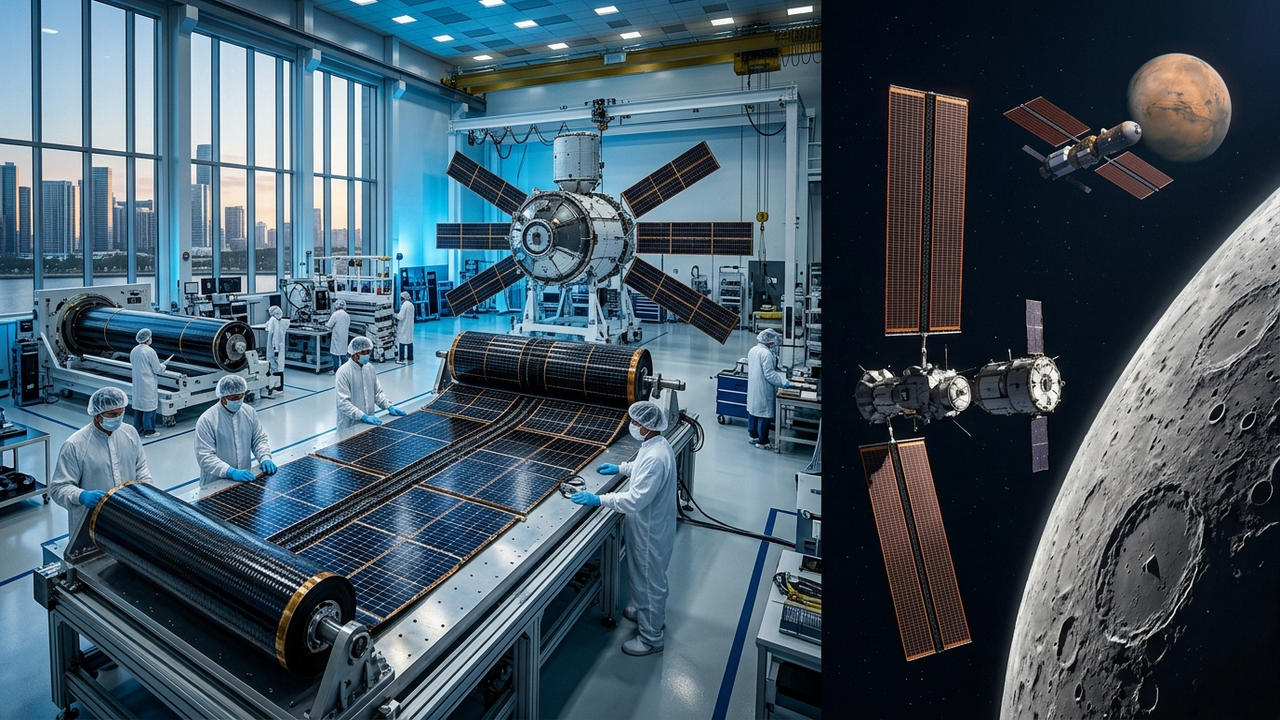
Redwire, a leading provider of critical components for space exploration and national security, has seen its backlog surpass $500 million, demonstrating five consecutive quarters of growth. The company’s patented Roll-Out Solar Arrays (ROSA) have been chosen as the primary power source for NASA’s Power and Propulsion Element (PPE), part of the lunar Gateway, and for the 2028 SR-1 Freedom mission to Mars, owing to their superior lightweight and compact storage volume.
Technical & Operational Details
The Roll-Out Solar Arrays (ROSA) developed by Redwire boast significant advantages over traditional rigid solar panels, being approximately 20% lighter and requiring one-quarter of the storage volume during launch. This technology utilizes flexible composite booms to autonomously deploy large solar arrays in space. Their compact stowed configuration allows for more panels to be packed within a launch vehicle’s payload fairing, contributing to reduced launch costs and increased mission flexibility. ROSA has been selected as the central power system for the Power and Propulsion Element (PPE) of NASA’s lunar Gateway, which is essential for meeting power demands in deep space exploration around the Moon. Furthermore, its adoption for the 2028 SR-1 Freedom mission to Mars means it will be responsible for providing stable power to the spacecraft and habitat modules during crewed Martian exploration. Given its high reliability and performance, this technology holds the potential to become a standard power solution for future deep space exploration missions.
Background & Industry Context
The space industry is in constant pursuit of lighter, higher-performing, and easily deployable power systems. For crewed missions to the Moon and Mars, launch mass and volume constraints are particularly stringent, making efficient power supply critical to mission success. Redwire’s ROSA technology offers an innovative solution to these challenges, earning high praise from leading space agencies like NASA. The selection of ROSA for both the lunar Gateway and a Mars mission indicates that the technology is building a strong flight heritage in deep space environments, solidifying Redwire’s position in the space infrastructure market. This success exemplifies how new space technologies are integrated into and fulfill the demands of governmental missions.
Strategic Significance & Outlook
The expanding adoption of Redwire’s ROSA technology signals a significant trend in the future of space power systems. The increase in the company’s backlog reflects ROSA’s growing status as a standard choice for both commercial and governmental space missions. Beyond ROSA, Redwire is broadening its business scope, showcasing innovative solutions like its European VLEO platform, Phantom, at events such as the Space Defense & Security Summit. In the future, ROSA could be widely applied not only to lunar base and Mars exploration power supplies but also to space stations, large satellites, and even future space infrastructure projects like space-based solar power. This trajectory further strengthens Redwire’s position as a key company driving the growth of the space economy. Investors are closely watching its technological advantage and continuous growth opportunities.
Source: https://www.fool.com/investing/2026/09/11/should-you-buy-redwire-while-its-below-13/
Get our weekly technology intelligence — free
Receive an infographic that lets you judge at a glance whether each field’s analysis report is worth reading.
Subscribe Free — Weekly Tech Intelligence
By subscribing, you’ll receive Troy-Technical’s weekly technology intelligence newsletter.
- Your email and selected fields are used only to deliver the newsletter.
- We never share your information with third parties.
- You can unsubscribe anytime via the link in each email.
See our Privacy Policy for details.
Takes about a minute · Unsubscribe anytime








Comments