
Key Findings
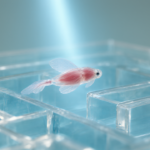
The Cornell team has successfully integrated sensing and actuation in a microscopic system that can detect thermal gradients and actively redistribute fluids. The system employs a closed-loop regulation architecture where sensing drives actuation, and the resulting fluid movement alters the sensed variable. A specific control policy allows the robots to generate forward flow above a threshold temperature and reverse flow below it, effectively functioning as a microscopic thermostat.
Technical Details
To overcome the challenges of low Reynolds numbers—where viscous forces dominate and reciprocal motion produces no net flow—the researchers implemented a two-hinge design. This design breaks symmetry by moving hinges in a deliberate sequence, creating a nonreciprocal stroke that imparts directional momentum to the liquid, mimicking natural cilia.
- Fabrication: Actuators and electronics are produced using semiconductor manufacturing techniques, allowing for individual or group addressing via electronic signals.
- Communication: The system uses a leader-follower scheme. A leader circuit detects the thermal state of the environment, and a follower circuit adjusts the pumping behavior of the cilia array.
- Scale: The robots are approximately the width of a human hair, a regime where surface forces like capillary adhesion and viscous drag outweigh gravity.
Background & Context
Conventional electromagnetic motors are impractical at this scale as they cannot be shrunk below tens of micrometers while maintaining power. The Cornell team’s approach draws inspiration from biological cilia, such as those in human airways that move mucus in metachronal waves. This work integrates previous developments in autonomous walking, environmental sensing, and inter-robot communication into a single functional system.
Significance & Outlook
The ability to detect and respond to localized temperature differences has significant implications for biomedical applications, as inflammation, infection, or tumors often exhibit elevated metabolic activity and heat. Additionally, the programmable nature of the cilia allows for reconfiguration of the threshold and pumping rate for other uses, such as circulating nutrient solutions in agriculture.
Source: https://bioengineer.org/microrobots-sense-heat-and-pump-fluids-together-in-a-world-first/
Get our weekly technology intelligence — free
Receive an infographic that lets you judge at a glance whether each field’s analysis report is worth reading.
Subscribe Free — Weekly Tech Intelligence
By subscribing, you’ll receive Troy-Technical’s weekly technology intelligence newsletter.
- Your email and selected fields are used only to deliver the newsletter.
- We never share your information with third parties.
- You can unsubscribe anytime via the link in each email.
See our Privacy Policy for details.
Takes about a minute · Unsubscribe anytime