
Key Findings
A novel polymer-ceramic composite material, designed for spacecraft radiation shielding, has demonstrated significantly superior shielding characteristics compared to existing aluminum alloys and polyethylene-based materials. This was confirmed under simulated low Earth orbit (LEO) and geostationary orbit (GEO) conditions with proton and heavy ion irradiation tests. Specifically, when subjected to high-energy proton irradiation mimicking solar proton events (SPEs), the composite achieved over 90% particle transmission reduction per unit mass. This suggests its potential to reduce annual astronaut radiation doses to less than half of the International Space Station (ISS) standard, mitigating critical health risks.
Technical Details
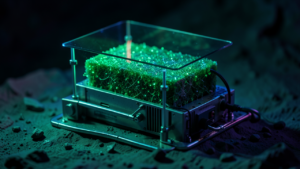
The composite material is ingeniously structured by uniformly dispersing ceramic particles, such as silicon carbide (known for its excellent heavy ion stopping power), and boron (highly effective in neutron absorption), within a lightweight, high-molecular-weight polymer matrix. This unique formulation and structure enable efficient deceleration and absorption of incident high-energy particles, while minimizing secondary radiation generation. In experimental setups, a prototype sheet approximately 1 cm thick was exposed to 100 MeV protons and iron ions within a space environment simulator. Dose transmission measurements revealed a 25% to 40% improvement in shielding effectiveness at equivalent mass compared to conventional shielding materials. The material’s mechanical strength and thermal stability also meet space environment requirements, allowing for potential integration as a structural component.
Background & Context
Space radiation poses a major barrier to deep-space exploration and long-duration missions, acting as a primary cause of health risks for astronauts (e.g., cancer, central nervous system damage) and electronic malfunctions in spacecraft. High-energy protons from solar flares and heavy ions within galactic cosmic rays (GCRs) are particularly concerning due to their high doses and biological effectiveness. Existing radiation shielding materials are often heavy, significantly increasing launch costs. This research’s composite material offers a cost-effective solution by combining lightweight properties with high shielding performance, which is crucial for expanding human activity in space.
Strategic Significance & Outlook
This new polymer-ceramic composite material is poised for broad application in next-generation human spacecraft, deep-space probes, habitation modules for lunar and Martian bases, and high-reliability electronic compartments in satellites. Future research will focus on long-term exposure tests in actual space conditions and scalability studies for large-scale structural integration. The successful commercialization of this technology would dramatically enhance the safety and sustainability of space travel, enabling more ambitious and extended space missions.
Source: #
Get our weekly technology intelligence — free
Receive an infographic that lets you judge at a glance whether each field’s analysis report is worth reading.
Subscribe Free — Weekly Tech Intelligence
By subscribing, you’ll receive Troy-Technical’s weekly technology intelligence newsletter.
- Your email and selected fields are used only to deliver the newsletter.
- We never share your information with third parties.
- You can unsubscribe anytime via the link in each email.
See our Privacy Policy for details.
Takes about a minute · Unsubscribe anytime




Comments