Key Findings
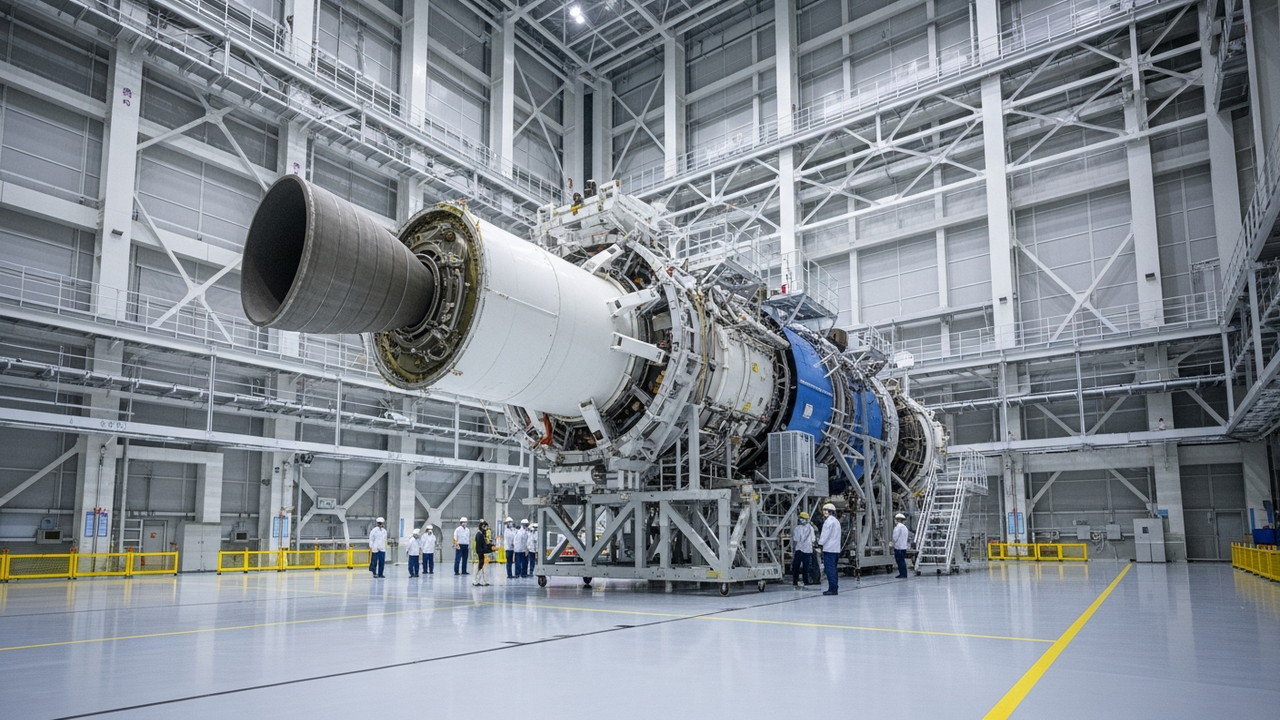
The Japan Aerospace Exploration Agency (JAXA) has announced the successful completion of a critical firing test for the LE-9 engine, the first-stage engine of Japan’s next-generation H3 launch vehicle. This successful test re-confirms the LE-9 engine’s design performance and high reliability, marking an extremely significant milestone for future H3 rocket testing and operationalization. This represents a crucial step for strengthening Japan’s autonomous space transportation capabilities and enhancing its competitiveness in the international space launch services market.
Technical Details
The LE-9 engine is an expander cycle engine powered by liquid hydrogen and liquid oxygen, characterized by high combustion efficiency and thrust adjustability. The firing test conducted was a long-duration test (hundreds of seconds), simulating actual launch conditions, and was performed repeatedly on multiple test engines. During the tests, the engine’s thrust, specific impulse, combustion stability, and the integrity of key components (turbopumps, combustion chamber, nozzle, etc.) were meticulously evaluated. Specifically, it was confirmed that the vibration characteristics during high-speed rotation of the turbopumps and the heat load distribution within the combustion chamber matched the design values. Furthermore, the proper functioning of the engine’s overall system, including its anomaly detection and shutdown capabilities, was demonstrated. These data are indispensable for the final adjustments and safety assurance of the engine system in preparation for the upcoming H3 rocket flight tests.
Background & Context
The H3 rocket is under development as Japan’s next-generation flagship launch vehicle, succeeding the H-IIA/B rockets, to support Japan’s space transportation needs. Its development goals include halving launch costs, increasing launch capability, and maintaining high reliability, aiming to strengthen its competitiveness in the international commercial launch market. The development of the LE-9 engine is one of the most critical elements determining the H3 rocket’s performance. Overcoming past challenges, this success provides significant confidence towards achieving the H3 rocket’s objective of ‘making Japan’s access to space cheaper and more reliable.’
Strategic Significance & Outlook
The successful LE-9 engine firing test is a significant advancement for the smooth progress of the H3 rocket’s flight test program. Based on this achievement, JAXA plans to continue ground tests of the entire H3 rocket system, accelerating preparations for the inaugural test flight with a production vehicle slated for the latter half of the 2020s. Once the H3 rocket becomes operational, it will be capable of meeting not only Japanese government mission demands but also commercial satellite launch requirements from overseas, contributing to the further development of the space industry. In the long term, the stable operation of the H3 rocket will be indispensable for enhancing Japan’s capacity to contribute to lunar exploration and deep-space missions.
Get our weekly technology intelligence — free
Receive an infographic that lets you judge at a glance whether each field’s analysis report is worth reading.
Subscribe Free — Weekly Tech Intelligence
By subscribing, you’ll receive Troy-Technical’s weekly technology intelligence newsletter.
- Your email and selected fields are used only to deliver the newsletter.
- We never share your information with third parties.
- You can unsubscribe anytime via the link in each email.
See our Privacy Policy for details.
Takes about a minute · Unsubscribe anytime





Comments