Key Findings
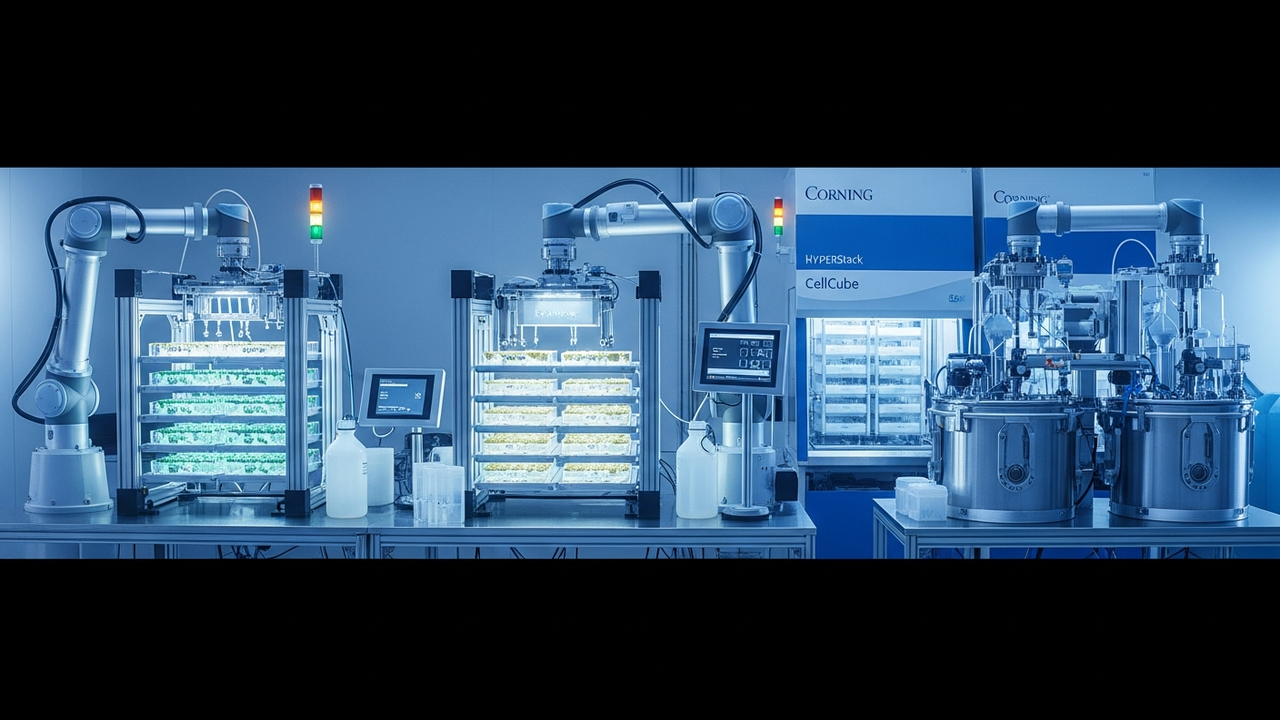
Automation technology has been shown to dramatically improve the consistency and efficiency of scaling out adherent cell cultures. This is particularly effective in situations where labor and bioprocessing expertise are limited. Automated culture platforms enhance consistency in critical parameters such as media exchange flow rates, timing, and temperature control, which stabilizes cell growth and product quality, ultimately leading to higher yields and improved product quality. Corning’s HYPERStack system offers a threefold increase in surface area compared to traditional planar cell culture devices, significantly boosting production capacity, while the CellCube system’s modular design allows for flexible scale-up or scale-out from development stages to commercial production.
Technical/Clinical Details
- Enhanced Consistency through Automation: Adherent cell cultures, by their nature, involve multiple manual steps, which can lead to variability in product quality due to differences in operator technique and fluctuating working conditions. Automated systems standardize these steps, providing reproducible processes that ensure batch-to-batch consistency. For instance, automated control of precise media exchange volumes and timings consistently maintains an optimal nutrient environment for cells, maximizing growth.
- High-Density Culture Systems: Corning’s HYPERStack system achieves vast cell culture surface area within a limited footprint through its multi-layered structure. This allows for culturing significantly more cells in a single device compared to traditional culture flasks or plates, making it suitable for large-scale applications such as cell therapy, vaccine production, and protein manufacturing. The threefold increase in surface area directly translates to increased production throughput.
- Modular Scalability: Corning’s CellCube system adopts a modular concept, offering the flexibility to increase or decrease culture capacity as needed. This is highly advantageous when scaling up incrementally from early-stage R&D to clinical trials and eventual commercial production. Adding or removing modules optimizes capital investment and allows for rapid adaptation to fluctuating demand.
- Implementation of Closed-System Processing: To minimize contamination risks in cell culture processes, technologies like the closed-system workflow for end-to-end processing of human pluripotent stem cells (hPSC) offered by companies such as Miltenyi Biotec are crucial. Catalent’s autologous and allogeneic cell therapy manufacturing also employs closed-system processing to support cGMP compliance, underscoring the indispensable role of such closed systems in improving the scalability and quality of adherent cell cultures.
Background & Context
In the fields of cell therapy, regenerative medicine, and biopharmaceutical manufacturing, large-scale cultivation using adherent cells is essential. However, these processes have often been complex, costly, labor-intensive, and fraught with reproducibility challenges. Particularly for cells requiring adherent culture, such as pluripotent stem cells and certain T-cell types, there is a demand for methods to efficiently scale out while maintaining cell quality and viability. The development of automated high-density culture systems represents a significant advancement in overcoming these challenges and producing high-quality cell products more economically.
Strategic Significance & Outlook
Further advancements in automation and high-density culture systems for adherent cell cultures will significantly accelerate the commercialization of cell therapeutics and regenerative medicine products. Achieving more consistent and cost-effective manufacturing processes is key to bringing these innovative treatments to a broader patient population. Moving forward, greater integration of AI and robotics is expected to further refine culture process optimization and monitoring, ultimately leading to fully autonomous and scalable cell manufacturing platforms.
Get our weekly technology intelligence — free
Receive an infographic that lets you judge at a glance whether each field’s analysis report is worth reading.
Subscribe Free — Weekly Tech Intelligence
By subscribing, you’ll receive Troy-Technical’s weekly technology intelligence newsletter.
- Your email and selected fields are used only to deliver the newsletter.
- We never share your information with third parties.
- You can unsubscribe anytime via the link in each email.
See our Privacy Policy for details.
Takes about a minute · Unsubscribe anytime