Key Findings
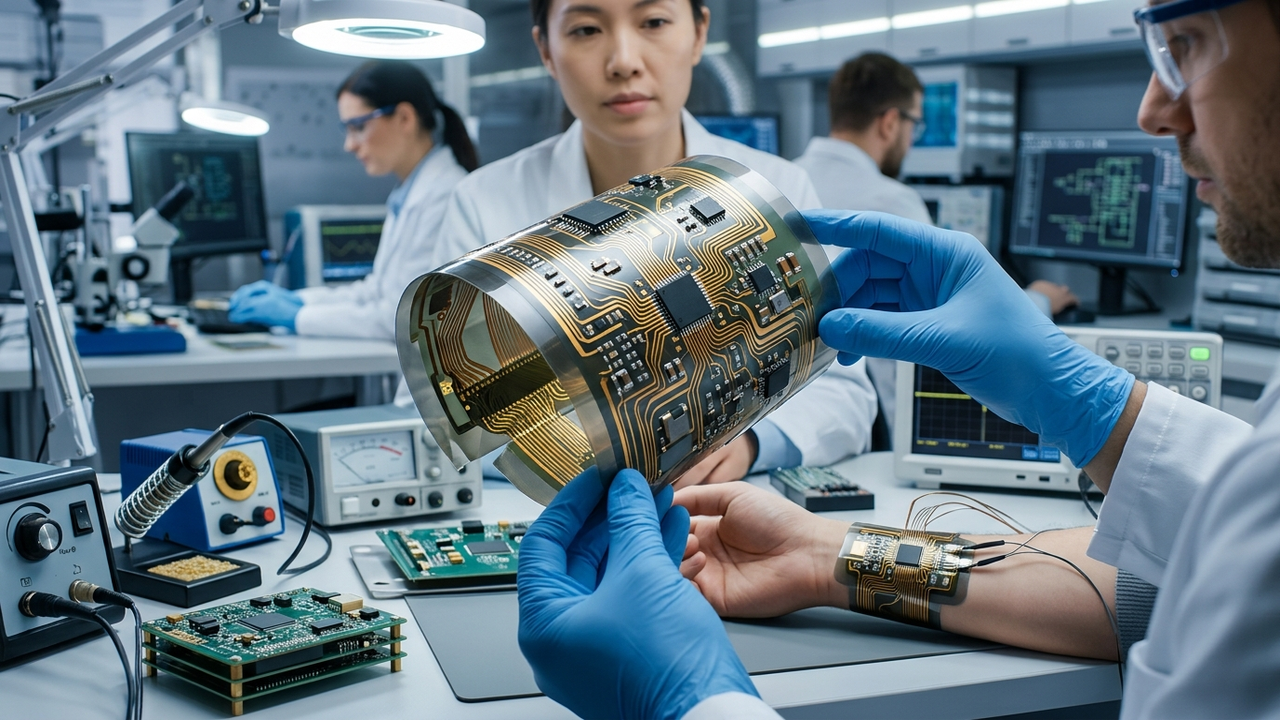
Germany’s applied research institution, Fraunhofer IZM (Fraunhofer Institute for Reliability and Microintegration), has conducted the latest demonstration of its High-Density Flexible Hybrid Substrate (FHS) technology. This FHS technology opens new possibilities for next-generation compact and high-performance electronic products by achieving both excellent flexibility and high integration, which were difficult to realize with conventional rigid printed circuit boards. FHS enables the direct mounting of multiple semiconductor chips (e.g., ASICs, MCUs) and passive components (resistors, capacitors) onto a flexible, bendable, and twistable substrate, connecting them with high-density wiring. This technology is expected to significantly reduce footprint and enhance functionality in applications requiring miniaturization and flexible form factors, such as wearable devices, medical sensors, implants, and various IoT (Internet of Things) devices.
Technical and Development Details
Key features of the FHS technology demonstrated by Fraunhofer IZM include:
- High-Density Wiring: Applies fine line/space (L/S) technology to flexible substrates to create complex circuit patterns and numerous I/O connections.
- Heterogeneous Integration: Seamlessly integrates not only silicon-based semiconductor chips but also different types of components such as MEMS (Micro-Electro-Mechanical Systems) sensors, RF modules, and power management ICs on the same substrate.
- Flexibility and Durability: Utilizes thin, bendable polymer materials for the substrate, ensuring high durability against repeated bending and twisting. This enables use in dynamic environments, such as body-worn devices.
- Thermal Management: Integrates thermally conductive materials and structural designs that allow for efficient heat dissipation from high-heat components, despite the flexible nature of the material.
- Miniaturization and Lightweighting: Significantly improves the form factor of end products by making the entire package thinner, smaller, and lighter.
IZM emphasizes that this FHS technology enables applications across a wide range of fields, including medical, automotive, aerospace, and consumer electronics.
Background and Industry Context
The explosive growth of IoT devices and the evolution of wearables are further driving the miniaturization and performance enhancement of electronic products. Conventional rigid printed circuit boards and individual packaged components are increasingly struggling to meet these demands, creating a need for new packaging technologies that combine flexibility with integration. Flexible hybrid substrate technology addresses these market needs, and technological innovations by research institutions have a significant impact on product development across the industry.
Strategic Significance and Outlook
Fraunhofer IZM’s FHS technology is expected to bridge the gap from prototype to mass production. Moving forward, the institution aims to deepen collaboration with material suppliers, manufacturing equipment manufacturers, and end-product manufacturers to achieve early practical application and market introduction of this technology. The widespread adoption of FHS will accelerate the emergence of smaller, more multifunctional, and body-conformable wearable devices, as well as smart sensors that can be deployed in various environments, bringing new value to our lives and industrial activities.
Source: #
Get our weekly technology intelligence — free
Receive an infographic that lets you judge at a glance whether each field’s analysis report is worth reading.
Subscribe Free — Weekly Tech Intelligence
By subscribing, you’ll receive Troy-Technical’s weekly technology intelligence newsletter.
- Your email and selected fields are used only to deliver the newsletter.
- We never share your information with third parties.
- You can unsubscribe anytime via the link in each email.
See our Privacy Policy for details.
Takes about a minute · Unsubscribe anytime







Comments