Background
The relentless pursuit of reusable spacecraft is fundamental to reducing space transportation costs and enhancing access to orbit and beyond. Heat shield technology has undergone continuous evolution, from the disposable capsules of the Apollo era and the partially reusable Space Shuttle, to modern systems like SpaceX’s Falcon 9 and the visionary Starship. For ultra-heavy reusable vehicles such as Starship, which present vast surface areas to extreme aerodynamic heating, high-performance and exceptionally durable Thermal Protection Systems (TPS) are not merely advantageous but indispensable. This ongoing fusion of materials science breakthroughs and sophisticated thermal management strategies is crucial for overcoming these technical hurdles, thereby establishing a robust foundation for sustainable space exploration.
Key Findings
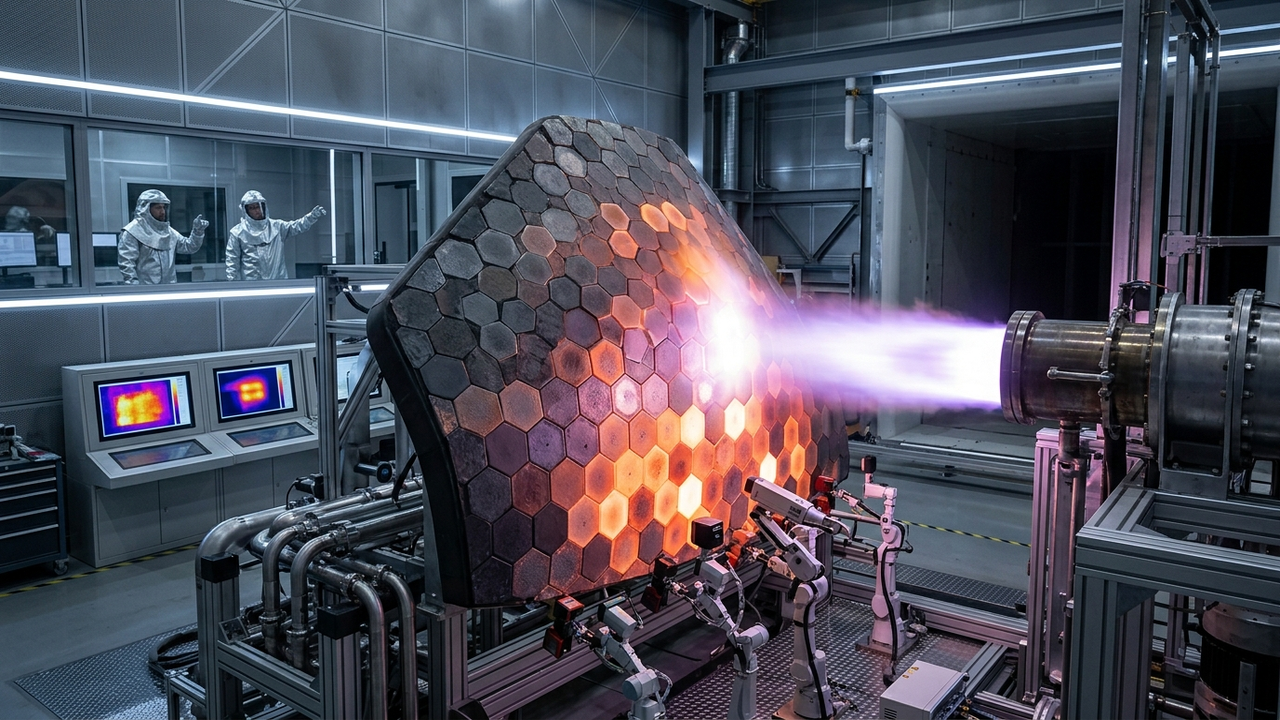
SpaceX’s Starship is demonstrating an advanced Thermal Protection System (TPS) engineered for full reusability, specifically designed to withstand the extreme thermal loads encountered during high-velocity atmospheric re-entry. At the core of this system are the innovative Axiom silica tiles. These tiles, fabricated from aerogel and ceramic composites, are pivotal in enabling reusable spacecraft components to endure severe thermal cycling and fatigue, essential for both deep space missions and repeated, high-stress atmospheric re-entries.
Technical Details
The Axiom silica tiles are a marvel of material engineering, combining cutting-edge aerogel technology with high-strength ceramic composites. This hybrid approach yields a material with both superior thermal insulation and exceptionally low mass. Aerogel, characterized by its intricate microscopic porous structure, exhibits extremely low thermal conductivity, creating an effective barrier that prevents the transfer of extreme external temperatures to the spacecraft’s delicate interior. Concurrently, the ceramic composite provides the necessary structural integrity to endure the severe mechanical stresses and high-temperature plasma environments encountered during re-entry. The overall effectiveness of this TPS is further optimized through its integration with advanced aerodynamic braking maneuvers and precisely controlled descent trajectories, collectively ensuring a safe return despite intense frictional heating. This comprehensive capability is fundamental to Starship’s multi-reuse design, dramatically enhancing the cost-efficiency of future space transportation.
Strategic Significance & Outlook
The advanced TPS technology embodied in Starship holds profound strategic significance, directly enabling the large-scale cargo and crew transport essential for future human missions to Mars and the establishment of lunar bases. The enhanced reusability afforded by this system will dramatically increase launch frequency, acting as a powerful catalyst for invigorating the entire space economy. Moreover, the underlying principles of these heat-resistant materials and this design philosophy are highly adaptable, offering potential applications for other reusable launch vehicles and interplanetary transport systems, thereby fostering the broader development of space travel and industry. Ultimately, these technological innovations are poised to be indispensable cornerstones in humanity’s permanent expansion across the solar system.
Get our weekly technology intelligence — free
Receive an infographic that lets you judge at a glance whether each field’s analysis report is worth reading.
Subscribe Free — Weekly Tech Intelligence
By subscribing, you’ll receive Troy-Technical’s weekly technology intelligence newsletter.
- Your email and selected fields are used only to deliver the newsletter.
- We never share your information with third parties.
- You can unsubscribe anytime via the link in each email.
See our Privacy Policy for details.
Takes about a minute · Unsubscribe anytime






Comments