Key Findings: Radiation-Resistant Perovskite Solar Cells Retain Over 85% Efficiency for Lunar Power Systems
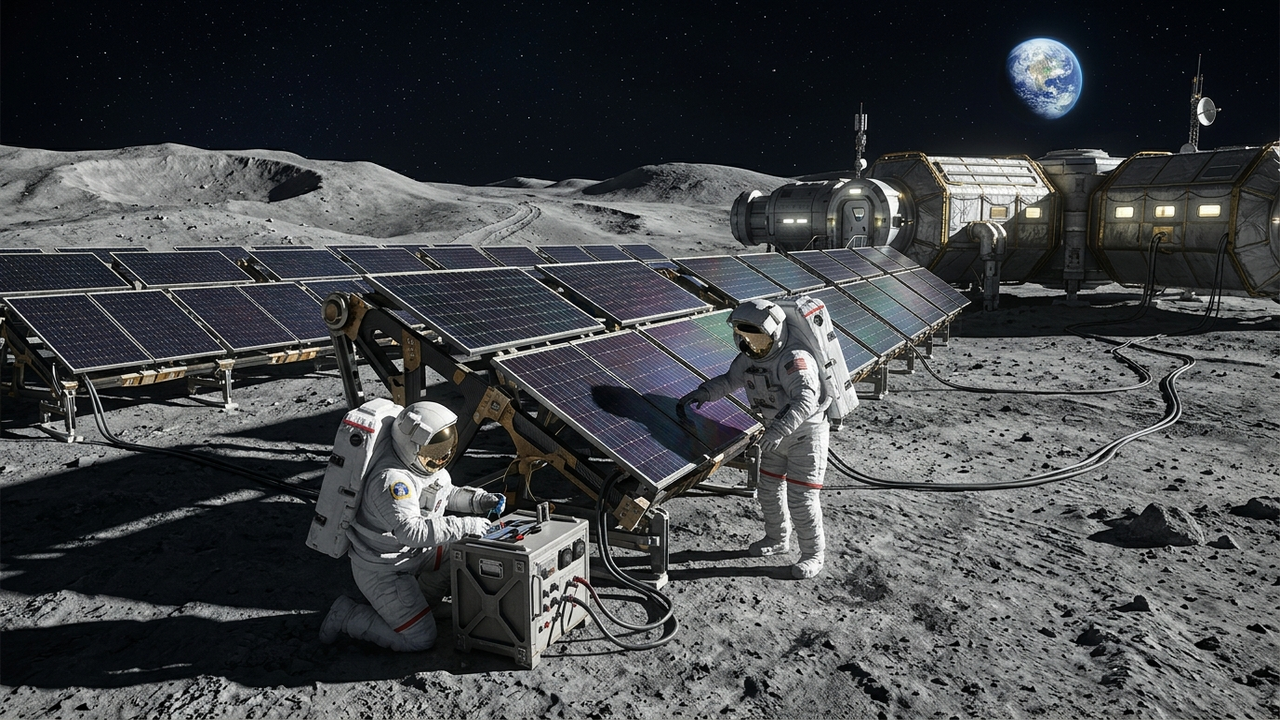
The development of materials capable of withstanding the Moon’s harsh environment—including extreme temperatures, vacuum, intense radiation, and abrasive dust—is crucial for establishing future lunar outposts. A recent review highlights that perovskite-based tandem photovoltaic (PV) architectures show exceptional promise, maintaining over 85% of their initial efficiency even after proton irradiation. This demonstrates a high degree of radiation tolerance, making them a leading candidate for long-term power generation on the lunar surface.
Technical & Clinical Details: ISRU-Compatible Materials and Innovative PV Technology
The review details various In-Situ Resource Utilization (ISRU)-compatible materials critical for lunar power generation, storage, and transmission. Radiation-resistant PV systems are designed to provide stable power during the long lunar day. Regolith-based thermal energy storage systems can store heat to warm habitats and power systems through the frigid lunar night. Furthermore, conductors manufactured from lunar-derived materials are vital for minimizing dependency on Earth-supplied resources, thereby significantly reducing launch mass. Perovskite tandem PVs offer high efficiency and superior resistance to radiation degradation compared to traditional silicon-based solar cells, fulfilling crucial requirements for the lunar environment, with proton irradiation causing only a minor decrease in efficiency.
Background & Industry Context: Towards Sustainable Lunar Exploration
With increasing international momentum for lunar exploration, spearheaded by initiatives like NASA’s Artemis program, establishing a sustainable human presence on the Moon is a pressing objective. Achieving this requires autonomous infrastructure that minimizes reliance on Earth-based resupply, with stable power generation being paramount. The advancement of ISRU-compatible materials and radiation-resistant PV technology is essential for enabling long-duration lunar stays and serving as a stepping stone for deeper space exploration to Mars. These technologies are expected to be central to the future space economy, reducing the cost and risks associated with space development.
Future Outlook: Advancing Lunar Infrastructure and New Industry Creation
Progress in these materials technologies will accelerate the construction of permanent lunar bases, scientific research facilities, and infrastructure for regolith mining and resource processing. Highly efficient and durable power systems, in particular, will form the backbone for lunar communications, life support, transportation, and construction activities. This will transform the Moon into a new frontier for economic activity, contributing to the creation of novel industries such as space resource utilization and lunar tourism. These technological innovations represent a crucial step for humanity to expand its sphere of activity across the solar system.
Source: https://www.azom.com/news.aspx?newsID=65756
Get our weekly technology intelligence — free
Receive an infographic that lets you judge at a glance whether each field’s analysis report is worth reading.
Subscribe Free — Weekly Tech Intelligence
By subscribing, you’ll receive Troy-Technical’s weekly technology intelligence newsletter.
- Your email and selected fields are used only to deliver the newsletter.
- We never share your information with third parties.
- You can unsubscribe anytime via the link in each email.
See our Privacy Policy for details.
Takes about a minute · Unsubscribe anytime







Comments