


Key Findings
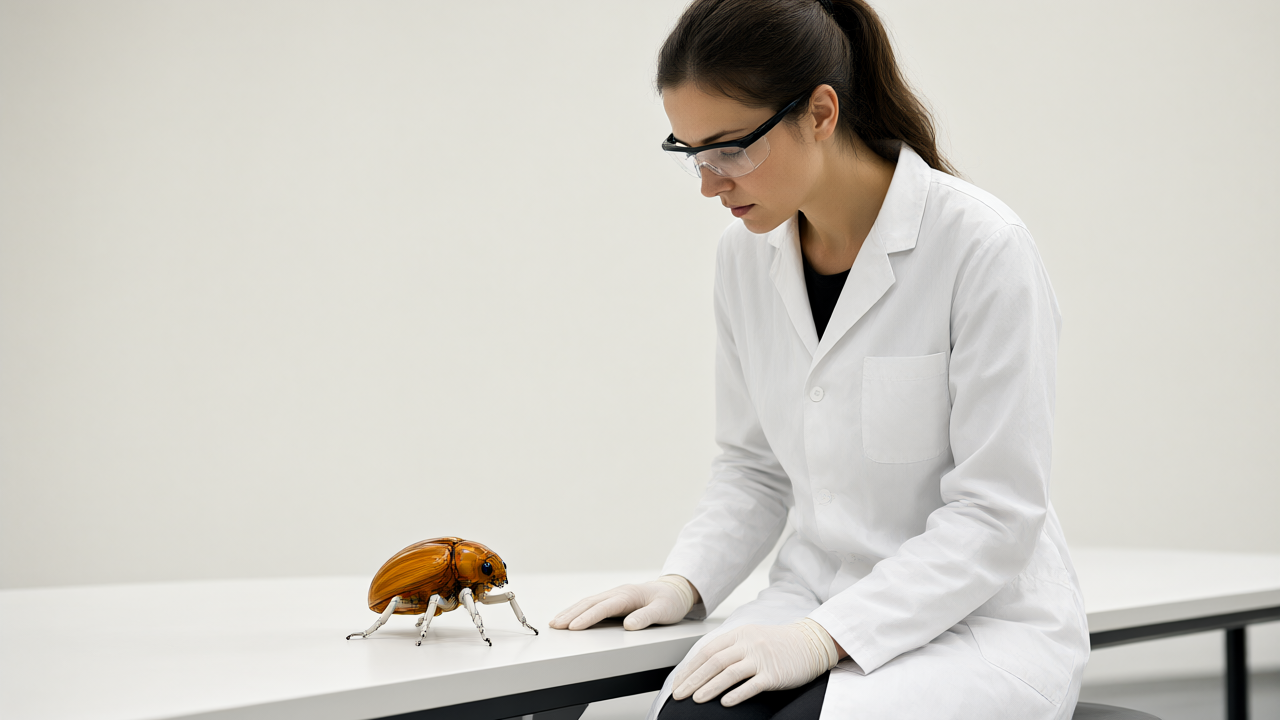
A joint research team from KAIST, the California Institute of Technology (Caltech), and Nanyang Technological University (NTU) has developed “BeetleBot,” a soft robot modeled after the leg and mandible structure of a beetle. The system integrates locomotion, object grasping, visual and tactile sensing, and user control into a single bidirectional feedback loop, allowing a user to navigate obstacles and transport objects remotely.
Technical Details
The robot’s movement is driven by artificial muscles fabricated from 3D-printed liquid crystal elastomer (LCE), a polymer that contracts when heated. These muscles are coupled with electrically driven heating elements; by controlling the activation sequence of the muscles in each leg, the robot can walk forward or turn. The gripper, mimicking beetle mandibles, also utilizes LCE artificial muscles and includes a pressure sensor to detect contact with objects.
User control is achieved through a stretchable sensor patch containing carbon nanotubes (CNTs). This patch detects changes in electrical resistance as the user’s fingers bend and extend, translating these movements into four Bluetooth commands: move forward, turn left, turn right, and grasp. The user monitors the operation via an onboard camera and the gripper’s pressure sensor.
Background & Context
While conventional soft robots typically treat sensing and locomotion as separate functions, BeetleBot combines these into one system. The research findings were published in the journal Science Advances on Aug. 19.
Significance & Outlook
This technology is positioned for remote operations in environments too confined for humans, such as inspecting narrow gaps in industrial equipment or retrieving small samples. To transition to industrial deployment, the team identifies the need to improve energy efficiency, durability, power supply, communication stability, and actuation speed. Future development will focus on creating artificial muscles that operate quickly at low temperatures and refining the integration of visual and tactile data into motion control.
Source: https://mbiz.heraldcorp.com/article/10900385
Get our weekly technology intelligence — free
Receive an infographic that lets you judge at a glance whether each field’s analysis report is worth reading.
Subscribe Free — Weekly Tech Intelligence
By subscribing, you’ll receive Troy-Technical’s weekly technology intelligence newsletter.
- Your email and selected fields are used only to deliver the newsletter.
- We never share your information with third parties.
- You can unsubscribe anytime via the link in each email.
See our Privacy Policy for details.
Takes about a minute · Unsubscribe anytime