
Key Findings
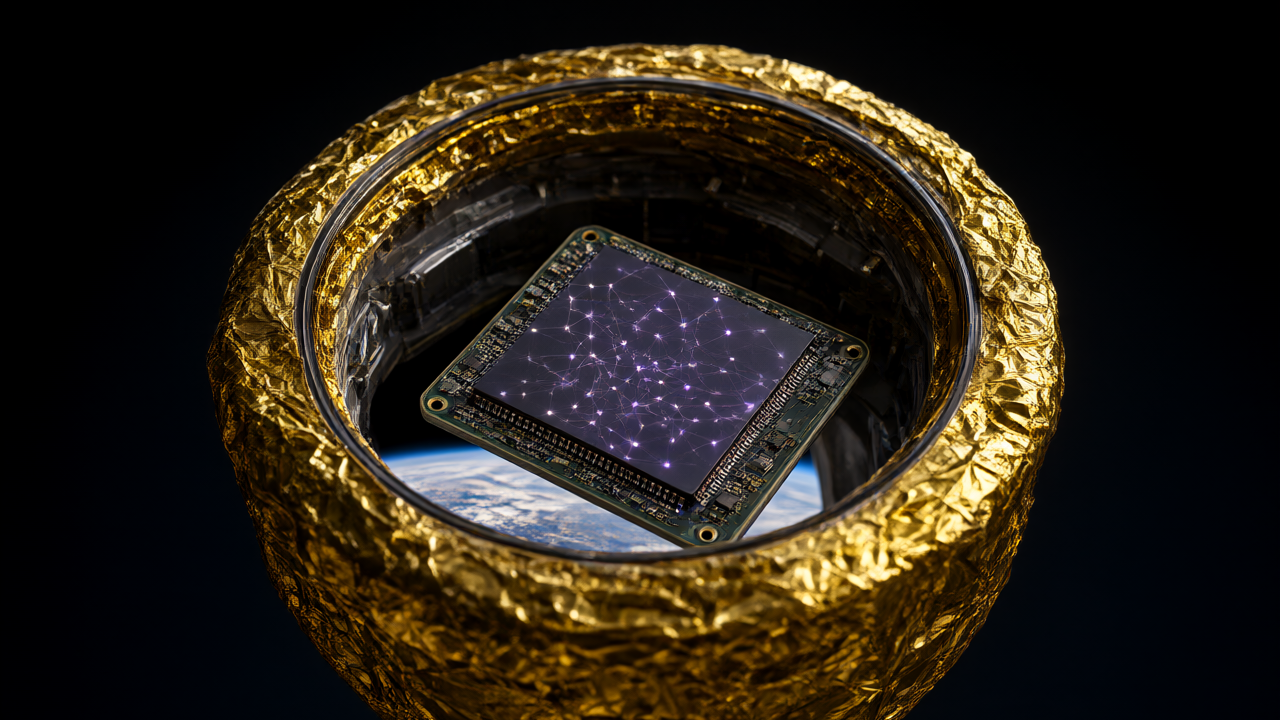
Neuromorphic implementations can achieve an 8–47× reduction in energy consumption over GPU baselines for representative satellite workloads, with a minimal impact on inference accuracy, which remains within 2.1%. The framework provides a closed-form energy model calibrated against silicon measurements from Loihi and SpiNNaker, enabling a quantitative comparison against FPGA and GPU architectures.
Technical Details
The paper proposes three original neuromorphic algorithms designed for specific satellite functions: a Spiking Kalman-Complementary Filter (SKCF) for attitude estimation, a Temporal Contrast Anomaly Detector (TCAD) for spacecraft health monitoring, and a Spike-Based Adaptive Modulation and Coding (SAMC) scheme for cognitive satellite links. To address on-orbit learning, the authors formalize a constrained Spike-Timing Dependent Plasticity (STDP) rule that provably bounds weight drift.
The framework further introduces a radiation fault-rate model integrated into a taxonomy of four radiation-aware neuromorphic architecture classes. This is supported by a formal Energy-Accuracy-Latency (EAL) trade-off surface populated with numerical estimates from published silicon data.
Background and Context
Conventional von Neumann architectures suffer from a data movement bottleneck, where 60–80% of total energy in a 10-layer convolutional network is spent transferring activations and weights between DRAM and compute units. For example, a ResNet-18 equivalent inference pass on a Jetson Nano costs roughly 400 mJ, which is untenable for a 3U CubeSat limited to 2 W total power. Neuromorphic computing mitigates this by co-locating memory and computation and using sparse binary spike events. Intel’s Loihi 2, for instance, consumes 1–2 mW at biologically realistic firing rates.
Significance and Outlook
The framework provides concrete design points for diverse mission classes, including 12U CubeSat Earth observation, GEO communications payloads, and autonomous deep-space probes. This is critical for platforms generating terabytes of imagery per orbit or probes operating beyond 2 AU, where round-trip light-times exceed 30 minutes and demand unsupervised hazard response.
Source: https://arxiv.org/html/2610.12471v2
Get our weekly technology intelligence — free
Receive an infographic that lets you judge at a glance whether each field’s analysis report is worth reading.
Subscribe Free — Weekly Tech Intelligence
By subscribing, you’ll receive Troy-Technical’s weekly technology intelligence newsletter.
- Your email and selected fields are used only to deliver the newsletter.
- We never share your information with third parties.
- You can unsubscribe anytime via the link in each email.
See our Privacy Policy for details.
Takes about a minute · Unsubscribe anytime