

Key Findings
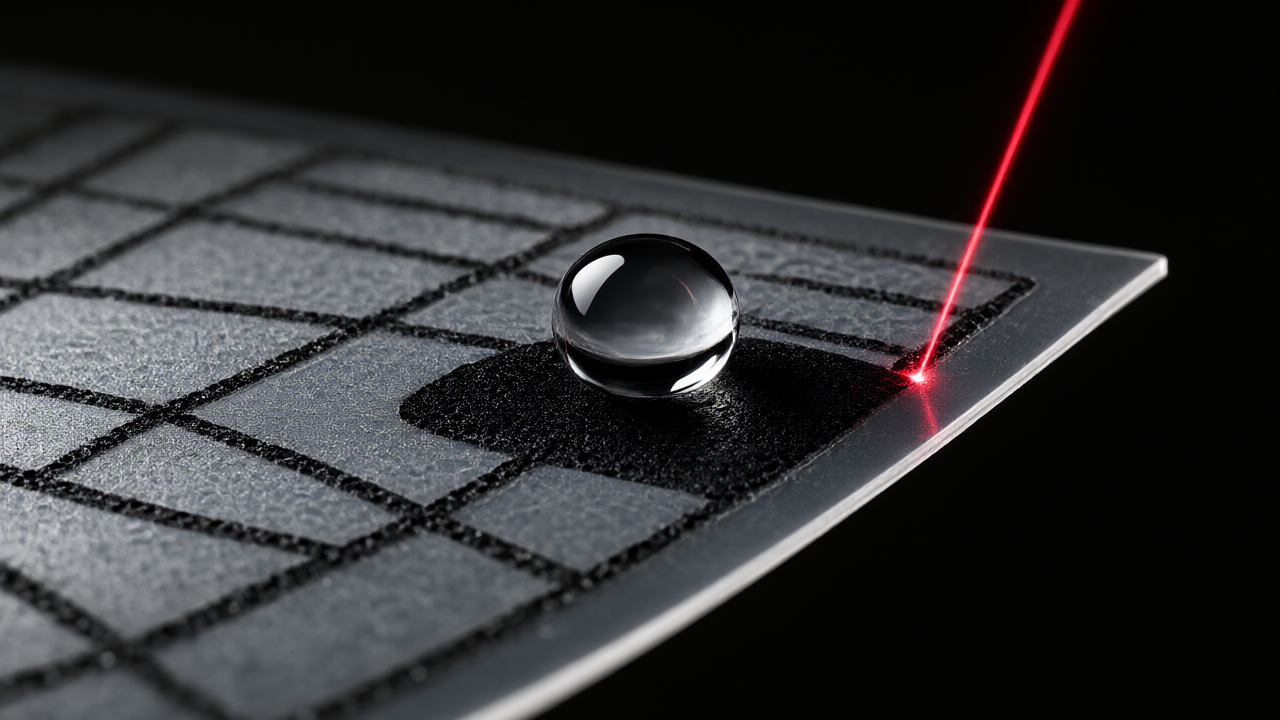
The study introduces a monolithic material transformation that converts polydimethylsiloxane (PDMS) into a hierarchical SiOC/graphenic composite. This platform achieves a water contact angle of 157° and a sliding angle of approximately 3°. Under high-load conditions of 10 8 CFU/mL, the material demonstrated a 94.47% reduction in Escherichia coli (E. coli) attachment. Despite this superhydrophobicity, the interface allows for rapid interfacial charge transfer (k 0 = 0.00708 cm/s) under applied electrochemical potentials, enabling the fabrication of a bacterial-imprinted polymer (BIP) biosensor with a limit of detection of 348 CFU/mL.
Technical Details
The process utilizes a one-step, ambient-air direct laser writing (DLW) strategy. Repeated laser passes are employed to facilitate thermal relaxation and build the hierarchical roughness required for both superhydrophobicity and an enhanced electroactive surface area. The resulting architecture creates a thermodynamic barrier to biofouling guided by the Young-Dupré equation. While the macroscopic surface remains antifouling, applied potentials trigger localized electrowetting within the hierarchical domains, overcoming the typical Faradaic charge transfer barriers associated with superhydrophobic silica films.
Background & Context
PDMS is widely used in flexible microdevices due to its biocompatibility and transparency, but it is typically insulating and prone to biofouling. Previous attempts to add conductivity or antifouling properties relied on heterogeneous solutions, such as:
- Surface-grafted hydrophilic polymers or conductive inks, which often suffer from delamination.
- Metallic biocides, which can lead to leaching and cytotoxicity.
- Bulk carbon doping, which can embrittle the elastomer.
- Transferring laser-induced graphene (LIG) from polyimide substrates, which increases procedural complexity.
Significance & Outlook
This approach resolves the long-standing dichotomy between antifouling properties and electrical conductivity in PDMS. By eliminating the need for external carbon precursors or complex multi-material integration, the monolithic SiOC/graphenic composite provides a feasible paradigm for durable, self-cleaning bioelectronics and in-situ microbial monitoring.
Source: https://www.oaepublish.com/articles/ss.2026.178
Get our weekly technology intelligence — free
Receive an infographic that lets you judge at a glance whether each field’s analysis report is worth reading.
Subscribe Free — Weekly Tech Intelligence
By subscribing, you’ll receive Troy-Technical’s weekly technology intelligence newsletter.
- Your email and selected fields are used only to deliver the newsletter.
- We never share your information with third parties.
- You can unsubscribe anytime via the link in each email.
See our Privacy Policy for details.
Takes about a minute · Unsubscribe anytime