

Key Findings
ETH Zurich researchers have created bioactuators that enable centimetre-scale biohybrid robots to perform complex movements, including jumping, swimming, walking, and grasping. A walking version of the robot reaches speeds of 6.2 millimetres per second, which is faster relative to body length than any previously reported walking biohybrid robot. In jumping tests, a single contraction lifts the actuator approximately five millimetres, or one-third of its body length.
Technical Details
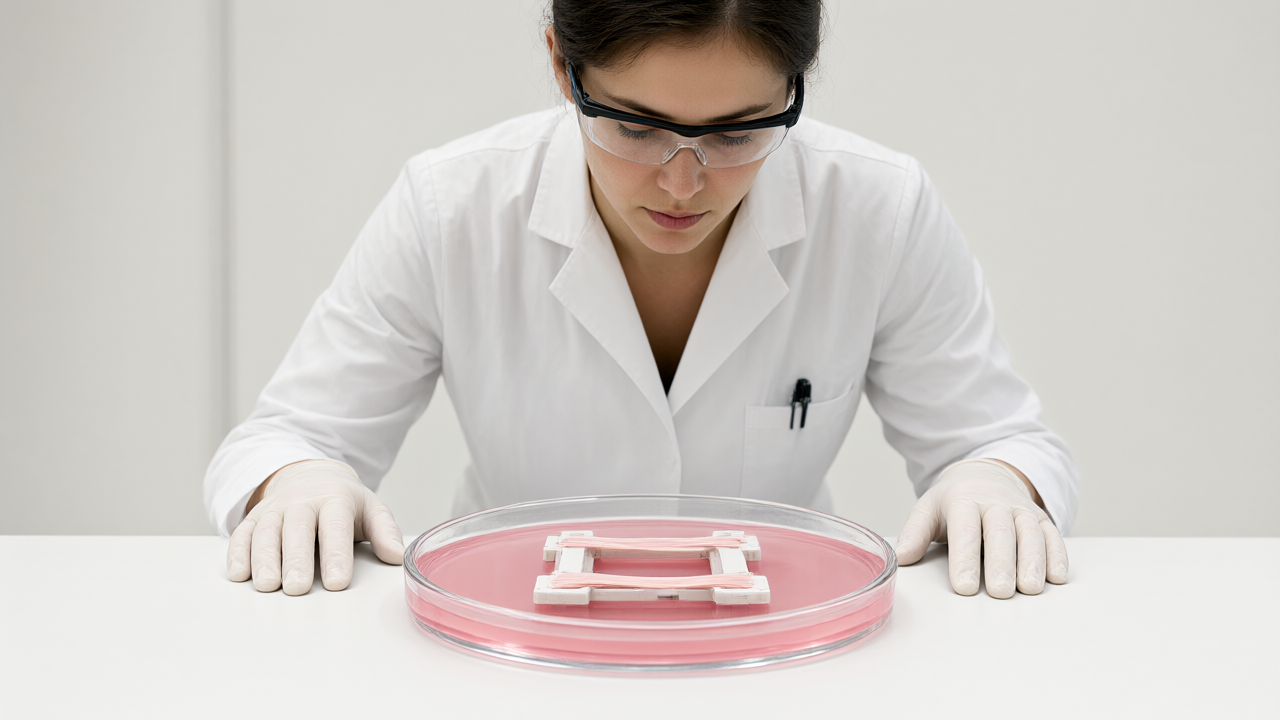
The bioactuators, each approximately 1.5 centimetres long, combine living skeletal muscle tissue grown from mouse muscle cells with a soft hydrogel scaffold. Unlike previous methods, the muscle tissue configuration and the scaffold were designed simultaneously using a computer algorithm to maximize the movement of the entire component. The scaffolds are produced via xolography, a light-based 3D-printing technique that takes about one minute per scaffold.
To ensure efficient force transfer, the scaffold features fine grooves that allow the tissue to anchor firmly and align muscle fibres. This seamless connection prevents the loss of muscle strength during the transfer to the artificial structure.
Background and Context
Traditionally, lab-grown skeletal muscle contractions are so slight they are barely visible, often requiring a microscope. The ETH Zurich team, including co-lead authors Aiste Balciunaite and Mike Y. Michelis under Professor Robert Katzschmann, shifted the focus from the amount of muscle tissue to the interaction between the muscle and the scaffold. This iterative process involved feeding experimental data on material properties back into computer simulations to optimize the design.
Significance and Outlook
The study demonstrates that muscle shape can be an engineered variable rather than a fixed constraint. However, several challenges remain before these robots can leave the laboratory:
- Life Support: Current robots require a nutrient solution; larger systems will need an artificial vascular system to deliver oxygen and nutrients and remove waste.
- Consistency: Due to the natural variability of living tissue, cultured actuators do not all behave identically, requiring better control over how tissue matures in the lab.
Get our weekly technology intelligence — free
Receive an infographic that lets you judge at a glance whether each field’s analysis report is worth reading.
Subscribe Free — Weekly Tech Intelligence
By subscribing, you’ll receive Troy-Technical’s weekly technology intelligence newsletter.
- Your email and selected fields are used only to deliver the newsletter.
- We never share your information with third parties.
- You can unsubscribe anytime via the link in each email.
See our Privacy Policy for details.
Takes about a minute · Unsubscribe anytime