

Key Findings
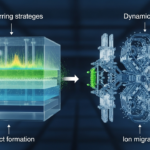
The study demonstrates a monolithic perovskite/textured Si tandem solar cell with an efficiency of 30.93%. By utilizing solvent-free co-evaporation, the researchers established a vertical compositional modulation that significantly enhances long-term stability. The device retained 90% of its initial performance after 1,820 hours of maximum-power-point tracking under one-sun illumination in a nitrogen environment.
Technical Details
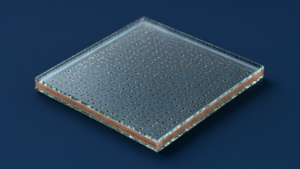
The co-evaporation process creates a specific architecture consisting of a formamidinium iodide (FAI)-rich mixed two/three-dimensional (2D/3D) seed layer paired with a stoichiometric wide-bandgap absorber. Unlike conventional 2D passivation, this approach avoids bulky organic cations that typically impede vertical charge transport.
Low-dose atomic-resolution transmission electron microscopy confirmed the following structural characteristics:
- Coherence and continuous corner-sharing lead-halide octahedral connectivity within the 2D/3D seed layer.
- Continuous connectivity across the interface between the seed layer and the absorber.
This native-cation architecture suppresses the formation of halide vacancies and formamidinium, prevents light-induced segregation, and inhibits photocarrier-mediated redox reactions.
Background & Context
Perovskite/silicon tandem solar cells are a primary route for next-generation photovoltaics, but their operational lifespan is often limited by degradation at buried interfaces. In these areas, photocarriers, mobile ions, and defects tend to accumulate. While solution processing is widely used, it often fails to provide precise interface control because subsequent deposition steps can reconstruct or dissolve the underlying materials.
Significance & Outlook
The use of co-evaporation allows for the programming of compositional evolution and precise control over crystal growth and carrier transport. By enabling efficient out-of-plane carrier transport without the disruption caused by foreign bulky cations, this method addresses critical stability and efficiency bottlenecks in perovskite optoelectronics.
Source: https://doi.org/10.21203/rs.3.rs-11237567/v1
Get our weekly technology intelligence — free
Receive an infographic that lets you judge at a glance whether each field’s analysis report is worth reading.
Subscribe Free — Weekly Tech Intelligence
By subscribing, you’ll receive Troy-Technical’s weekly technology intelligence newsletter.
- Your email and selected fields are used only to deliver the newsletter.
- We never share your information with third parties.
- You can unsubscribe anytime via the link in each email.
See our Privacy Policy for details.
Takes about a minute · Unsubscribe anytime