Key Findings
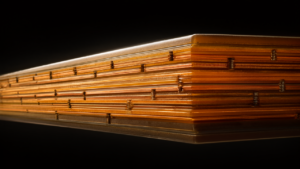
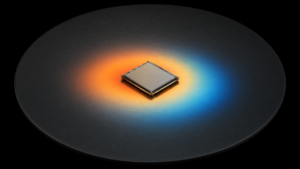
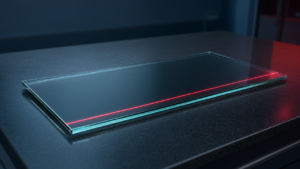
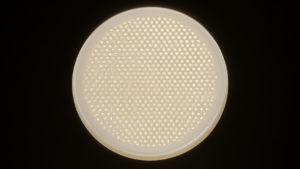
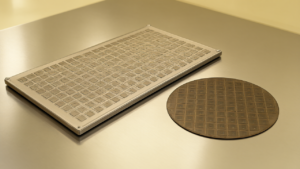
Kim Bok-hyun and a research team at the GIST Advanced Photonics Research Institute have developed a specialized low-dielectric glass material designed specifically for high-performance semiconductor packaging. Unlike repurposed display glass, this material is engineered from the ground up to optimize signal transmission and thermal stability for AI semiconductors.
Technical Details
The team improved the composition of aluminoborosilicate glass—consisting of silicon dioxide, boron oxide, and aluminum oxide—to achieve a balance of physical properties. The primary technical goals were the reduction of the dielectric constant (Dk) and the dielectric loss factor (Df), which is critical as data transmission frequencies reach 10–20 gigahertz (GHz) or higher.
- Signal Integrity: Lowering Dk and Df reduces signal attenuation, noise, and heat generation during high-speed data travel over copper wiring.
- Thermal Management: The material is engineered to expand and contract at levels comparable to silicon chips, mitigating the risk of warping or cracks at junctions.
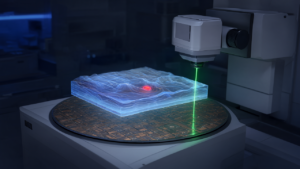
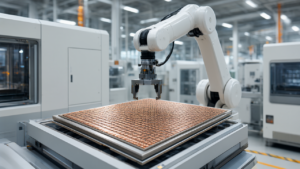
- Processability: The glass is designed to withstand high-temperature manufacturing processes, including drilling and wiring formation.
Background & Context
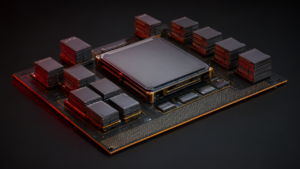
Current semiconductor packages primarily rely on polymer-based organic substrates (such as blue or green PCBs). However, as AI semiconductors integrate multiple computing chips and high-bandwidth memory (HBM) into single packages, power consumption and package size increase. This leads to “warpage,” where heat causes the organic substrate to bend, and signal attenuation that degrades overall system performance.
Significance & Outlook
By replacing organic substrates with this specialized glass, AI semiconductors can achieve higher power efficiency and improved performance. Beyond electrical improvements, the research team intends to expand this technology into “optical interconnects,” utilizing the glass substrate to create internal pathways for light to replace traditional copper wiring to further reduce power consumption.
Source: https://www.mt.co.kr/index.php/en/future/2026/10/25/2026101915054962909
Get our weekly technology intelligence — free
Receive an infographic that lets you judge at a glance whether each field’s analysis report is worth reading.
Subscribe Free — Weekly Tech Intelligence
By subscribing, you’ll receive Troy-Technical’s weekly technology intelligence newsletter.
- Your email and selected fields are used only to deliver the newsletter.
- We never share your information with third parties.
- You can unsubscribe anytime via the link in each email.
See our Privacy Policy for details.
Takes about a minute · Unsubscribe anytime