


Key Findings
Engineering modeling published in Discover Vehicles indicates that the PHEV-ReGrid platform can reduce the overall mass of a mid-size passenger electric vehicle by roughly 210 kg. The study finds that this configuration lowers vehicle manufacturing costs by between $8,500 and $9,500 and reduces annual electric energy consumption by 11% to 13%.
Technical Details
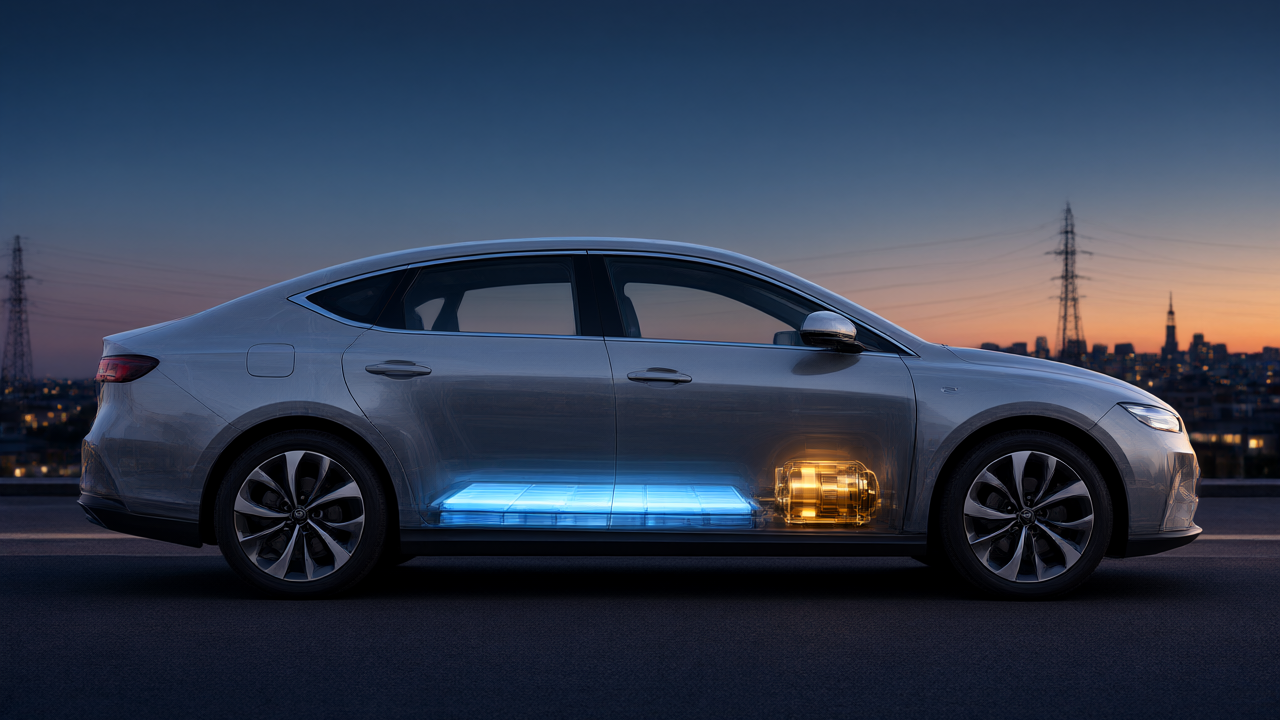
The researcher, Luis Juanicó, modeled the platform by redesigning a 2025 Tesla Model 3 Long-Range Rear-Wheel Drive sedan. The baseline vehicle’s 82 kWh nickel-manganese-cobalt lithium-ion battery (approximately 500 kg) was replaced with a 30 kWh sodium-ion battery pack weighing approximately 210 kg. This pack is based on 2025 to 2026 CATL Naxtra technology, featuring a cell-level energy density of 175 Wh/kg and a pack-level density of 150 to 160 Wh/kg.
To maintain highway range, the platform utilizes a lightweight motorcycle-derived internal combustion engine acting strictly as an electrical generator. Modeling showed that at a steady-state highway velocity of 120 km/h, the baseline sedan requires 23.8 kW of tractive power. A small engine operating at optimum thermal efficiency can provide sufficient electrical output to offset battery depletion, removing the need for commercial fast-charging stops during long trips.
Background and Context
The study addresses the strain that high-power public charging networks place on electrical grids. Current station outputs have risen from 50 kW to 350 kW, with some approaching 1 MW per dispenser. A single 1 MW charger exerts a demand equivalent to 300 to 400 residential households. Upgrading 250,000 public charging ports in the U.S. and Canada to support megawatt-scale equipment would require tens of billions of dollars in infrastructure reinforcements.
Significance and Outlook
By pairing a sodium-ion battery sized for daily driving with an on-board generator, the PHEV-ReGrid platform resolves the conflict between rapid electrification and grid stability. This approach mitigates the temporal imbalance between midday solar generation and evening peak charging demand, potentially reducing the need for utility operators to expand fossil-fueled peaker plants.
Source: https://bioengineer.org/sodium-battery-hybrid-platform-cuts-vehicle-mass-and-delivers-grid-storage/
Get our weekly technology intelligence — free
Receive an infographic that lets you judge at a glance whether each field’s analysis report is worth reading.
Subscribe Free — Weekly Tech Intelligence
By subscribing, you’ll receive Troy-Technical’s weekly technology intelligence newsletter.
- Your email and selected fields are used only to deliver the newsletter.
- We never share your information with third parties.
- You can unsubscribe anytime via the link in each email.
See our Privacy Policy for details.
Takes about a minute · Unsubscribe anytime