


Key Findings
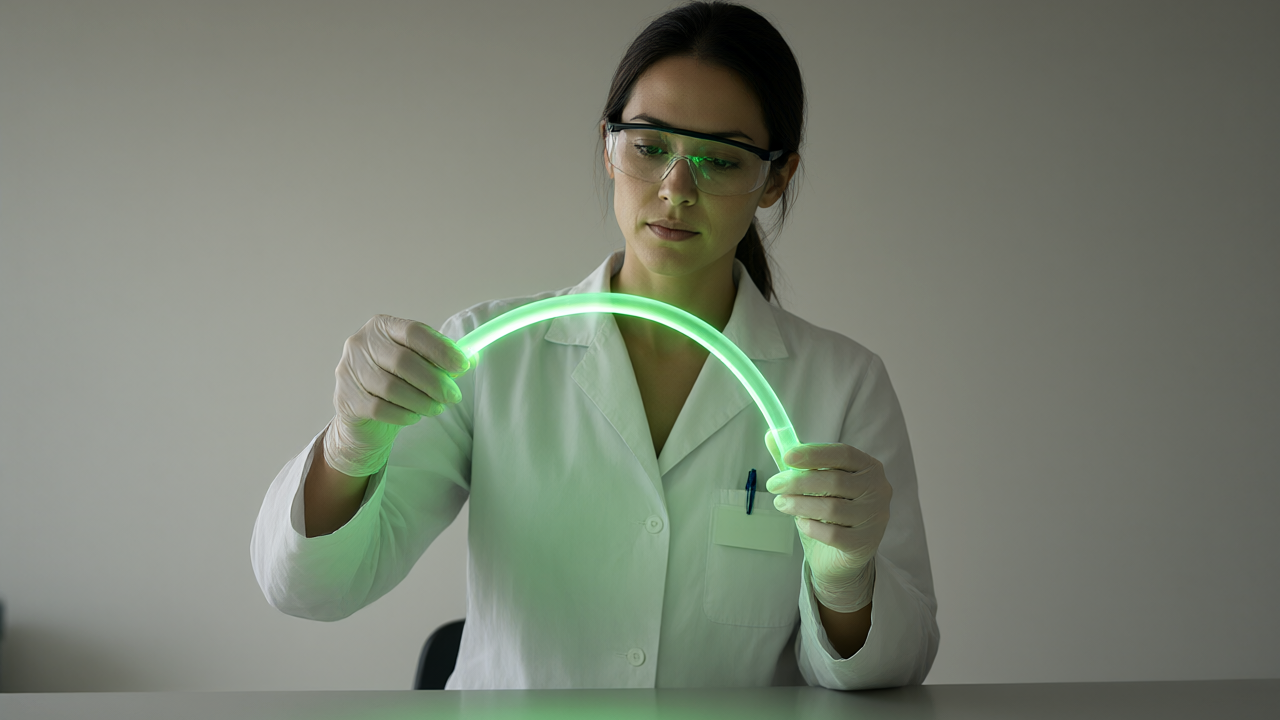
A research team led by Professor Soon Moon Jeong at DGIST has developed a tubular mechanoluminescent fiber that enables soft robots to emit green light during movement. This technology functions as a battery-free optical sensor, allowing for the direct and intuitive observation of bending and stretching trajectories without external power supplies or complex electronic circuitry.
Technical Details
The sensing technology utilizes “mechanoluminescence,” a phenomenon where materials emit light when subjected to mechanical forces such as pressure, bending, or stretching. The team engineered the fibers by mixing zinc sulfide luminescent particles with a flexible polymer material, which was then filled into an elastic silicone tube. Technical specifications include:
- Durability: The fibers can withstand stretching to more than 200% of their original length.
- Stability: Initial light-emitting performance is maintained after more than 1,000 stretching–release cycles.
- Implementation: The fibers are applied as a mesh-like network over the surface of the soft robot, triggering immediate light emission from areas undergoing deformation.
Background & Context
Soft robots, constructed from rubber or silicone, are designed for medical devices and disaster rescue due to their ability to mimic human muscles or octopus arms. However, traditional movement detection requires the attachment of numerous rigid electronic sensors and wires, which often compromises the robot’s inherent flexibility. This research, co-authored by Minseok Lee and Seongkyu Song, was published as the Front Cover article in the October issue of Small Structures.
Significance & Outlook
This approach provides a method for detecting deformation in soft robots without interfering with their flexible movements or requiring external power. Professor Soon Moon Jeong stated that the team intends to further improve fiber durability and light-emitting performance. Future applications are expected to expand into next-generation flexible electronic devices, including artificial skin and wearable devices for human–robot interaction.
Get our weekly technology intelligence — free
Receive an infographic that lets you judge at a glance whether each field’s analysis report is worth reading.
Subscribe Free — Weekly Tech Intelligence
By subscribing, you’ll receive Troy-Technical’s weekly technology intelligence newsletter.
- Your email and selected fields are used only to deliver the newsletter.
- We never share your information with third parties.
- You can unsubscribe anytime via the link in each email.
See our Privacy Policy for details.
Takes about a minute · Unsubscribe anytime