Key Findings
Ayar Labs has announced crucial performance enhancements for its groundbreaking Optical I/O chiplets, designed to meet the escalating demands for higher bandwidth and lower power consumption in AI applications. This latest evolution delivers up to a 50% improvement in power efficiency and extends the total chiplet-to-chiplet bandwidth to 3.2 terabits per second (Tbps), fundamentally resolving data transfer bottlenecks within AI systems.
Technical / Clinical Details
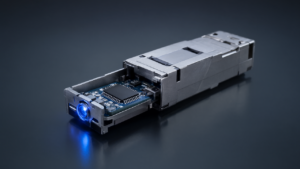
- Ayar Labs’ Optical I/O chiplets convert electrical signals into optical signals, transmitting them via optical fibers either within a chip package or between different chips. The recent performance gains are primarily attributed to improved efficiency in optical modulators and photodetectors, along with optimization of low-power driving circuits.
- Specifically, the energy consumption per bit has been substantially reduced. This significantly lowers the overall system power footprint while maintaining extremely high data rates (e.g., 100Gbps per lane) compared to traditional electrical interconnects. This is critically important for AI processors, which demand data transfer rates reaching hundreds of gigabytes per second.
- The technology also offers the flexibility to extend connection distances between chiplets up to several meters, enabling seamless integration of diverse chiplets—including CPUs, GPUs, memory, and specialized AI accelerators—without compromising power efficiency or performance.
Background & Context
Modern AI models possess a vast number of parameters and require immense computational resources and data movement for training and inference. This data movement often becomes a primary performance bottleneck, as the bandwidth of electrical interconnects, both internal to chips and between them, lags behind the computational capabilities of CPUs and GPUs. Chiplet architectures offer a promising approach to address this by integrating multiple smaller, specialized chips, but high-speed, low-power communication between these chiplets has been the next hurdle. Optical I/O presents a direct solution to this challenge.
Strategic Significance & Outlook
Ayar Labs’ Optical I/O chiplet advancements hold the potential to revolutionize the design of chiplet-based AI systems. The dramatic improvements in power efficiency and bandwidth will accelerate the realization of larger and more complex AI models, while also contributing to a reduction in the total cost of ownership (TCO) for data centers. Major AI chip manufacturers and cloud service providers are expected to integrate this technology into their next-generation AI accelerators and CPUs, seeking to establish a competitive advantage in both computational power and energy efficiency.
Source: https://www.ayarlabs.com/blog/XXXXXX/next-gen-optical-io-performance.html
Get our weekly technology intelligence — free
Receive an infographic that lets you judge at a glance whether each field’s analysis report is worth reading.
Subscribe Free — Weekly Tech Intelligence
By subscribing, you’ll receive Troy-Technical’s weekly technology intelligence newsletter.
- Your email and selected fields are used only to deliver the newsletter.
- We never share your information with third parties.
- You can unsubscribe anytime via the link in each email.
See our Privacy Policy for details.
Takes about a minute · Unsubscribe anytime