Key Findings
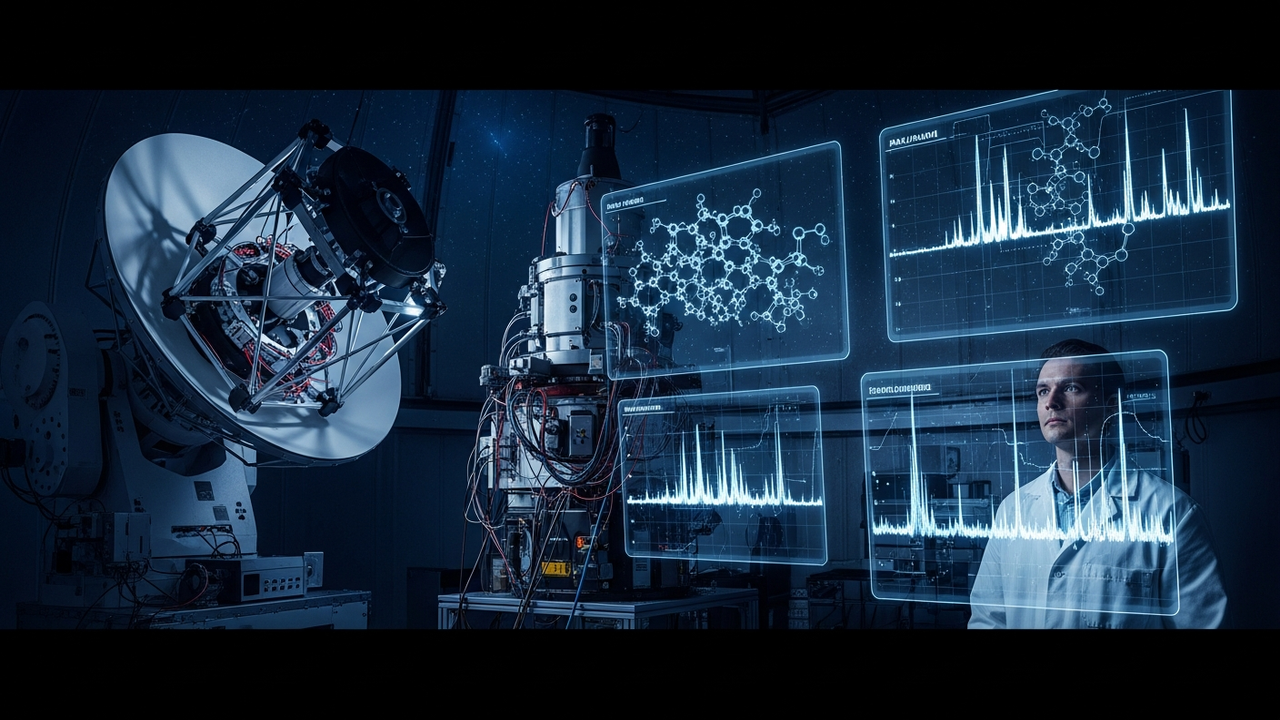
A comprehensive research paper has been published detailing the theoretical and experimental infrared (IR) spectra of astronomical polycyclic aromatic hydrocarbons (PAHs) and their nitrogenated analogs (PANHs) in the 2000–1650 cm⁻¹ (approximately 5–6 μm) range. This study, correlating with observations from the James Webb Space Telescope (JWST) and other advanced instruments, provides more detailed spectroscopic fingerprints essential for identifying and characterizing complex organic molecules in space.
Technical & Research Details
- Molecules Under Study: Polycyclic aromatic hydrocarbons (PAHs) are a group of molecules composed of multiple fused benzene rings of carbon and hydrogen atoms, known to be widely present in space, particularly in interstellar medium and protoplanetary disks. PANHs are analogs where some carbon atoms in the ring structure are replaced by nitrogen atoms, and their potential relevance to the origin of life has been suggested.
- Importance of IR Spectra: PAHs and PANHs exhibit characteristic IR spectra. The 2000–1650 cm⁻¹ (approx. 5–6 μm) range, in particular, is rich in various overtones and combination bands arising from C–H out-of-plane bending vibrations, offering valuable information about the molecular structure and their surrounding environment.
- Theoretical Calculations and Experimental Data: This research derived theoretical IR spectra for PAH/PANHs using advanced quantum chemical calculations and simultaneously measured the IR spectra of PAH/PANH analog molecules synthesized in terrestrial laboratories. Comparing these two datasets helps bridge the gap between space observational data and theoretical/experimental models, enabling more robust molecular identification.
- Synergy with James Webb Space Telescope: The JWST, with its exceptional infrared observation capabilities, is acquiring increasingly detailed spectral information of PAH/PANHs in the cosmos. These research findings will serve as a powerful tool for interpreting the complex spectral features obtained from JWST data, allowing for a more precise understanding of where and what organic molecules exist in space.
Background & Industry Context
The detection and understanding of organic molecules in space are critically important for fields such as astrobiology, planetary formation, and interstellar chemistry. PAHs and PANHs are also suggested as potential precursors to amino acids and nucleic acids, which are fundamental building blocks of life on Earth, making them crucial clues in the search for the origin of life in the universe. Detailed elucidation of the spectroscopic properties of these molecules will influence future deep-space exploration missions and target setting for extraterrestrial life detection.
Future Outlook
This study, by deepening the understanding of PAH/PANH IR spectra, paves the way for extracting richer scientific insights from the vast amounts of data collected by next-generation space telescopes like JWST. This is expected to lead to a significant advancement in our understanding of complex organic chemical processes in space, molecular evolution in star-forming regions, and the potential for extraterrestrial life. This achievement represents crucial fundamental research at the intersection of astronomy, chemistry, and astrobiology, and will be indispensable for defining the direction of future space science research.
Get our weekly technology intelligence — free
Receive an infographic that lets you judge at a glance whether each field’s analysis report is worth reading.
Subscribe Free — Weekly Tech Intelligence
By subscribing, you’ll receive Troy-Technical’s weekly technology intelligence newsletter.
- Your email and selected fields are used only to deliver the newsletter.
- We never share your information with third parties.
- You can unsubscribe anytime via the link in each email.
See our Privacy Policy for details.
Takes about a minute · Unsubscribe anytime









Comments