Key Findings
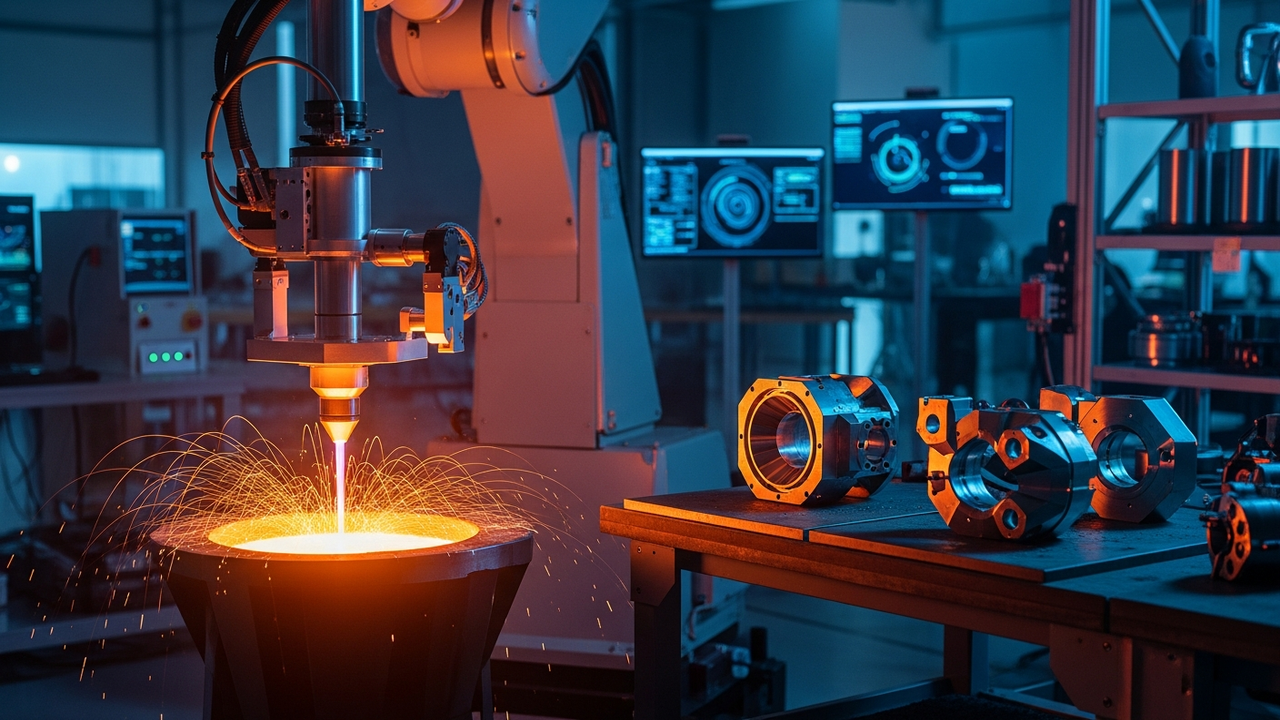
Scientists at the U.S. National Institute of Standards and Technology (NIST) have developed a novel 3D printing technique that innovatively controls the laser path during additive manufacturing. This method facilitates the mixing of complex alloys, particularly high-entropy alloys (HEAs) and lightweight titanium alloys, which were previously challenging to manufacture into intricate parts. Termed ‘laser stirring,’ this new technology utilizes micro-elliptical or circular laser paths to agitate molten metal before solidification, enabling more uniform alloy formation and the simultaneous construction of complex components.
Technical / Clinical Details
In conventional additive manufacturing processes, such as Laser Powder Bed Fusion (LPBF), a laser typically scans material linearly, creating a melt pool that then solidifies. This linear scanning often leads to issues like non-uniform mixing and phase separation, especially when dealing with multiple metal powders of different compositions. The NIST research team modified the laser operating algorithm to create micro-stirring effects within the melt pool by tracing elliptical or circular paths instead of linear scans. This enhanced convection within the molten metal pool, ensuring that different metallic elements are uniformly mixed before solidification. This precise laser path control significantly improves uniform alloy formation between materials with disparate properties, such as dense, flame-retardant high-entropy alloys and lightweight, high-strength titanium alloys, thereby drastically increasing the design freedom for materials in additive manufacturing.
Background & Context
High-entropy alloys (HEAs), which consist of multiple elements in roughly equal proportions, are garnering significant attention as next-generation materials. They possess a combination of properties—high strength, superior hardness, excellent heat resistance, and corrosion resistance—that are difficult to achieve with conventional alloys. Titanium alloys, on the other hand, are critical materials meeting the needs for lightweighting and high strength, particularly in the aerospace industry. However, these complex alloys are challenging to control in terms of composition using traditional manufacturing methods like casting and forging, making the production of intricate parts a major hurdle. Additive manufacturing technology, capable of directly fabricating complex geometries, holds potential for expanding the applications of these advanced alloys, but ensuring material uniformity has been a technical bottleneck.
Strategic Significance & Outlook
The ‘laser stirring’ technology developed by NIST holds the potential to be a game-changer in the manufacturing of high-performance alloy parts via additive manufacturing. It is expected to accelerate the on-demand production of complex components that meet specialized requirements—such as lightweight, high strength, and high heat resistance—particularly in sectors like aerospace, defense, energy, and medical. The research team is exploring further optimization of this technology and its application to a wider variety of alloy systems. In the future, this could herald an era where innovative alloy materials with incredibly complex microstructures, previously considered ‘impossible’ to obtain, become feasible through 3D printing.
Source: https://newatlas.com/materials/3d-printing-technique-high-entropy-alloy/
Get our weekly technology intelligence — free
Receive an infographic that lets you judge at a glance whether each field’s analysis report is worth reading.
Subscribe Free — Weekly Tech Intelligence
By subscribing, you’ll receive Troy-Technical’s weekly technology intelligence newsletter.
- Your email and selected fields are used only to deliver the newsletter.
- We never share your information with third parties.
- You can unsubscribe anytime via the link in each email.
See our Privacy Policy for details.
Takes about a minute · Unsubscribe anytime







Comments