TROY TECHNICAL · BEGINNER’S GUIDE
READ THIS FIRSTAll-solid-state batteries — An Introduction
What changes when a battery electrolyte becomes solid?
Japanese version →Does removing liquid automatically make a battery lighter, safer and longer-lasting? All-solid-state batteries offer opportunities but introduce the difficulty of joining solids. Begin with the mechanism they share with other rechargeable batteries, then identify what changes.
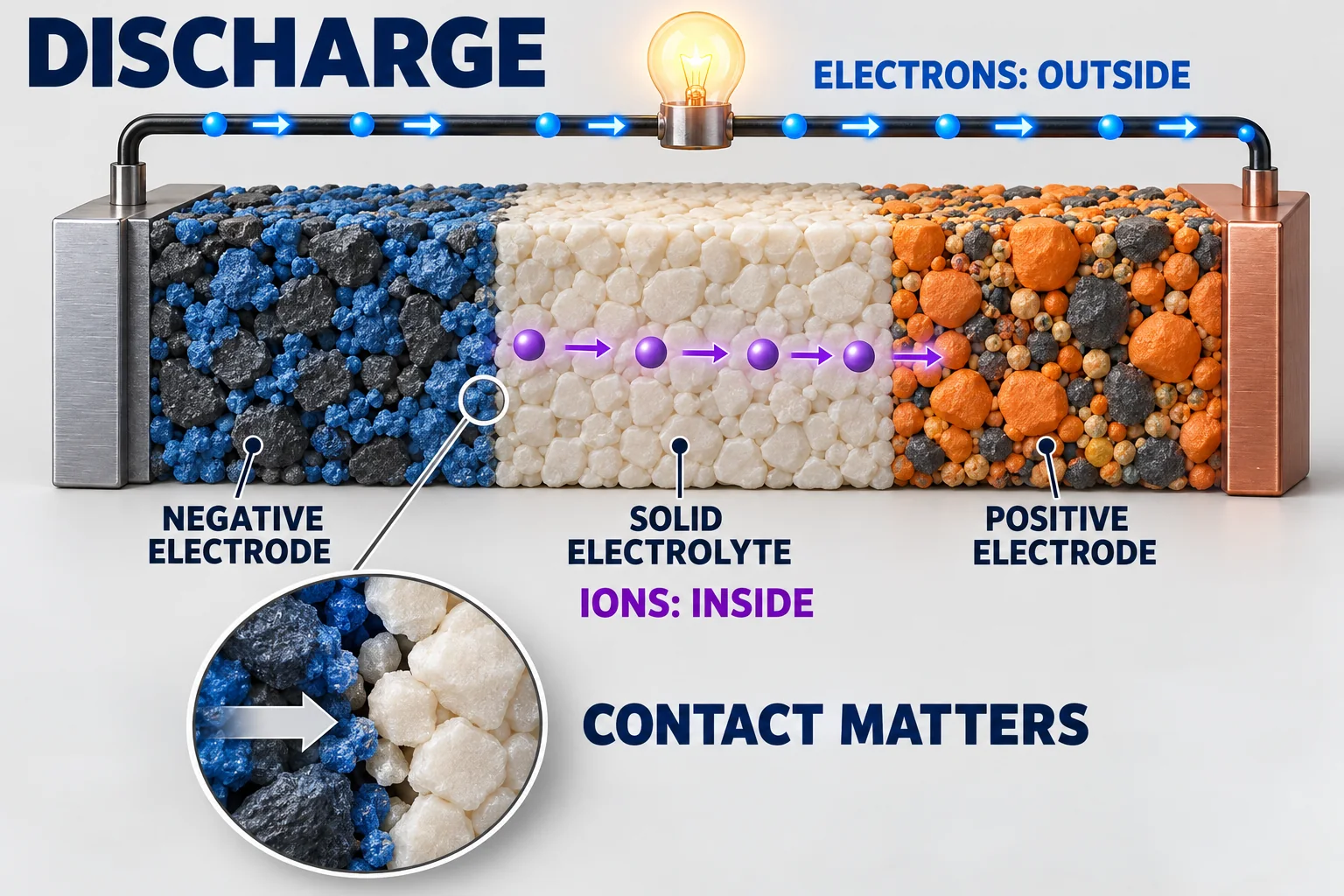
01Ions move inside; electrons move outside
A rechargeable battery has two electrodes and an electrolyte that carries ions between them. During discharge, electrons travel through the external circuit to power a device while ions move inside the cell. Charging uses external power to restore the stored-energy state.
That principle remains in an all-solid-state battery. Its electrolyte should conduct the required ions while strongly limiting electronic conduction. If electrons simply travelled directly between the electrodes as through a metal wire, the cell would short rather than power the intended external load.
Background: [1]
02What might replacing liquid enable?
Reducing flammable liquid components and broadening electrode options are important motivations. Some research pairs solid electrolytes with lithium metal for higher capacity. But “all-solid-state” and “lithium-metal” describe different design choices. A solid-state cell can use another negative electrode.
Solid also does not mean incapable of fire or exempt from thermal management. Electrode reactions, internal shorts and surrounding materials still need assessment. Potential benefits must be demonstrated in complete cells and packs.
Background: [2]

03Solids do not form a good interface simply by touching
Liquid can wet small gaps, whereas two solids may touch only over part of their apparent area. Ions struggle to cross missing contact. Fast transport within a material is not enough if the interface becomes the bottleneck.
Electrode volume changes during cycling can also disrupt contact. Coatings, composite structures and applied pressure are possible tools, but higher pressure does not solve every problem. Shorting, chemical reactions and mechanical damage must be considered together.
Background: [3]
04Read material families as trade-offs, not a league table
Sulfides, oxides and halides are different electrolyte material families. They differ not only in ion transport but also in processability, response to moisture and compatibility with electrodes. Mixing, thinning and establishing contact are part of the technology.
Moisture-sensitive materials require appropriate manufacturing and storage controls. A good result in a pressed laboratory specimen does not automatically transfer to a thin, large-area cell. Keep material, electrode, cell and production-line evidence distinct.
Background: [2]
05Read the conditions alongside performance
Read storage capacity together with discharge rate, cycling, temperature and applied pressure. Energy per unit mass also depends on electrode loading, excess lithium and whether supporting components are included.
All-solid-state is not a label for solving every battery problem at once. Ask which weakness a design addresses for a particular application, and what it makes harder in exchange. That question connects the articles on materials, interfaces and manufacturing.
Background: [3]
Connect the ideas in one situation
ILLUSTRATIVE SCENARIO — NOT A PERFORMANCE CLAIM
Suppose cells are being compared for a vehicle
A long-lived small test cell may require temperature or pressure conditions that are difficult to maintain in a vehicle. Count pressure fixtures, protection and cooling when considering the pack, not just cell mass.
A promising material and a manufacturable vehicle battery are separated by electrode, cell, pack and production validation. Keeping those stages distinct supports realistic expectations.
Return to the starting idea
The central change is the electrolyte that carries ions inside the battery. A solid electrolyte alone does not deliver a successful battery: interfaces and the complete cell design matter.
You do not need to memorize every technology name. Understanding the intended improvement, the mechanism being changed and the conditions needed to demonstrate it gives you a foundation for the detailed articles. Choose one route that matches your question.
Choose your next article
Read a route from top to bottom, or select just the question you need. You do not have to read everything.
Materials and contact
Negative electrodes and shorting
Manufacturing and structure
Browse all technical articles in this field (12)
- SEI, the Solid Electrolyte Interphase
- What an Anode-Free Cell Is
- Argyrodite Solid Electrolytes
- What a Lithium Dendrite Is
- Dry Electrodes
- Hybrid and Composite Electrolytes
- Halide Solid Electrolytes
- The Bipolar Stack
- Lithium Metal Anodes and Anode-Free Cells
- What Interfacial Resistance Is
- What Sulfide Solid Electrolytes Are
- Oxide Solid Electrolytes and LLZO
Sources and scope
This introductory synthesis connects the existing technical articles. Its grouping and design scenarios are explanatory, not standard classifications or test results. It does not catalogue current records, product availability or approvals, or forecast costs. Foundational references are below; linked articles provide more detailed technical sourcing.