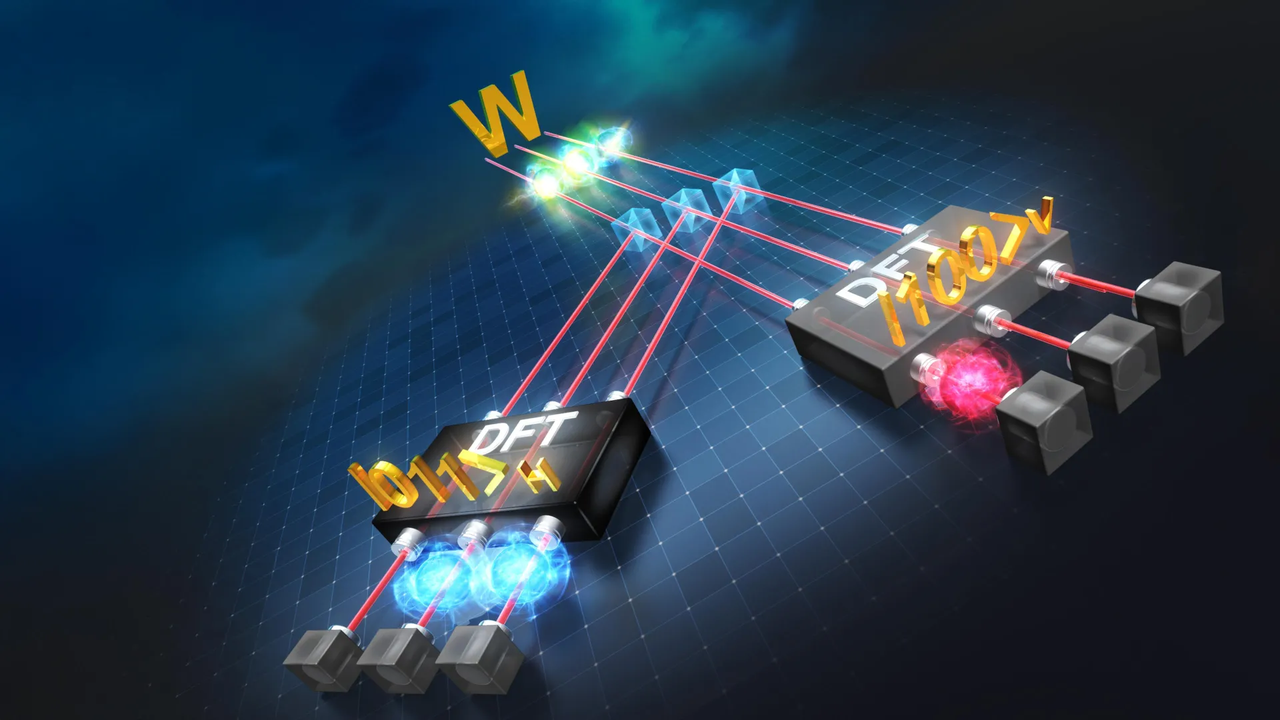
Background: The Elusive Quantum “W State” in Quantum Information Science
Quantum information science is poised to fundamentally transform future technologies, from secure communication to powerful computation and ultrasensitive sensing. At its core lies quantum entanglement, a phenomenon where multiple quantum bits are intrinsically linked. Among the various types of entangled states, the “W state” is particularly notable for its robustness: unlike some other states, its entanglement persists even if some qubits are lost, making it a valuable resource for distributed quantum networks and certain quantum computing architectures. However, the efficient and instantaneous detection of this specific multi-photon W state has remained a significant technical hurdle in quantum physics for many years, posing a bottleneck for advancing quantum communication and teleportation technologies.
Key Findings / Results: Kyoto University’s Real-Time W State Detection
A research team at Kyoto University in Japan has made a groundbreaking advancement by developing a new method for the instantaneous detection of the quantum “W state.” This innovation resolves a critical, long-unsolved puzzle in quantum information science. The newly devised technique allows for the real-time identification of multi-photon W states, which are essential for various quantum information protocols. Specifically, the ability to instantly detect these entangled states will significantly accelerate the development of quantum communication, including highly secure quantum key distribution, and advanced quantum teleportation, where quantum information is transferred between distant locations without physical contact. Furthermore, the W state’s inherent robustness, now coupled with efficient detection, is crucial for developing powerful new quantum computing systems, particularly in constructing fault-tolerant and distributed quantum computing networks. This breakthrough enables more stable quantum gate operations and potentially simpler quantum error correction schemes. The research aligns with broader international efforts aimed at transitioning quantum technologies from delicate laboratory demonstrations to more scalable and robust platforms suitable for practical applications, signaling a major step towards making quantum technologies a real-world utility.
Technical Significance & Outlook: Accelerating the Quantum Technology Roadmap
The instantaneous detection of the quantum W state by Kyoto University carries immense technical significance for the entire field of quantum technology. For quantum communication, it paves the way for more resilient and longer-distance secure information transfer, forming a stronger foundation for the nascent quantum internet. In quantum teleportation, improved detection fidelity and speed will bring the vision of instantaneous information transfer across physical distances closer to reality. Within quantum computing, the efficient utilization of multi-photon entangled states will enable the tackling of more complex computational problems, accelerating innovation in drug discovery, materials science, and financial modeling. The technology also has implications for enhancing the precision of quantum sensing, opening up new applications in medical diagnostics and environmental monitoring where ultra-sensitive measurements are required. Future research will focus on refining this detection technique, scaling it to higher numbers of qubits, and integrating it into more complex quantum systems, thereby accelerating the roadmap toward practical quantum devices. This achievement by Kyoto University is a pivotal milestone that promises to unlock new capabilities across quantum communication, computation, and sensing, fundamentally shaping the future of high-technology industries and scientific discovery.
Source: https://www.sciencedaily.com/releases/2026/05/260513034640.htm








Comments