Background: The Escalating Speed Demands of AI Networks
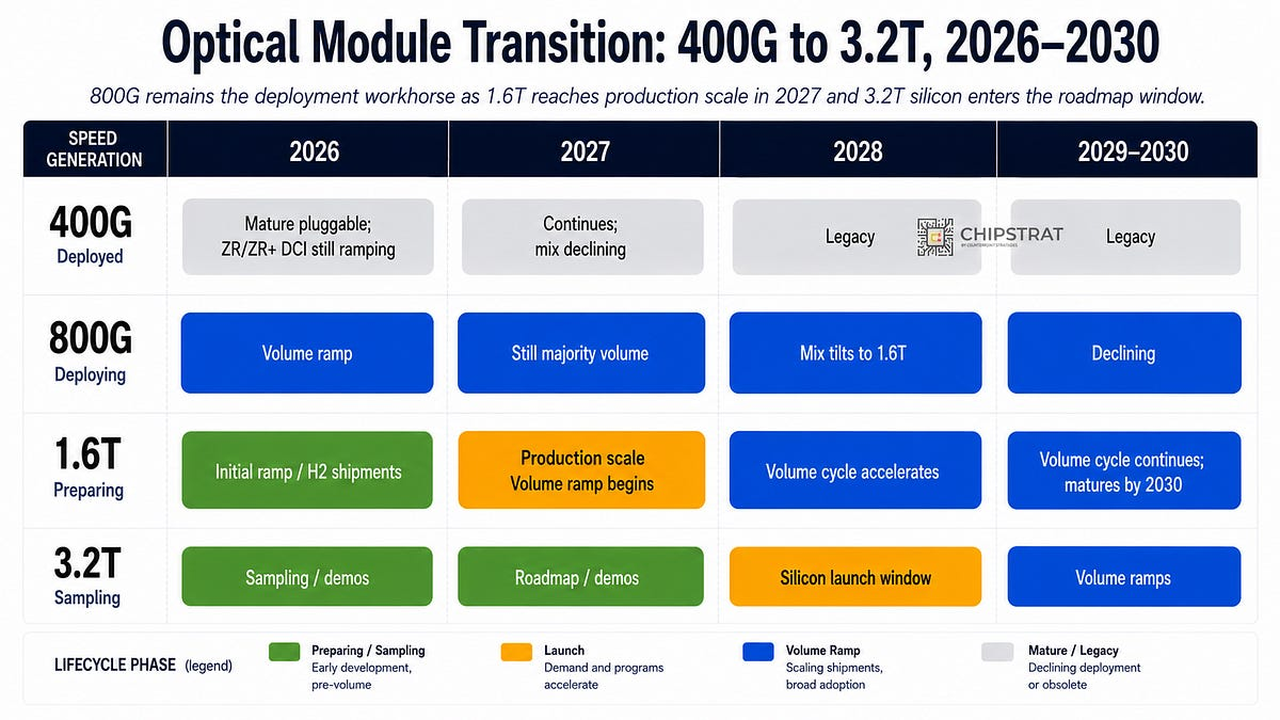
The proliferation of artificial intelligence, particularly large-scale model training and high-performance computing, has created an insatiable demand for network bandwidth and speed. Data centers are rapidly pushing beyond 800G optical interconnects, with the industry aggressively pursuing 1.6T and setting sights on 3.2T. This ‘speed race’ is a critical indicator of the pace of innovation in optical networking, driven by the need to efficiently move massive datasets between GPUs and AI accelerators.
Key Findings: Optical Transceiver Evolution and Industry Pioneers
The optical transceiver market is undergoing a profound transformation, marked by several key developments:
- 1.6T Enters Production: By the second half of fiscal 2026, leading companies such as Marvell are initiating volume production of 1.6T optical transceivers. This rapid commercialization is crucial for meeting the immediate high-bandwidth requirements of current AI clusters.
- OFC 2026 Highlights Advanced Technologies: The Optical Fiber Communication Conference (OFC) 2026 served as a showcase for next-generation optical solutions:
- Coherent’s Diverse 1.6T Portfolio: Coherent demonstrated a comprehensive range of 1.6T transceiver types, including those based on Silicon Photonics (SiPh), Electro-absorption Modulated Lasers (EML), and Vertical Cavity Surface Emitting Lasers (VCSEL). This multi-technology approach caters to diverse application needs and deployment scenarios. Furthermore, Coherent previewed 400G/lane PAM4 links, a foundational technology for achieving 3.2T optical networks.
- NVIDIA’s Co-Packaged Optics (CPO): NVIDIA showcased its cutting-edge Spectrum-X Photonics (Ethernet) and Quantum-X Photonics (InfiniBand) CPO switches. CPO integrates optical components directly with the switch ASIC, offering significant improvements in power efficiency, bandwidth density, and latency—critical for hyperscale AI deployments.
- AAOI’s On-Board Optics: Applied Optoelectronics, Inc. (AAOI) demonstrated 1.6T and 6.4T on-board optics solutions. On-board optics place the optical engine close to the host chip but often in a separate module, bridging the gap between pluggable transceivers and full CPO, and indicating readiness for Near-Packaged Optics (NPO) and CPO architectures.
- POET + Lessengers 1.6T 2xDR4: The collaboration between POET Technologies and Lessengers resulted in the exhibition of 1.6T 2xDR4 optical modules, highlighting advancements in integrated photonic platforms that promise high efficiency and scalability.
Technical Significance & Outlook: Sustaining AI’s Trajectory
This rapid progression in optical transceiver speeds is fundamentally transforming AI data centers. The availability of 1.6T solutions and the clear roadmap to 3.2T are essential for:
- Accelerating AI Workloads: Eliminating bandwidth bottlenecks between AI accelerators, thereby reducing model training times and enabling more complex AI applications.
- Improving Power Efficiency: Technologies like CPO and on-board optics drastically cut down power consumption associated with data movement, which is critical for managing the increasing energy footprint of AI data centers.
- Enhancing Scalability: High-density, high-speed optical interconnects enable AI clusters to scale efficiently to thousands of XPUs, supporting the continuous expansion of AI infrastructure.
The fierce competition and collaborative innovation among leading vendors are accelerating the development of advanced optical communication technologies. This ‘speed race’ is not just about raw performance; it’s about building a sustainable and highly efficient infrastructure that can continue to fuel the AI revolution for years to come. The future of AI is inextricably linked to the capabilities of its underlying optical network, making these advancements paramount for continued technological progress.
Source: https://www.chipstrat.com/p/inside-the-800g-16t-32t-race








Comments