
Background
The global energy storage landscape is undergoing a profound transformation, with solid-state battery (SSB) technology emerging as a potential game-changer due to its promise of higher energy density, enhanced safety, and longer cycle life compared to conventional lithium-ion batteries. This shift necessitates a re-evaluation of the entire battery materials supply chain, prompting a deep dive into the nascent but rapidly expanding market for SSB materials. Understanding the trajectory of this market requires an assessment of technological readiness, industrial scalability, and the strategic maneuvers of key players across the automotive and electronics sectors.
Key Findings / Results
The Fortune Business Insights report highlights a pivotal transition in the solid-state battery sector, emphasizing that the primary drivers for the SSB materials market are the accelerating commercialization milestones set by leading industry players. Mercedes-Benz and Factorial are actively testing vehicles equipped with solid-state batteries, signaling a tangible move towards real-world applications. Concurrently, Toyota, with support from Japan’s Ministry of Economy, Trade and Industry (METI), is advancing its own SSB production plans. Furthermore, Samsung SDI has laid out an ambitious roadmap targeting mass production of solid-state cells by 2027, with an energy density goal of 900 Wh/L (as mentioned in Article 10).
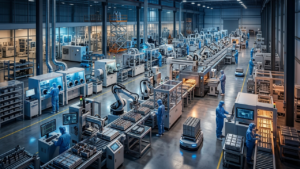
A critical insight from the report is the market’s evolution from a primary focus on laboratory-scale chemical validation to a comprehensive emphasis on industrial-scale material and process readiness. This indicates that the challenges of mass production extend beyond mere electrochemical performance, now encompassing:
- Supply Chain Establishment: Ensuring reliable and scalable sourcing of advanced solid electrolyte materials and other components.
- Efficient Processing Methods: Developing cost-effective and high-throughput manufacturing techniques for materials.
- Rigorous Certification Processes: Establishing robust validation and qualification standards for new materials and battery designs.
This holistic approach underscores the industry’s recognition that successful commercialization hinges on robust engineering and manufacturing infrastructure as much as on groundbreaking science.
Technical Significance & Outlook
The shift in focus from pure research to industrial readiness for solid-state battery materials marks a significant maturation point for the technology. The emphasis on supply chain, processing, and certification points to the growing pains of scaling a revolutionary technology. For materials scientists and engineers, this means that novel material discoveries must increasingly be accompanied by viable strategies for their large-scale, cost-effective synthesis and integration into existing or new manufacturing processes. The specific mentions of companies like Mercedes-Benz, Factorial, Toyota, and Samsung SDI provide concrete benchmarks for the industry’s progress, indicating that while challenges remain, the path to commercialization by the late 2020s is becoming clearer. The demand for next-generation solid electrolytes (e.g., sulfides, oxides, polymers) and compatible electrode materials will intensify, driving innovation not just in material properties but also in process engineering and manufacturing compatibility.
Source: https://www.fortunebusinessinsights.com/solid-state-battery-materials-market-116332






Comments