Key Findings
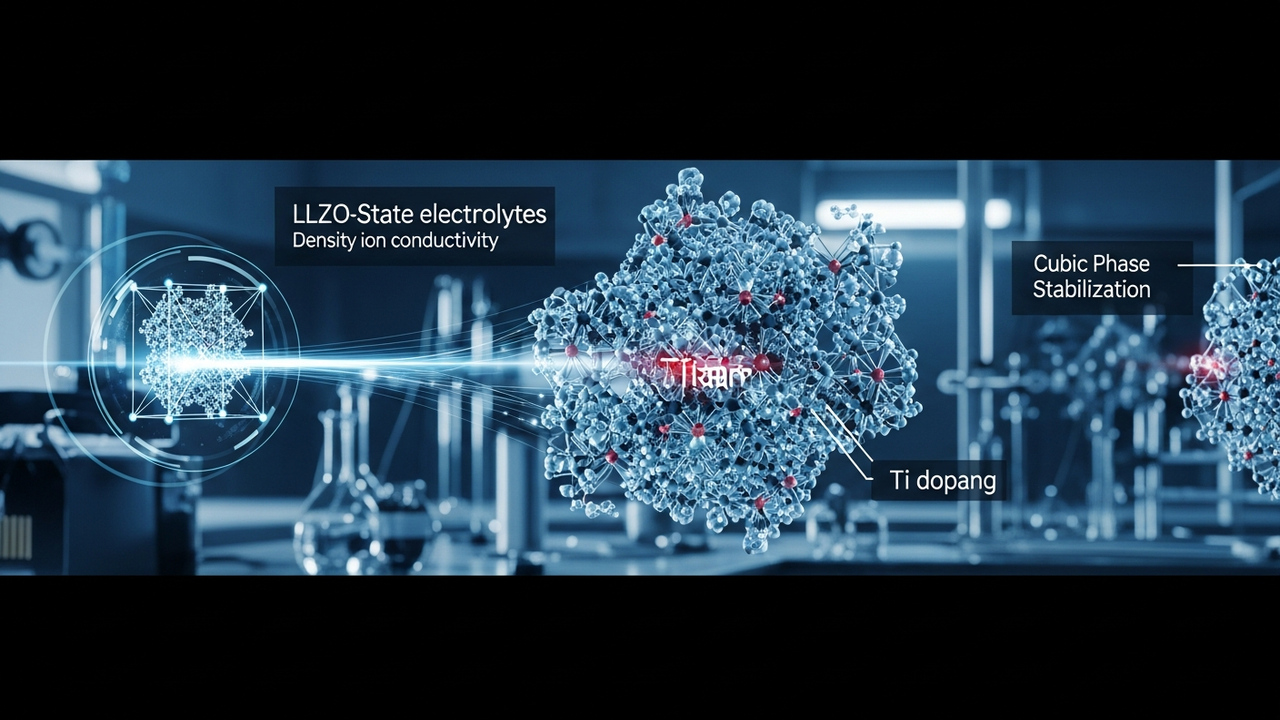
In research aimed at improving the performance of the garnet-type solid electrolyte Li7La3Zr2O12 (LLZO), the impact of titanium (Ti) doping on lithium-ion transport properties and structural stability was thoroughly investigated. The study revealed that Ti-doping not only enhances the bulk density of LLZO but also promotes the formation of a cubic phase, which is critical for achieving high ionic conductivity and stability.
Technical Details
LLZO is considered a promising material for solid electrolytes in all-solid-state batteries, but its cubic phase is metastable, posing challenges in manufacturing process control. This study demonstrated that introducing Ti ions into the LLZO crystal structure improves lattice stability, resulting in denser sintered bodies. Enhanced bulk density leads to improved physical contact between the solid electrolyte and electrodes, which reduces interfacial resistance. Furthermore, Ti-doping was found to increase room-temperature Li-ion conductivity (though specific numerical values were not provided), directly contributing to improved battery performance. This approach suggests a more efficient method for LLZO electrolyte fabrication, addressing challenges associated with conventional high-temperature sintering processes.
Background & Context
All-solid-state batteries are gaining attention as a next-generation battery technology that can improve the range, safety, and charging speed of electric vehicles (EVs). The core solid electrolyte must possess high ionic conductivity, chemical stability, and mechanical strength. Garnet-type LLZO is a strong candidate meeting these requirements, but manufacturing difficulties have been a barrier to commercialization. The reported improvements in density and cubic phase stabilization through Ti-doping offer a practical solution to this manufacturing challenge, paving the way for the mass production of high-performance LLZO solid electrolytes.
Strategic Significance & Outlook
The improvement in LLZO properties through Ti-doping represents a significant step towards enhancing all-solid-state battery performance. Future research is expected to focus on optimizing Ti doping levels and exploring the effects of co-doping with other elements. A key aspect will also be how this technology is integrated into manufacturing processes to enable cost-effective mass production. Ultimately, these research findings are anticipated to contribute to the realization of highly reliable, high-energy-density, and long-lifespan all-solid-state batteries, accelerating innovation across various sectors including the EV market, portable electronic devices, and stationary energy storage systems.
Source: https://arxiv.org/abs/2606.31669
Get our weekly technology intelligence — free
Receive an infographic that lets you judge at a glance whether each field’s analysis report is worth reading.
Subscribe Free — Weekly Tech Intelligence
By subscribing, you’ll receive Troy-Technical’s weekly technology intelligence newsletter.
- Your email and selected fields are used only to deliver the newsletter.
- We never share your information with third parties.
- You can unsubscribe anytime via the link in each email.
See our Privacy Policy for details.
Takes about a minute · Unsubscribe anytime









Comments