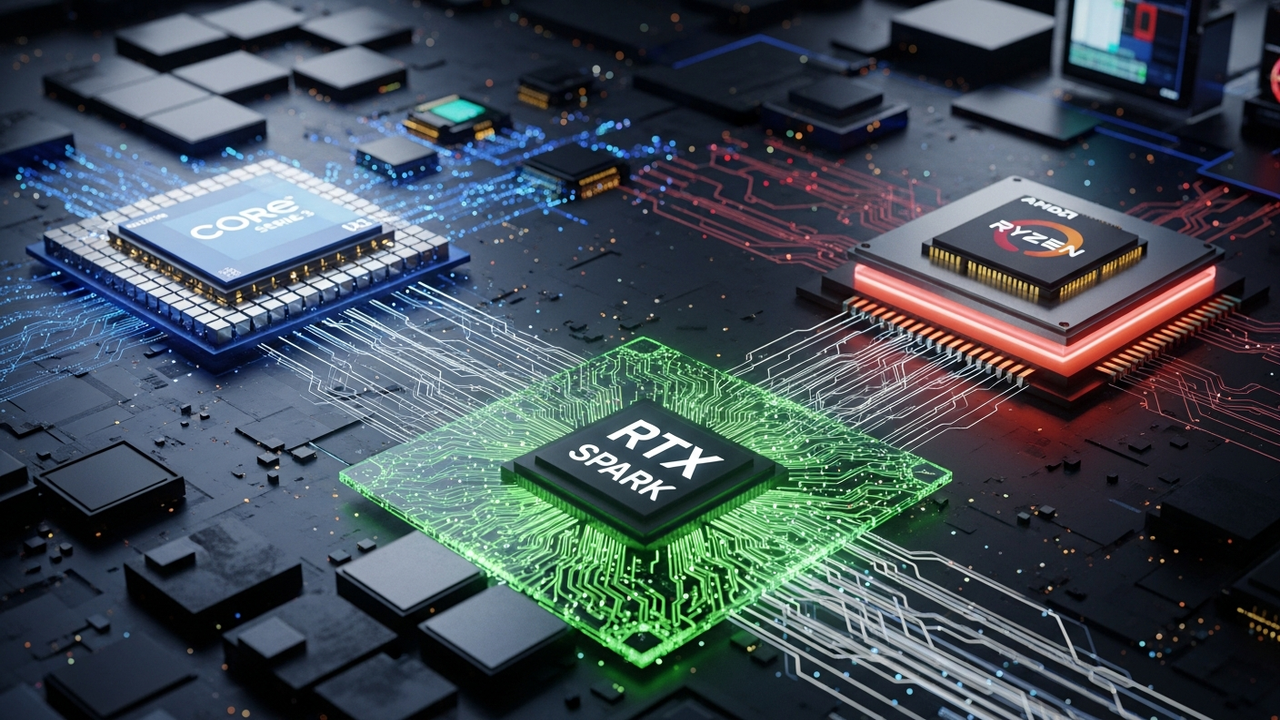
Key Findings: NVIDIA’s “RTX Spark” Spearheads Personal AI, Intel & AMD Accelerate Edge AI Markets
NVIDIA unveiled its new “RTX Spark” AI chip for personal computers on July 4, 2026, slated for release this fall in upcoming Windows PCs from leading manufacturers including Lenovo, HP, Dell, Microsoft Surface, ASUS, and MSI. NVIDIA CEO Jensen Huang hailed it as a “new superchip” ushering in the “era of personal AI agents,” effectively reinventing the computer. Simultaneously, Intel is integrating CPU, GPU, and NPU resources within its new Core Ultra Series 3 processors to enhance industrial edge AI and real-time automation. AMD has also introduced its Ryzen AI Embedded P100 and X100 series processors, enabling low-latency AI inference on edge devices. This intense competition is underscored by a 70% year-on-year increase in edge AI-enabled smartwatch shipments in Q1 2026, achieving 25% market penetration, unequivocally signaling surging demand for AI at the edge.
Technical & Clinical Details: Dedicated NPUs and Platform Integration for Performance Gains
- NVIDIA RTX Spark: By integrating AI capabilities into personal PCs, the RTX Spark will significantly enhance on-device AI agent execution, enabling novel user experiences and productivity improvements. NVIDIA also hints at a serious foray into the CPU market, predicting $20 billion in standalone CPU sales this year, with its first standalone CPU expected this fall as part of the Vera Rubin platform.
- Intel Core Ultra Series 3 Processors: Featuring an integrated NPU (Neural Processing Unit), a dedicated AI accelerator, these processors act as an efficient engine for local AI function execution with low power consumption. Capable of delivering up to 120 platform TOPS across the CPU/GPU/NPU, they enable sustained AI inference and real-time automation in robotics and industrial edge applications. This translates to improved performance and energy efficiency for robotic systems in manufacturing and logistics.
- AMD Ryzen AI Embedded P100/X100 Series: These processors accelerate AI workloads on edge devices, allowing for low-latency AI inference. The competitive landscape in edge AI chips is further intensifying with NXP Semiconductors introducing the i.MX 93W application processor, combining a dedicated AI NPU with tri-radio wireless connectivity—an industry first.
- Growth of Edge AI Device Market: The artificial intelligence edge device market, valued at $25.1 billion in 2025, is projected to grow to over $118.3 billion by 2035, with the smartwatch market serving as a leading indicator. Qualcomm is also set to introduce its Snapdragon Wear Elite with a dedicated NPU in 2026, and Google’s next Tensor-based wearable silicon is expected to deepen AI integration.
Background & Context: Distributed AI Workloads and Shift to Devices
The shift from cloud-based AI to “edge AI,” where AI processing occurs directly on devices, offers benefits such as lower latency, enhanced privacy protection, and improved offline processing capabilities. This enables more advanced and efficient AI functionalities across a wide range of devices, including smartphones, smartwatches, industrial robots, and IoT devices. The distribution of AI workloads is a crucial trend accelerating AI adoption while simultaneously alleviating the burden on data center infrastructure.
ASUS also demonstrated its expansion of the enterprise-to-edge AI ecosystem at Computex 2026, showcasing AI Mini PCs like the “ASUS NUC 16” with the latest Intel Core Series 3 processors and the “ASUS Ascent QN10” featuring a Qualcomm 80 TOPS NPU, designed for office, retail, and IoT applications. The approval of ASUS Blade Healthcare AI software by HSA in Singapore further highlights a concrete application of edge AI in the healthcare sector.
Strategic Significance & Outlook: Accelerating Personal AI and Industrial Automation
These new AI chips and devices are poised to bring the “era of personal AI agents” to fruition, allowing users to experience smarter, more personalized digital interactions. In the industrial sector, edge AI will fundamentally transform robotics and real-time automation, contributing to significant improvements in manufacturing efficiency, quality, and safety. The fierce competition among major semiconductor companies like Intel, NVIDIA, and AMD is expected to further accelerate AI innovation, creating new business opportunities in both hardware and software domains.
Source: https://aichipsnews.com/nvidia-announces-new-ai-chip-for-personal-computers/
Get our weekly technology intelligence — free
Receive an infographic that lets you judge at a glance whether each field’s analysis report is worth reading.
Subscribe Free — Weekly Tech Intelligence
By subscribing, you’ll receive Troy-Technical’s weekly technology intelligence newsletter.
- Your email and selected fields are used only to deliver the newsletter.
- We never share your information with third parties.
- You can unsubscribe anytime via the link in each email.
See our Privacy Policy for details.
Takes about a minute · Unsubscribe anytime







Comments