Key Findings
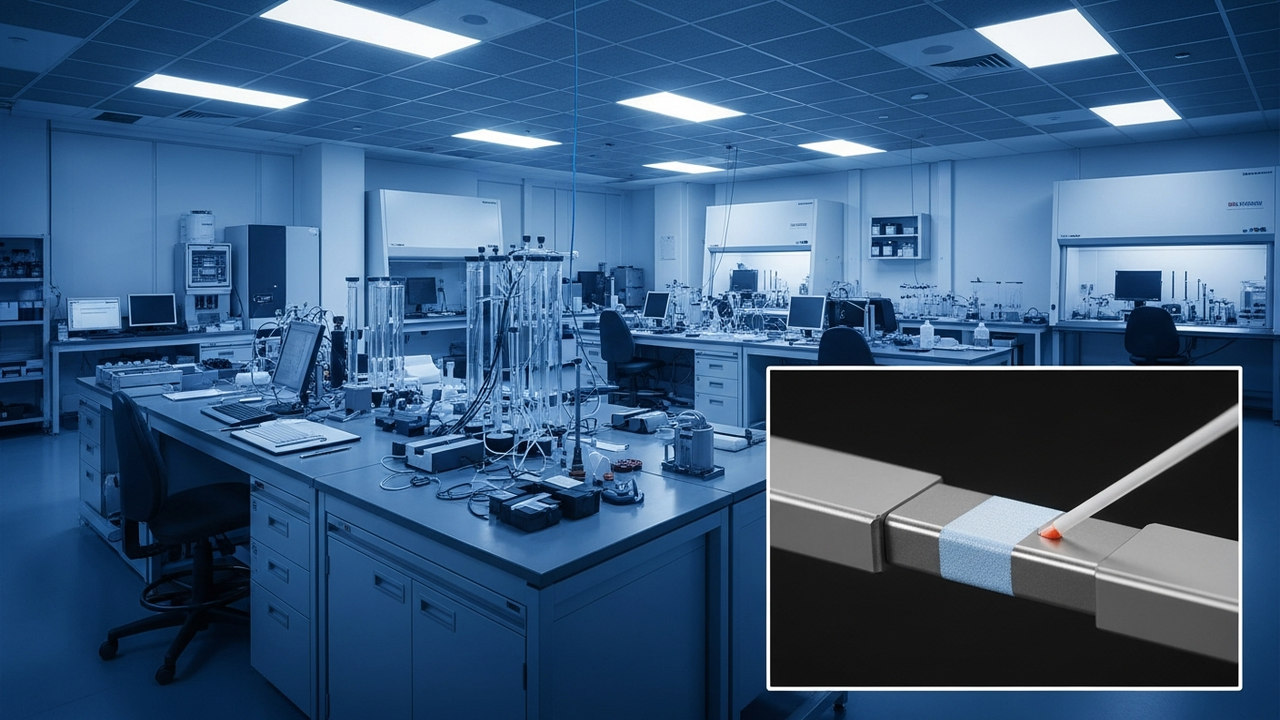
A collaborative research team from the Southwest Research Institute (SwRI) and Southern Methodist University (SMU) has embarked on a new research initiative focusing on ‘interfacial engineering’ as a novel approach to significantly enhance the reliability and safety of all-solid-state batteries. Specifically, they aim to improve battery lifespan and safety by employing a technique that forms an extremely thin film, ranging from tens to hundreds of nanometers in thickness, on the surface of the lithium metal anode. This ultrathin film is expected to play a critical role in mitigating damage to materials that come into contact with lithium metal and effectively suppressing the growth of lithium dendrites.
Technical / Clinical Details
The lithium metal anode is highly anticipated as the material capable of achieving the highest energy density in all-solid-state batteries; however, its high reactivity has posed challenges related to dendrite formation and side reactions at interfaces. The interfacial engineering approach offers a fundamental solution to this problem. The ultrathin film creates a stable protective layer between the lithium metal and the solid electrolyte, preventing direct reactions between the two. This helps to suppress the non-uniform growth of lithium dendrites and reduces the risk of short circuits. A film thickness of tens to hundreds of nanometers can function as a physical barrier without impeding lithium-ion conduction. This technology has the potential to significantly improve the overall performance profile of solid-state batteries by extending battery cycle life and enhancing stability in high-temperature environments.
Background & Context
All-solid-state batteries are anticipated as next-generation battery technology for electric vehicles (EVs) and large-scale energy storage systems, offering numerous advantages over conventional liquid-electrolyte lithium-ion batteries, such as higher energy density, superior safety (reduced thermal runaway risk), and longer lifespan. However, problems like dendrite formation and interfacial resistance, which impede the practical use of lithium metal anodes, have been long-standing challenges. SwRI has a strong track record in applied research and engineering, while SMU excels in fundamental research in materials science; their collaboration plays a crucial role in bridging fundamental scientific insights with practical technological development.
Strategic Significance & Outlook
The interfacial engineering research by SwRI and SMU holds critical significance for accelerating the commercialization of all-solid-state batteries. If this ultrathin film technology succeeds, it will significantly improve the safety and reliability of solid-state batteries employing lithium metal anodes, contributing to the realization of high-energy-density EV batteries. This approach is also applicable to other high-durability and high-reliability demanding application fields such as drones, robotics, and aerospace. Future research will focus on optimizing thin-film materials, improving the scalability of manufacturing processes, and evaluating long-term performance in full cells. This innovative interfacial design is poised to open new avenues for the widespread adoption of next-generation battery technology.
Get our weekly technology intelligence — free
Receive an infographic that lets you judge at a glance whether each field’s analysis report is worth reading.
Subscribe Free — Weekly Tech Intelligence
By subscribing, you’ll receive Troy-Technical’s weekly technology intelligence newsletter.
- Your email and selected fields are used only to deliver the newsletter.
- We never share your information with third parties.
- You can unsubscribe anytime via the link in each email.
See our Privacy Policy for details.
Takes about a minute · Unsubscribe anytime








Comments