Key Findings
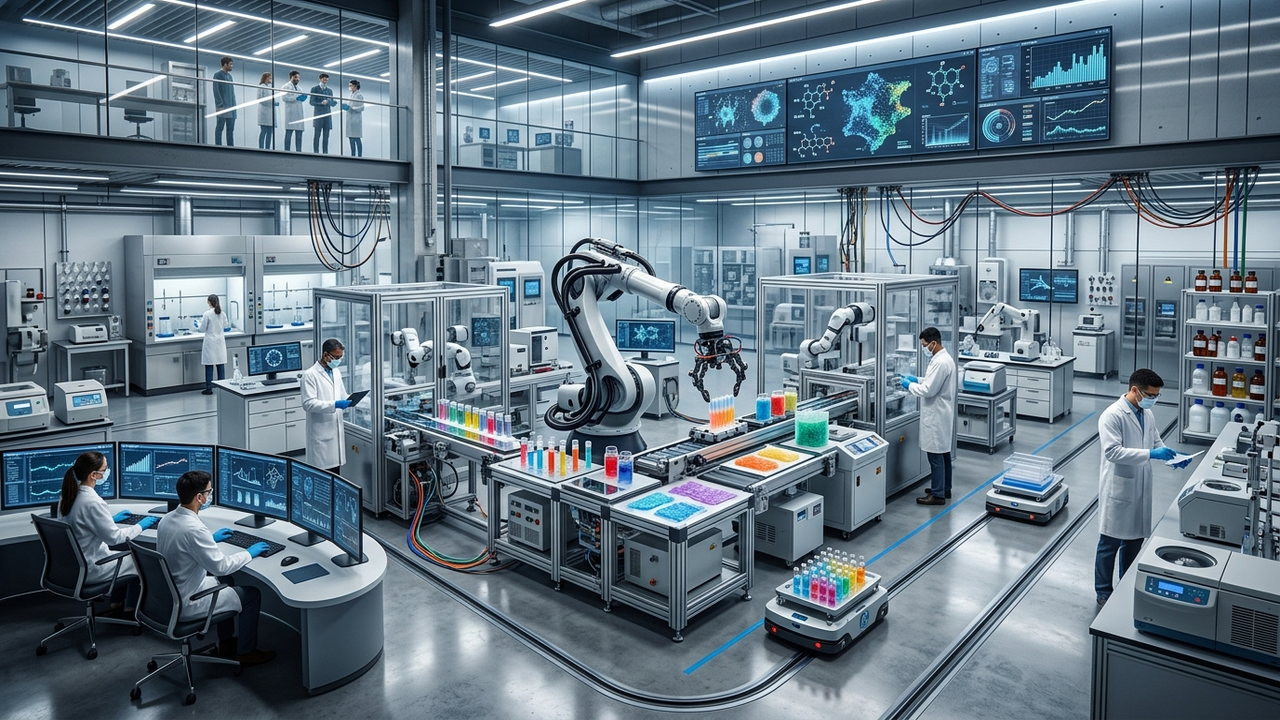
The U.S. National Science Foundation (NSF) has awarded a significant $20 million grant to PoLARIS (Polymer Laboratory for AI, Robotics, Informatics, and Standards), a pioneering research laboratory where artificial intelligence and robotics will autonomously conduct experiments. This state-of-the-art infrastructure is designed to dramatically accelerate the discovery and development of soft materials, including crucial components for advanced batteries and next-generation medical implants.
Technical / Clinical Details
PoLARIS will interconnect over 20 robotic workstations distributed across the University of Chicago and Argonne National Laboratory through a centralized cloud-based platform. This setup allows researchers, regardless of their physical location, to design experiments remotely, have them executed by robots, and collect and analyze data in real time. This autonomous experimental system streamlines the iterative trial-and-error process inherent in materials science, enabling rapid evaluation of millions of material compositions and processing conditions. In polymer science, where complex synthesis pathways and property predictions are particularly challenging, the integration of AI and robotics holds the potential to drastically reduce development times for innovations such as novel battery electrolytes, biocompatible polymers, and self-healing materials.
Background & Context
In the field of materials science, the discovery and development of new functional materials are critical drivers of innovation across foundational industries such as energy, medicine, electronics, and defense. Traditionally, materials development has been heavily reliant on time-consuming and costly manual experimental procedures. However, recent advancements in AI and robotics have rapidly propelled the automation of scientific research, leading to the concept of ‘robot scientists.’ These systems enable larger-scale and higher-throughput experimentation with minimal human intervention. The PoLARIS project stands at the forefront of this trend, strategically positioned to enhance the competitiveness of U.S. materials science research and bolster the resilience of domestic supply chains.
Strategic Significance & Outlook
PoLARIS has the potential to fundamentally transform the paradigm of polymer science research. This autonomous laboratory will free researchers to focus on more complex scientific problems, dramatically increasing the speed of discovery. In the future, it is anticipated that this platform will become standardized and widely adopted by both academia and industry, leading to the faster societal implementation of next-generation innovative materials. This acceleration could significantly contribute to addressing critical global challenges, including climate change mitigation, advancements in healthcare, and national security.
Get our weekly technology intelligence — free
Receive an infographic that lets you judge at a glance whether each field’s analysis report is worth reading.
Subscribe Free — Weekly Tech Intelligence
By subscribing, you’ll receive Troy-Technical’s weekly technology intelligence newsletter.
- Your email and selected fields are used only to deliver the newsletter.
- We never share your information with third parties.
- You can unsubscribe anytime via the link in each email.
See our Privacy Policy for details.
Takes about a minute · Unsubscribe anytime








Comments