
Key Findings: NASA Initiates Broad Call for Proposals to Accelerate Lunar Base Technologies Across Five Critical Areas
NASA has launched a comprehensive solicitation for proposals under its ‘Lunar Enabling Infrastructure Accelerator’ program, aiming to expedite technological innovations essential for establishing a sustainable Moon base at the lunar South Pole. This initiative is designed to enable long-term human exploration and significantly reduce dependence on Earth-based resupply missions by focusing on five critical technology domains:
- Vertical Solar Array Technology: For efficient power generation in low-angle sunlight conditions found at the lunar poles.
- In-Situ Resource Utilization (ISRU) for Oxygen Extraction: Technologies to produce resources like water and oxygen from lunar soil (regolith).
- Radioisotope Stirling Generator (RSG) Technology: Nuclear power systems for stable, continuous power supply regardless of solar illumination.
- In-Space Advanced Manufacturing: Technologies like 3D printing to produce necessary parts and structures on the lunar surface.
- Innovative Nanomaterials Production: Manufacturing high-performance new materials specifically adapted for the space environment.
This initiative seeks to bridge the infrastructure and technological gaps required for sustained human activity at the lunar South Pole.
Technical Details: Specific Goals for Lunar Self-Sufficiency Across Key Areas
Each targeted technology area has specific objectives aimed at enhancing the self-sufficiency of a lunar base:
- Vertical Solar Arrays: Designs to maximize energy generation, particularly on crater rims, ensuring prolonged periods of sunlight capture.
- ISRU Oxygen Extraction: Development of processes to efficiently extract breathable oxygen for astronauts and propellant oxygen from lunar regolith, thereby reducing oxygen transportation costs from Earth.
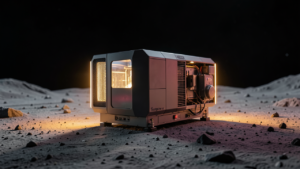
- RSG Technology: Provides stable baseload power for lunar rovers and base operations during extended lunar nights and in permanently shadowed regions, where solar power is unavailable.
- Advanced Manufacturing: Reduces reliance on Earth-sent parts, enabling on-site repair of broken components and production of new tools, enhancing mission flexibility and sustainability.
- Nanomaterials: Development of lightweight, high-strength structural materials and electronic components capable of withstanding space radiation and extreme temperature fluctuations.
These technologies are designed to be mutually complementary, forming an integrated ecosystem that enables living, working, and moving on the Moon.
Background and Industry Context: Artemis Program and Sustainable Lunar Presence
NASA’s Artemis program aims to return humans to the Moon and establish a long-term human presence. Achieving this ‘sustainable presence’ necessitates minimizing dependence on Earth and operating with near self-sufficiency on the lunar surface. This call for proposals reflects NASA’s strategy to identify technological bottlenecks and actively solicit innovative solutions from private companies and research institutions to accelerate development towards this goal, aligning with the broader vision for human exploration of deep space.
Strategic Significance and Outlook: Creation of a Lunar Economy and Expansion of Deep Space Exploration
Successful development and demonstration of these technologies will transform the Moon from merely a site of exploration into a vibrant hub for research, resource utilization, and potentially even tourism—creating new industries. Specifically, ISRU and advanced manufacturing technologies will form the core of a burgeoning lunar economy and serve as crucial preparations for future Mars missions. NASA’s initiative offers widespread opportunities across the entire space industry, and it is highly anticipated to strengthen the foundation for humanity’s deeper exploration of the solar system. This program represents a critical step towards establishing a multi-planetary future and fostering significant economic activity beyond Earth.
Source: https://www.meritalk.com/articles/nasa-seeks-proposals-to-advance-technology-for-moon-base/
Get our weekly technology intelligence — free
Receive an infographic that lets you judge at a glance whether each field’s analysis report is worth reading.
Subscribe Free — Weekly Tech Intelligence
By subscribing, you’ll receive Troy-Technical’s weekly technology intelligence newsletter.
- Your email and selected fields are used only to deliver the newsletter.
- We never share your information with third parties.
- You can unsubscribe anytime via the link in each email.
See our Privacy Policy for details.
Takes about a minute · Unsubscribe anytime




Comments