Key Findings
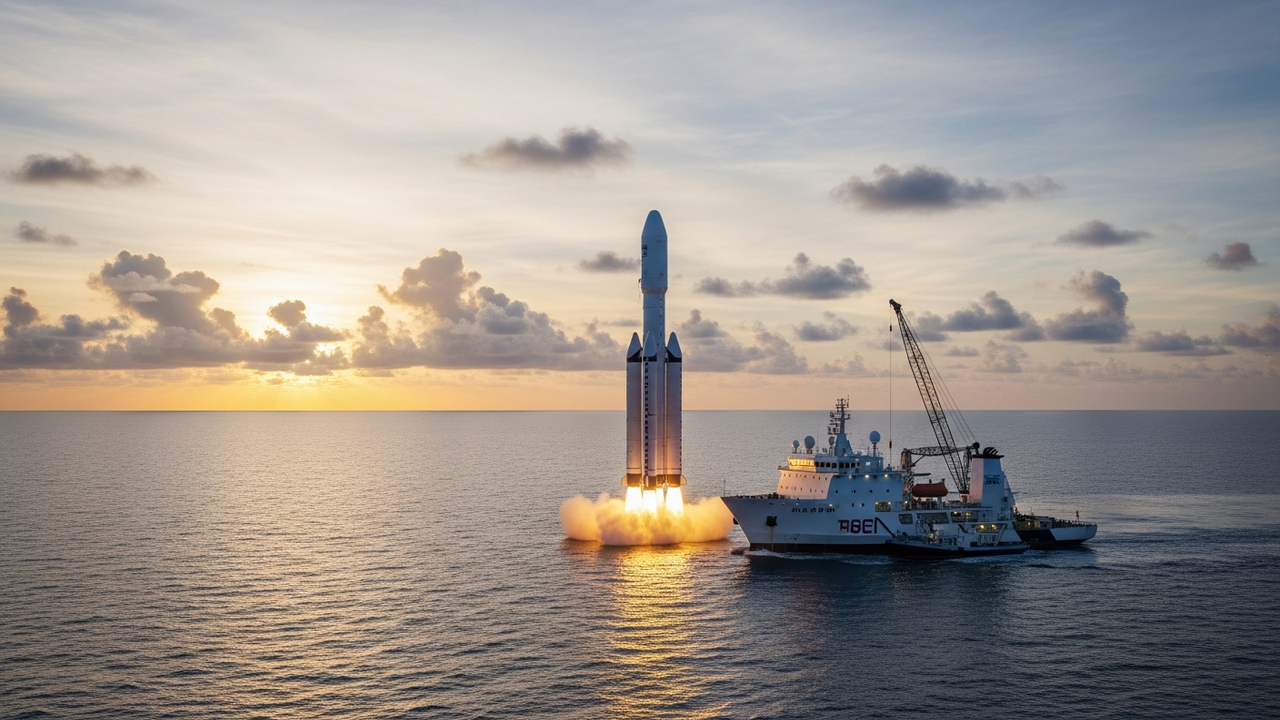
China’s new Long March 10B rocket successfully performed a vertical landing and recovery of its first-stage booster on an offshore platform during an orbital launch test. This achievement marks the first instance of China conducting a controlled recovery of an orbital-class rocket booster, representing a groundbreaking development in the nation’s reusable rocket technology program.
Technical & Clinical Details
The test demonstrated exceptionally advanced engineering, as the Long March 10B’s first-stage booster separated near orbital velocity, then autonomously guided itself, re-ignited its engines for deceleration, and precisely landed vertically on a dedicated offshore platform. Such a feat demands sophisticated technologies, including highly accurate navigation systems, multiple engine re-ignition capabilities, and robust thermal and impact-resistant designs. The successful establishment of this technology promises to drastically reduce both manufacturing and launch costs of rockets, significantly increasing launch frequency. The Long March 10B is also expected to be used for future crewed lunar missions.
Background & Context
Rocket reusability, pioneered by SpaceX’s Falcon 9, has revolutionized the global space transportation industry. Reducing launch costs is crucial for the deployment of satellite constellations, space tourism, and the construction of lunar bases, all of which are vital for the burgeoning space economy. In recent years, China has invested heavily in space development, both government-led and commercial, making the establishment of reusable rocket technology a national strategic priority. The Long March 10B’s success is seen as a significant milestone for China to catch up with or even surpass leading American companies like SpaceX in this critical domain, garnering substantial international attention.
Strategic Significance & Outlook
The successful recovery of the Long March 10B’s first-stage booster will significantly enhance China’s space transportation capabilities and bolster its competitiveness in the international commercial launch market. This technology will enable China to launch satellites more frequently and at a lower cost, accelerating the deployment of its own satellite networks and deep-space exploration plans. Furthermore, this success provides a crucial foundation for building reusable transportation systems for future crewed lunar and Martian missions, solidifying China’s status as a major space power.
Get our weekly technology intelligence — free
Receive an infographic that lets you judge at a glance whether each field’s analysis report is worth reading.
Subscribe Free — Weekly Tech Intelligence
By subscribing, you’ll receive Troy-Technical’s weekly technology intelligence newsletter.
- Your email and selected fields are used only to deliver the newsletter.
- We never share your information with third parties.
- You can unsubscribe anytime via the link in each email.
See our Privacy Policy for details.
Takes about a minute · Unsubscribe anytime





Comments