TROY TECHNICAL · BEGINNER’S GUIDE
READ THIS FIRSTBiosensors — An Introduction
Turning an invisible change in a body or sample into a readable signal.
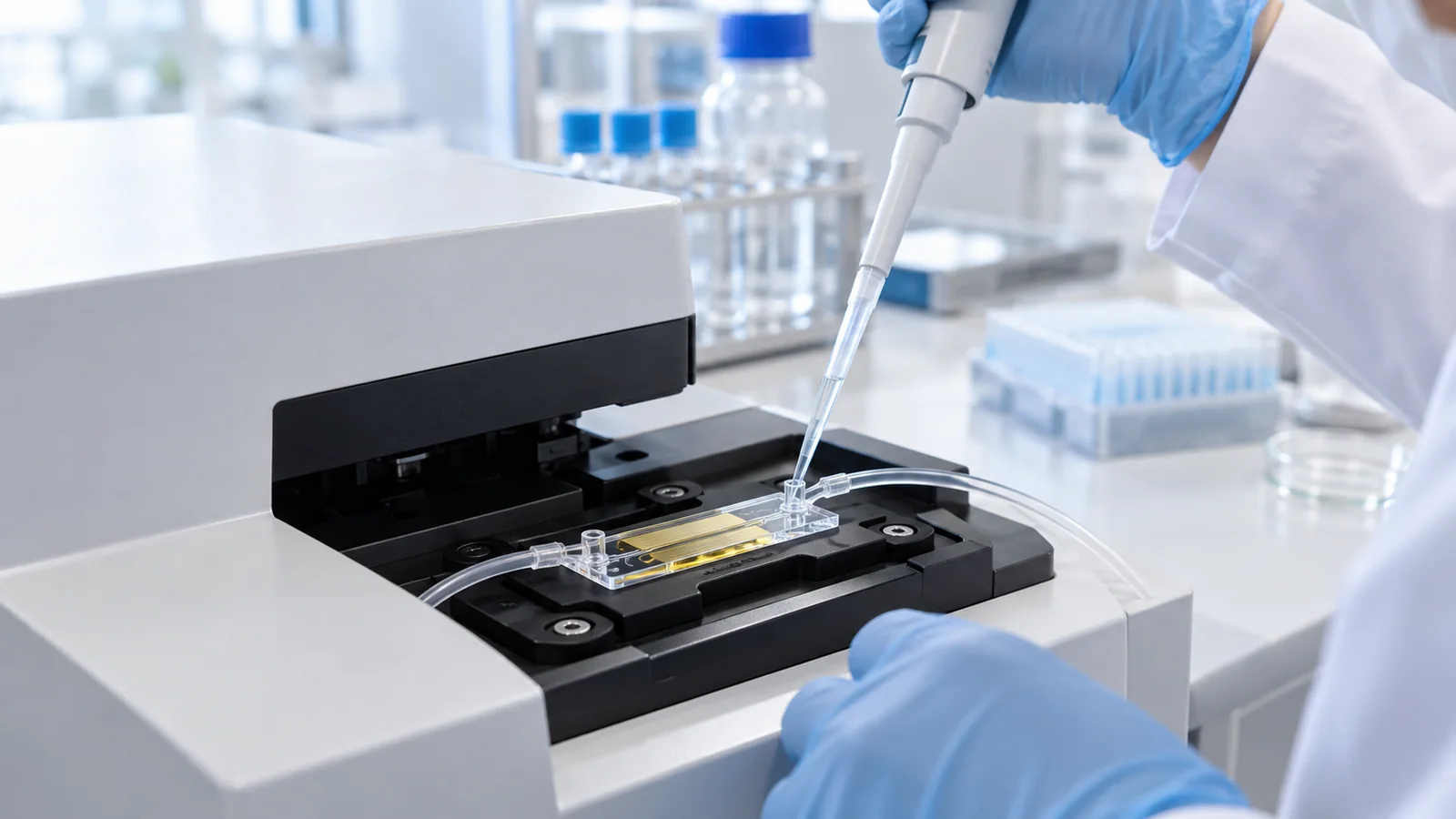
Japanese version →A wearable sensor and a test chip receiving one drop of sample begin with the same question: what do we want to know, and what are we actually measuring? Biosensors connect molecular recognition, signal conversion and interpretation. Understand that chain before considering miniaturization or AI.
01Separate recognition from readout
One glucose-sensing approach uses an enzyme and reads a current associated with its reaction. Other approaches use antibodies or aptamers to bind a target and detect the resulting electrical or optical change. The recognition material and the readout method are separate design choices.
Electrochemical methods measure electrical quantities, optical methods detect changes in light, and field-effect transistor methods sense electrical changes near a semiconductor surface. Not every device measuring the body contains a biological recognition element in the strict biosensor sense. This collection also covers enabling materials and measurement techniques.
Background: [1]

02The sample changes the measurement
Blood, sweat, saliva and interstitial fluid differ in composition, concentration and dynamics. A sweat reading cannot automatically be treated as a blood reading. Collection, extraction, interference control and fluid handling may all be needed before the sensing element can do its job.
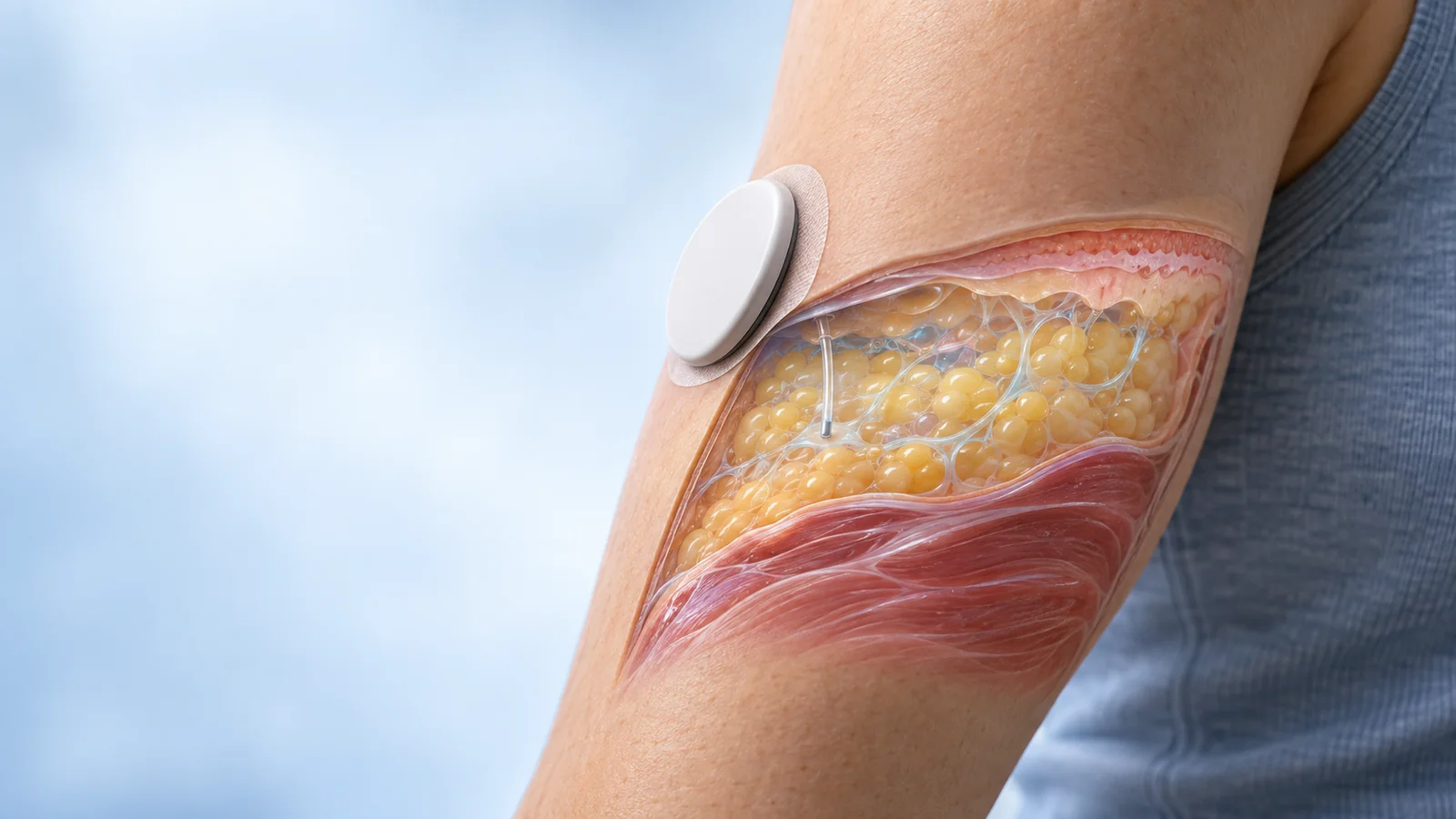
Continuous glucose monitoring, or CGM, generally measures glucose in fluid beneath the skin. It is not continuously drawing blood, and its response can lag changes in blood glucose. This is a useful example of considering what is measured alongside the convenience of continuous readings.
Background: [2]
03Detecting small amounts is not the same as identifying them correctly
A detection limit concerns how small a signal or amount can be distinguished from background variation. A low limit can be useful, but does not alone make a good test. The relevant concentration range, response to similar molecules and reproducibility in real samples also matter.
Analytical sensitivity can describe how strongly a signal changes with concentration. Diagnostic sensitivity means the proportion of people with a condition correctly identified as positive. These meanings are different. A low laboratory detection limit is not evidence by itself of accurate patient diagnosis.
Background: [1]
04Measurements can change during use
Proteins and other material can accumulate on a sensing surface and alter recognition or electrode behaviour. Temperature, drying, movement and poor attachment can also affect readings. Calibration at the start does not prevent later drift.
Adhesion, protective membranes, correction methods, usable lifetime and replacement are therefore part of the device. AI correction cannot guarantee recovery of information absent from the original signal. A useful system also needs to recognize when it should not provide a confident reading.
Background: [3]
05Define the decision before choosing the sensor
A device supporting hospital diagnosis, tracking trends at home or controlling a manufacturing process faces different requirements. In a closed-loop system that adjusts drug delivery automatically, measurement failure can become action failure. Fault detection and safe fallback are essential.
Follow the chain: target molecule, sample, recognition, readout, decision. This separates the roles of materials, instruments and AI. The guide explains measurement technology; it does not recommend a diagnosis or use of a particular medical device.
Background: [3]
Connect the ideas in one situation
ILLUSTRATIVE SCENARIO — NOT A PERFORMANCE CLAIM
After measuring a drop of sweat, what comes next?
Detecting a molecule in sweat does not prove that the reading directly describes health. Sweat rate, collection location, contamination and timing may all matter. Compare the same sample with a suitable reference measurement, then separately investigate its relationship to the bodily condition of interest.
Analytical accuracy and clinical meaning are different validation tasks. Adding AI still requires appropriately paired evidence.
Return to the starting idea
A reading may depend on more than the target molecule. The sample, measurement conditions and valid interpretation are part of the sensor design.
You do not need to memorize every technology name. Understanding the intended improvement, the mechanism being changed and the conditions needed to demonstrate it gives you a foundation for the detailed articles. Choose one route that matches your question.
Choose your next article
Read a route from top to bottom, or select just the question you need. You do not have to read everything.
Measurement principles
Using sensors on or in the body
From measurement to decisions
Browse all technical articles in this field (27)
- AI and Machine Learning for Sensor Data
- Lab-on-a-Chip
- Point-of-Care Testing (POCT)
- Aptamers
- Impedance Measurement
- Wearable Biosensors
- Closed-Loop Systems (Automated Insulin Delivery)
- Graphene and Carbon Nanotubes
- Smartphone Connectivity and Digital Twins
- Nanoparticles and Nanozymes
- Hydrogels as Cell Scaffolds
- Biomarkers and Clinical Endpoints
- Patch Sensors and Skin Adhesion
- Photodiodes for Optical Biosensors
- Microneedles
- Label-Free Detection and the Limit of Detection
- Raman Spectroscopy and SERS
- Biomarkers in Body Fluids
- Molecularly Imprinted Polymers (MIPs)
- Regulatory Pathways for Medical Devices and Home Use
- Implantable Sensors
- Regulatory Submissions and Real-World Data
- Continuous Glucose Monitoring (CGM)
- Surface Plasmon Resonance (SPR)
- Materials for the Enzyme–Electrode Interface
- Electrochemical Sensors
- Field-Effect Transistor (FET) Sensors
Sources and scope
This introductory synthesis connects the existing technical articles. Its grouping and design scenarios are explanatory, not standard classifications or test results. It does not catalogue current records, product availability or approvals, or forecast costs. Foundational references are below; linked articles provide more detailed technical sourcing.