


Key Findings
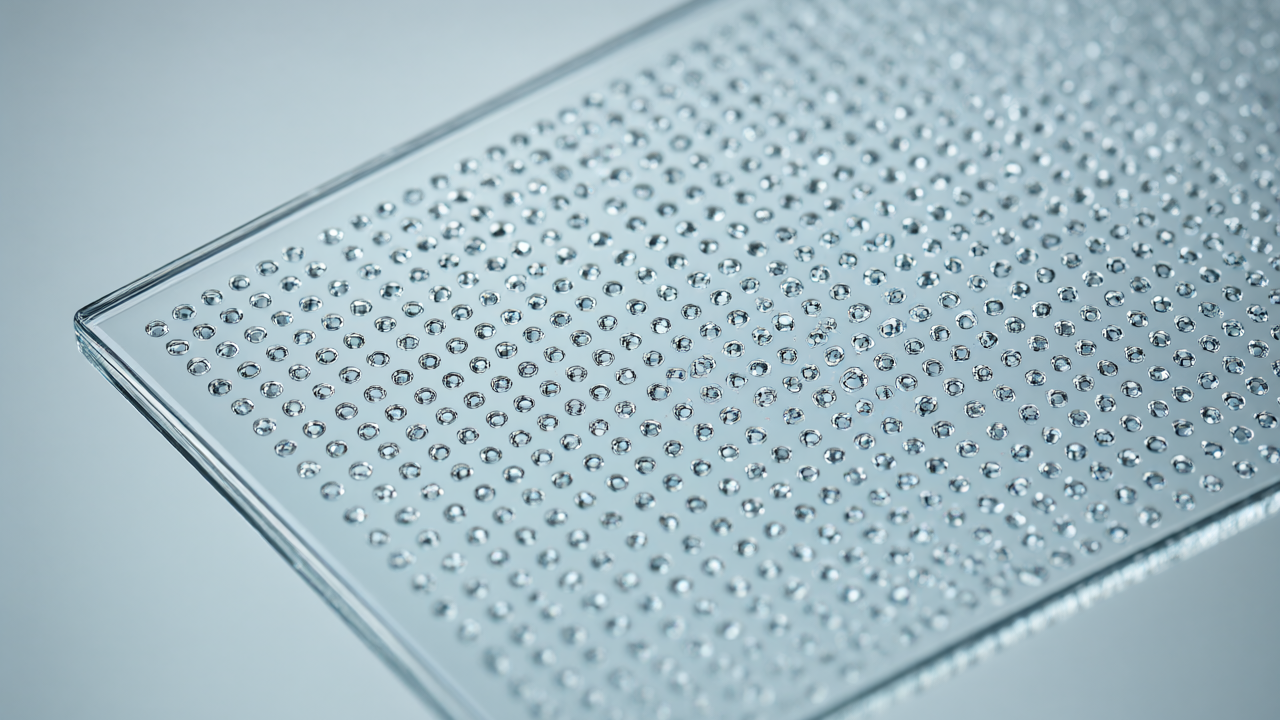
Nippon Sheet Glass presented a Through Glass Via (TGV) substrate designed for 5G and 6G communication infrastructure at CEATEC 2026. The substrate utilizes a proprietary alkali-free low-dielectric glass composition developed specifically for the company’s unique processing methods, resulting in superior via processability and low dielectric properties.
Technical Details
The TGV substrate is engineered for high-frequency and power-saving electronic circuits. Its physical and electrical specifications are as follows:
- Glass Type: Alkali-free glass
- Thermal Expansion Coefficient (CTE, 0–300°C): 3.2ppm
- Young’s Modulus: 76GPa
- Dielectric Constant (DK): 5.2F/m at both 1GHz and 10GHz
- Dielectric Loss Tangent (Df): 0.002tan at 1GHz and 0.003tan at 10GHz
The company identifies two primary competitive advantages. First, the via surfaces are extremely smooth, eliminating the micro-scratches that typically act as crack initiation points in standard TGVs, thereby increasing resistance to breakage. Second, the low dielectric constant and loss tangent minimize thermal and energy losses during operation.
Background & Context
The TGV development is complemented by other optical and material innovations showcased at the event. These include a liquid-based anti-fogging coating for automotive and surveillance cameras that creates a glass film via heat or plasma treatment, and a lens array (SLA 5EG) with lens elements reduced to a diameter of 300μm.
Significance & Outlook
Nippon Sheet Glass intends for the TGV substrate to serve as a replacement for silicon substrates in various electronic circuit boards and Micro-Electro-Mechanical Systems (MEMS) requiring high power efficiency. By combining a custom-designed glass composition with proprietary processing, the company aims to provide a more durable, low-loss alternative for next-generation high-frequency communication hardware.
Source: https://monoist.itmedia.co.jp/mn/articles/2611/04/news015.html
Get our weekly technology intelligence — free
Receive an infographic that lets you judge at a glance whether each field’s analysis report is worth reading.
Subscribe Free — Weekly Tech Intelligence
By subscribing, you’ll receive Troy-Technical’s weekly technology intelligence newsletter.
- Your email and selected fields are used only to deliver the newsletter.
- We never share your information with third parties.
- You can unsubscribe anytime via the link in each email.
See our Privacy Policy for details.
Takes about a minute · Unsubscribe anytime