Key Findings
TSMC is projected to significantly narrow the AI chip supply-demand gap, reducing it from approximately 20% to around 10% by the end of 2026, through aggressive expansion of its CoWoS advanced packaging capacity. This strategic scaling is vital for meeting the explosive growth in the AI market and alleviating critical bottlenecks in the semiconductor supply chain.
Technical and Business Details
- According to a TrendForce report, TSMC’s monthly CoWoS production capacity is anticipated to reach 120,000-140,000 chips by 2026. Including additional capacity from Outsourced Semiconductor Assembly and Test (OSAT) partners, the total monthly capacity is expected to approach 200,000 chips.
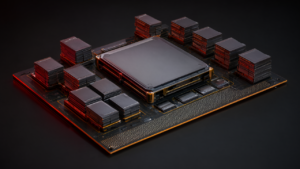
- CoWoS (Chip-on-Wafer-on-Substrate) is a 2.5D packaging technology that integrates multiple chips (e.g., GPUs and HBM) on a silicon interposer, indispensable for high-performance AI accelerators. This technology delivers high bandwidth, low latency, and superior power efficiency.
- To overcome current chip size limitations (up to 60x60mm), TSMC is also actively developing its next-generation packaging platform, CoPoS (Chip-on-Package-on-Substrate). CoPoS will enable the integration of larger chips or multiple chiplets, enhancing design flexibility for future AI chips.
- NVIDIA’s next-generation AI platform, Feynman, is slated to be the first customer for CoPoS, with full-scale mass production planned for 2028-2029, signaling further leaps in AI chip performance and integration density.
- This capacity expansion creates substantial business opportunities for advanced semiconductor equipment manufacturers (such as Lam Research, Applied Materials, and KLA) and material suppliers (including ABF substrates and glass substrates).
Background & Context
The rapid evolution of AI applications has created unprecedented demand for AI chips, with major AI chip design companies like NVIDIA heavily relying on advanced packaging capabilities such as TSMC’s CoWoS. However, demand has significantly outstripped supply, creating a severe bottleneck. TSMC’s proactive investments and CoWoS capacity ramp-up are crucial steps to address this supply-demand imbalance and accelerate the growth of the entire AI industry. The development of new technologies like CoPoS demonstrates TSMC’s foresight in pushing the boundaries of future AI hardware.
Strategic Significance & Outlook
TSMC’s CoWoS capacity expansion and CoPoS development will further accelerate the AI chip market’s growth and usher in a new era of high-performance computing. The narrowing supply-demand gap will contribute to greater stability in AI chip supply, meaning AI developers will have more accessible powerful hardware. This is expected to further advance the commercialization and application of AI technologies. Moreover, the mass production of CoPoS will dramatically boost the performance of next-generation AI accelerators, enabling the realization of even more complex and larger-scale AI models.
Get our weekly technology intelligence — free
Receive an infographic that lets you judge at a glance whether each field’s analysis report is worth reading.
Subscribe Free — Weekly Tech Intelligence
By subscribing, you’ll receive Troy-Technical’s weekly technology intelligence newsletter.
- Your email and selected fields are used only to deliver the newsletter.
- We never share your information with third parties.
- You can unsubscribe anytime via the link in each email.
See our Privacy Policy for details.
Takes about a minute · Unsubscribe anytime