TROY TECHNICAL · BEGINNER’S GUIDE
READ THIS FIRSTPolymers and resins — An Introduction
Why do plastics differ so much in stiffness, heat response and processing?
Japanese version →A bag bends, a gear carries load and an adhesive cures. All can involve polymers, yet their behaviour differs greatly. Understanding how long molecules arrange, move and connect is more useful than memorizing resin names. Follow those structures through processing and service.
01Molecular motion connects to material behaviour
A polymer molecule contains many connected structural units. Chain length, branching and interactions affect mobility. Some materials contain ordered crystalline regions alongside less ordered regions.
Tangled thread is a helpful first analogy, but molecular chains are not threads that glue together whenever they touch. Finished formulations can also contain stabilizers, pigments, fibres and powders. A base polymer name does not fully specify the product.
Background: [1]
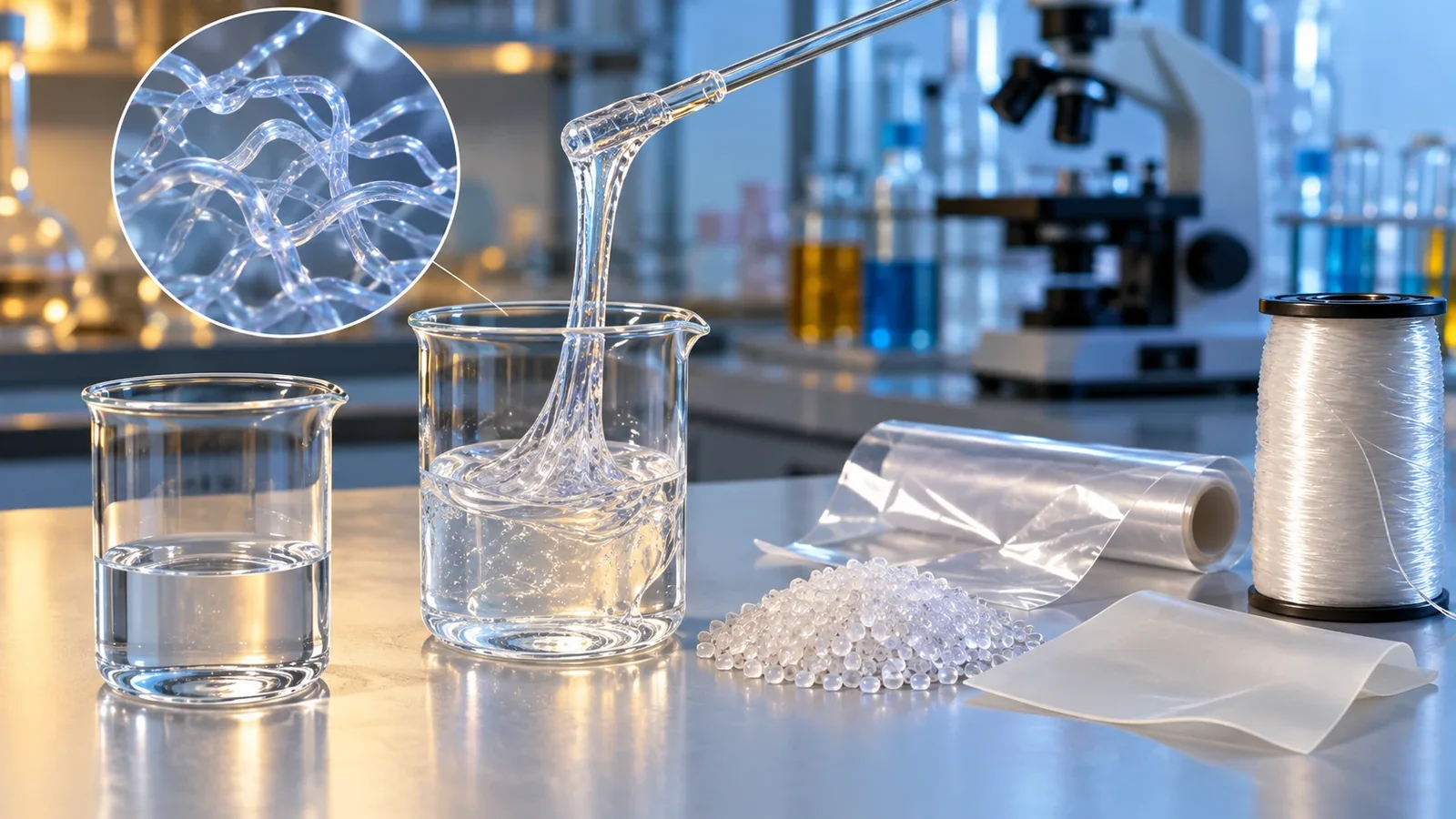
02Flow on heating or cure into a network
Thermoplastics can be softened by heating, shaped and cooled. Thermosetting materials cure to form molecular networks. After curing, they generally cannot be melted and flowed like thermoplastics.
That does not mean a thermoplastic survives unlimited reprocessing without degradation. A thermoset can be compliant, and it is not immune to heat damage. The distinction concerns structure and processing, not a universal ranking of hardness or quality.
Background: [2]
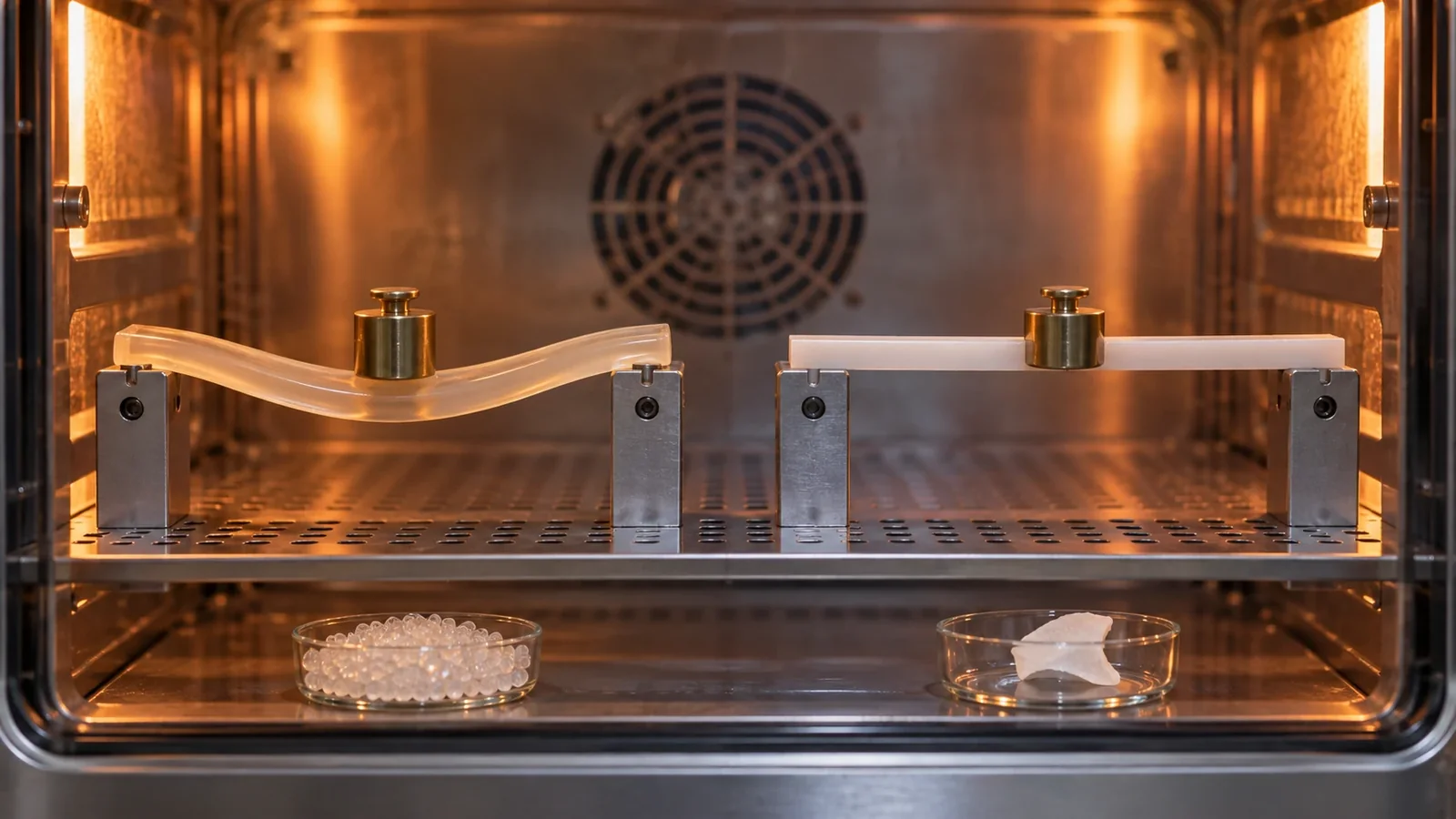
03Heat resistance is not one universal temperature
The glass transition, Tg, describes a change in molecular mobility in amorphous regions, often accompanied by a large change in mechanical response. It differs from crystalline melting, decomposition and a permitted long-term service temperature.
Under sustained load, creep can progressively change shape even without extreme heat. A strong short tensile test does not establish years of dimensional stability. Temperature, time, load, moisture and chemicals belong in the same assessment.
Background: [1]
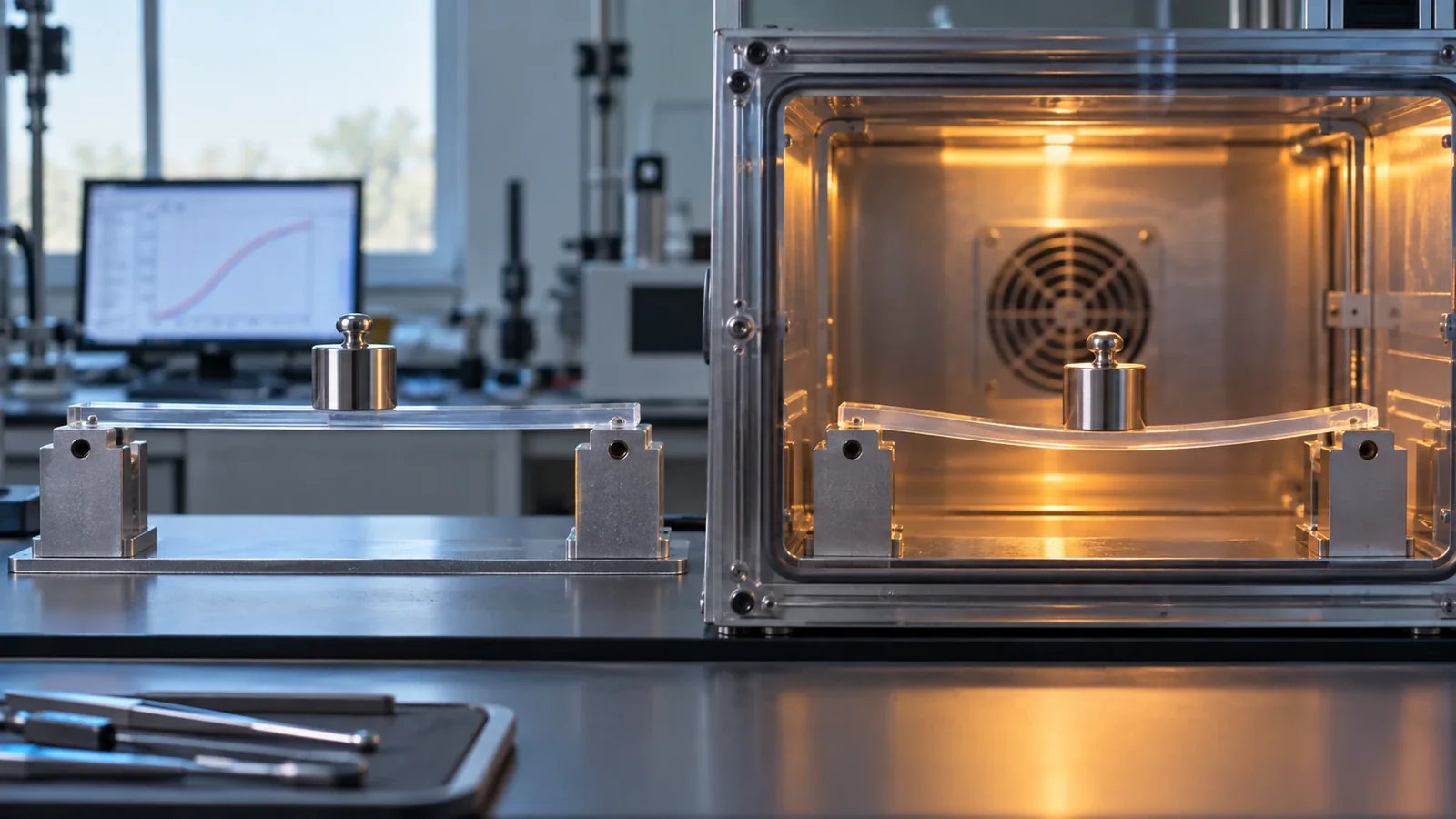
04Processing and formulation change the result
Injection moulding, extrusion, film formation and coating produce different orientations, cooling histories and residual stresses. Fibres create directional properties; powders can alter thermal or electrical behaviour while also changing viscosity.
A thin film and a precision gear need different properties. Interfaces, joining and thermal expansion also affect the product. Define requirements from the application rather than assuming a more prestigious resin name is always better.
Background: [1]
05Keep end-of-life terms separate
Bio-based concerns feedstock origin; biodegradable concerns breakdown under specified conditions. They are not synonyms, and biodegradability never means that littering is acceptable. Check both the conditions and the collection or treatment system.
Recycling requires sorting, cleaning and reprocessing into a usable quality. Additives and multilayer structures can help in service yet complicate recovery. Compare a consistent lifecycle boundary rather than judging environmental performance from low weight alone.
Background: [3]
Connect the ideas in one situation
ILLUSTRATIVE SCENARIO — NOT A PERFORMANCE CLAIM
Suppose a container needs a transparent window
Transparency is only one requirement. Consider impact, contents and cleaning chemicals, dimensional stability under heat, processing, joining and recovery.
Adding fibres for stiffness can change transparency, illustrating why desirable properties cannot simply be added together. Define the application first and compare performance under matching conditions.
Return to the starting idea
Polymers are long molecules. Chain chemistry, arrangement, networks, additives and processing history jointly determine the behaviour of the material.
You do not need to memorize every technology name. Understanding the intended improvement, the mechanism being changed and the conditions needed to demonstrate it gives you a foundation for the detailed articles. Choose one route that matches your question.
Choose your next article
Read a route from top to bottom, or select just the question you need. You do not have to read everything.
Molecules and thermal behaviour
Materials and processing
Recovery and environment
Browse all technical articles in this field (25)
- Resins for 3D Printing
- CFRP and Composite Materials
- PEEK and Super Engineering Plastics
- Underfill and Encapsulants
- Epoxy Resin
- What a Glass Substrate Is
- Glass Transition and Creep
- Chemical Recycling
- Bioplastics
- Barrier Properties and Coatings
- What a Package Substrate Is
- Fluoropolymers and PFAS
- Plastic Recycling (Mechanical Recycling)
- Polyamides (Nylons)
- Polyimide
- Polyurethanes and Elastomers
- Polyesters and PET
- Polyolefins
- Polycarbonate and ABS Resin
- Polymer Basics
- Polymer Blends and Fillers
- Microplastics and Life Cycle Assessment
- Semiconductor Package Molding Why the “black resin” is a structural material
- Thermoplastics and Thermosets
- What the Coefficient of Thermal Expansion Is
Sources and scope
This introductory synthesis connects the existing technical articles. Its grouping and design scenarios are explanatory, not standard classifications or test results. It does not catalogue current records, product availability or approvals, or forecast costs. Foundational references are below; linked articles provide more detailed technical sourcing.
- IUPAC. Glossary of basic terms in polymer science
- IUPAC Gold Book. Thermosetting polymer
- PWMI. Learning resources on plastics and recycling