TROY TECHNICAL · BEGINNER’S GUIDE
READ THIS FIRSTNext-generation energy storage — An Introduction
What must storage support, how much and for how long? Start before choosing a chemistry.
Japanese version →A phone, a vehicle and a large container beside a power plant ask storage to do different jobs. Understanding next-generation storage is not a search for one universally strongest battery. Begin with why energy must be stored, then connect materials, cells and complete systems.
01Amount and delivery rate are different
Energy capacity describes how much is stored, in units such as Wh. Power describes the rate of delivery, in units such as W. Think of water in a tank versus the flow rate through a pipe as a first analogy.
Capacity divided by power gives an idealized duration at constant output. Actual usable range, conversion losses, temperature and ageing change the result. A few seconds of power support and storage through the night need different evaluations.
Background: [2]
02A battery connects material reactions to an external current
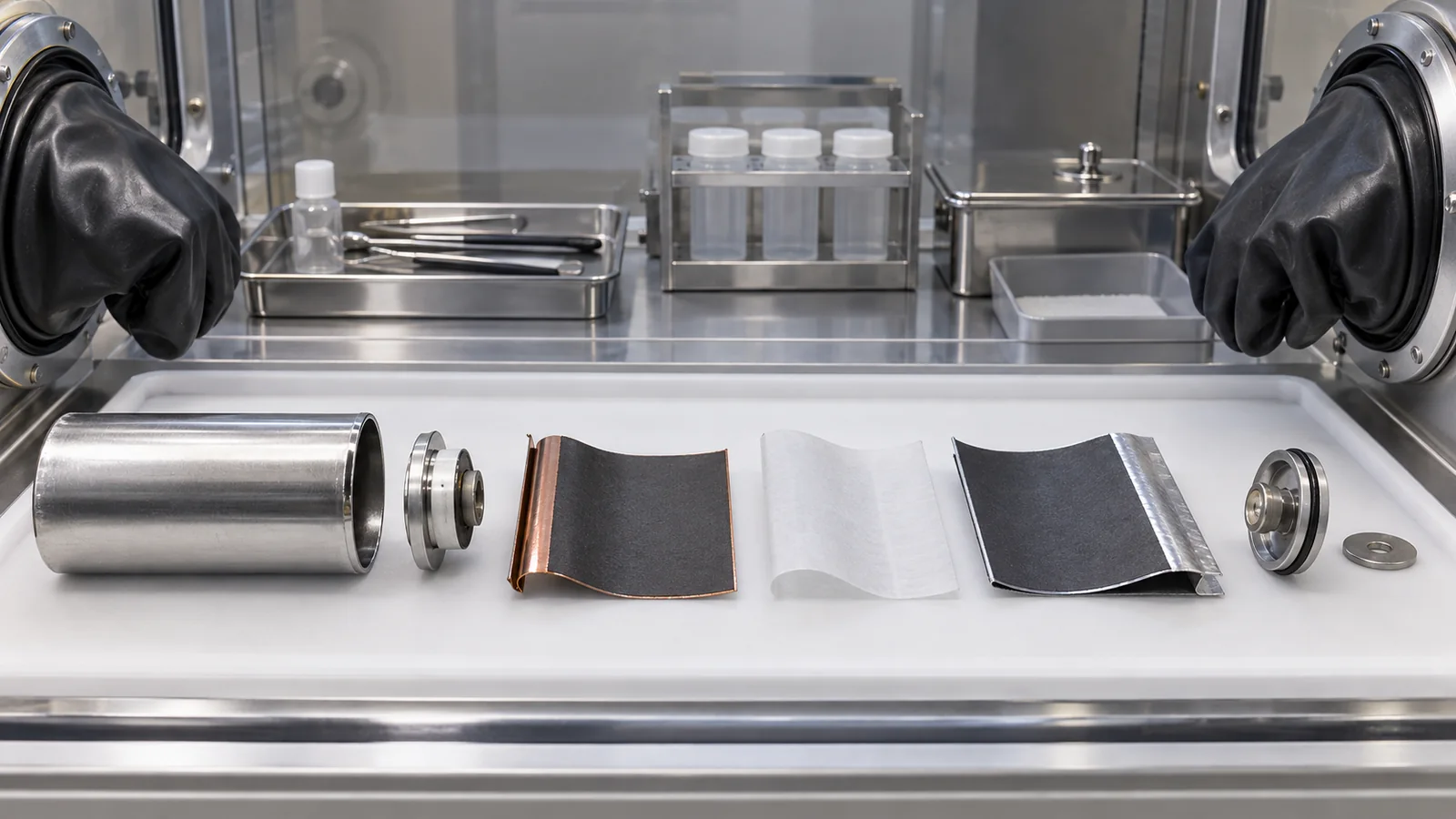
In a rechargeable battery, electrode reactions and ion movement inside the cell are coupled to electrons flowing through an external circuit. Lithium-ion batteries are one family. Positive and negative electrodes, electrolyte and separator perform different jobs, and their combination determines behaviour.
Improving one electrode does not produce an equal percentage improvement in a complete battery. Foils, containers and protection also add mass and volume. Align the comparison boundary: material, cell or pack.
Background: [1]
03Next-generation is not one chemistry
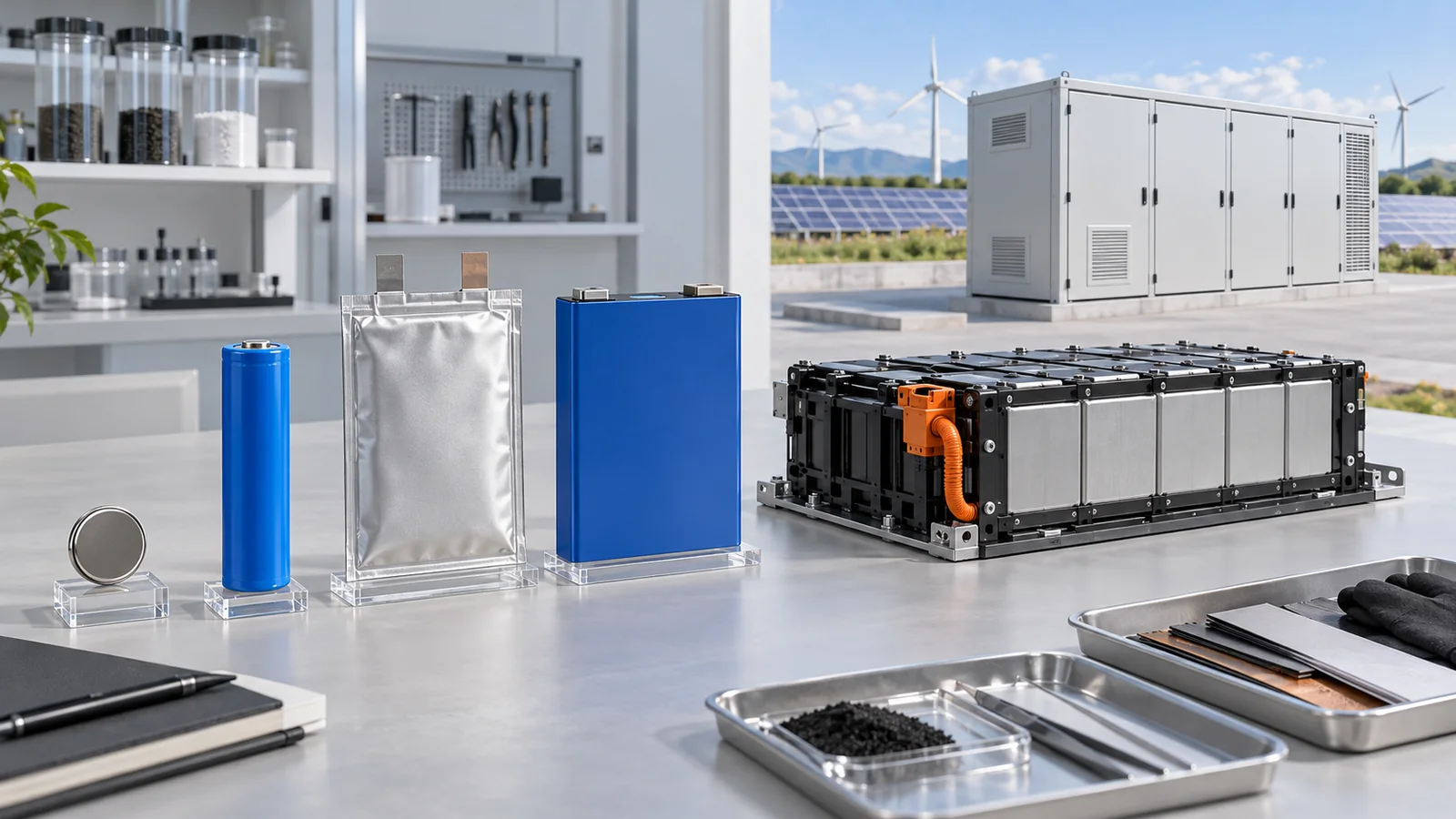
Routes include improving lithium-ion electrodes, using other ions such as sodium, and flow batteries that store reacting liquids in external tanks. All-solid-state describes electrolyte architecture; cylindrical, prismatic and pouch describe cell form. These are different classification levels.
A vehicle prioritizing compact mass and a stationary installation with room for tanks accept different trade-offs. Supply, manufacturing, maintenance and recovery matter too. A new approach need not eliminate every established one.
Background: [2]
04A storage installation also needs controls and converters
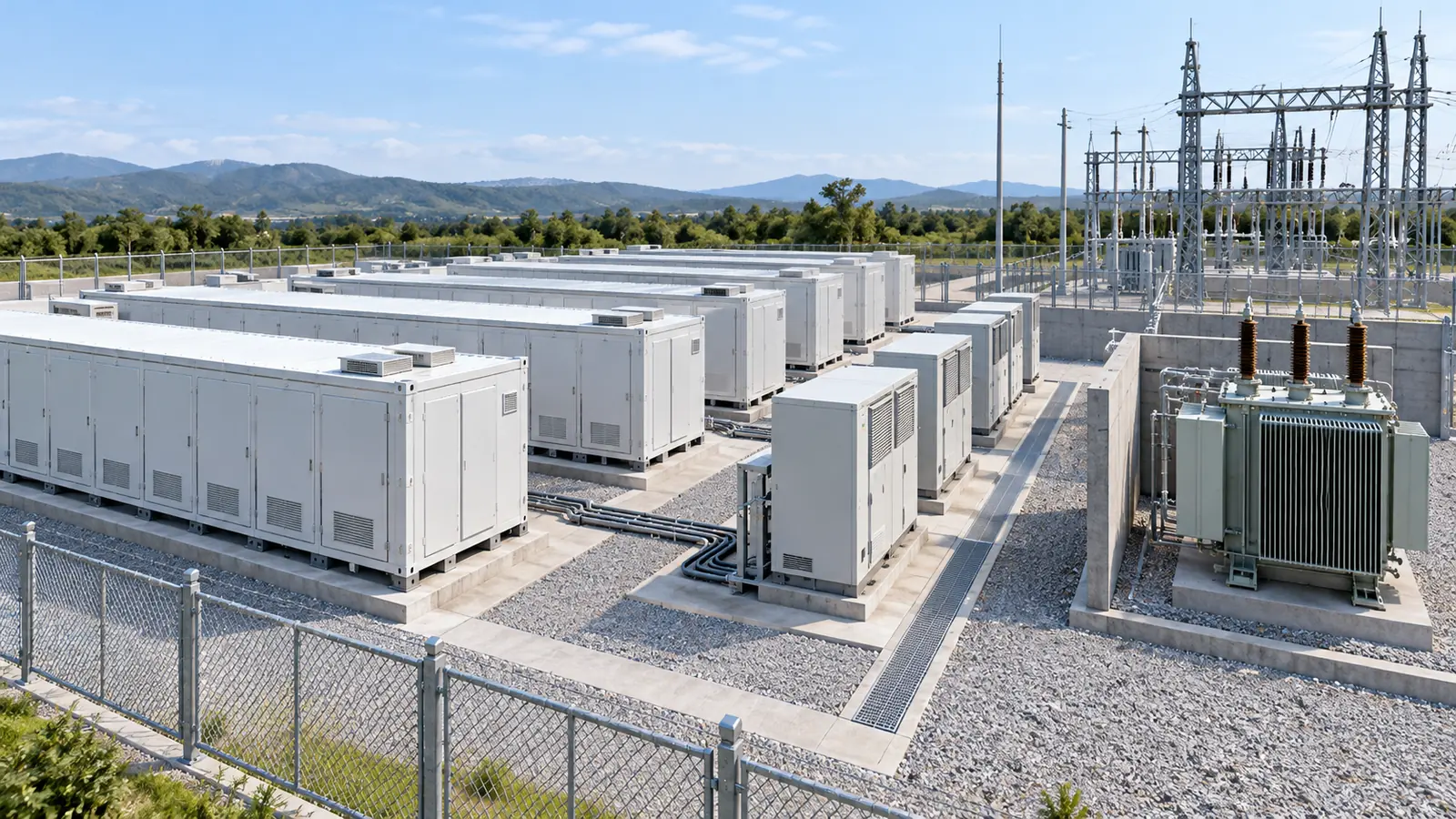
Combining many cells creates differences in temperature and state of charge. A battery management system, or BMS, monitors conditions and helps enforce operating limits. Grid installations also need power conversion and protection.
Smoothing renewable generation, providing backup and shifting demand require different durations and powers. Look beyond the batteries inside a container to the connection and operating strategy of the complete installation.
Background: [3]
05Compare lifetime, safety and cost under matching conditions
Lifetime is not determined by cycle count alone. Depth of cycling, temperature, rate and time spent in storage all matter. Safety depends on more than chemistry: fault detection, cooling, propagation control, installation and operation contribute.
Cost extends beyond cell purchase to conversion equipment, installation, losses, replacements and end of life. Define the service first, then compare candidates meeting its conditions. This keeps a material record from being mistaken for a proven system benefit.
Background: [2]
Connect the ideas in one situation
ILLUSTRATIVE SCENARIO — NOT A PERFORMANCE CLAIM
Suppose daytime solar energy is needed at night
Define the required night-time power and duration, then examine daytime surplus. Size capacity and conversion equipment with charging and discharging losses included. A larger battery does not automatically solve a prolonged period of low generation.
Test operation against time-varying generation and demand. A capacity number and an energy service are different things.
Return to the starting idea
Storage shifts energy in time and shapes power delivery; it does not create energy. Match capacity, power, lifetime, safety and system cost to the application.
You do not need to memorize every technology name. Understanding the intended improvement, the mechanism being changed and the conditions needed to demonstrate it gives you a foundation for the detailed articles. Choose one route that matches your question.
Choose your next article
Read a route from top to bottom, or select just the question you need. You do not have to read everything.
Cells and materials
Compare approaches
Systems and operation
Browse all technical articles in this field (33)
- SEI, the Solid Electrolyte Interphase
- Carbon Nanotubes
- Silicon Anodes and Nanostructured Electrodes
- Supercapacitors
- Cell Formats and Cell-to-Pack
- What a Lithium Dendrite Is
- Data Centers and Energy Storage
- Dry Electrodes
- Sodium-Ion Batteries
- Hard-Carbon Anodes
- Lithium-Ion Battery Fundamentals
- Lithium-Sulfur Batteries
- Lithium Metal Anodes and Anode-Free Cells
- Redox Flow Batteries
- Virtual Power Plants and Distributed Energy Resources
- Conductive Additives and Binders
- Next-Generation Battery Chemistries Compared
- Cathode Materials
- Thermal Runaway and Battery Safety
- Grid-Scale Battery Energy Storage Systems
- The Economics of Energy Storage
- Automotive Silicones and Encapsulants
- Long-Duration Storage (Iron-Air and Zinc-Based)
- Power Grids and Renewables
- Electrode Manufacturing
- Battery Evaluation and Degradation
- Battery Recycling and Second Use
- Battery Material Resources and Sourcing
- Battery Management Systems (BMS)
- The EU Batteries Regulation and the Battery Passport
- Electrolytes and Separators
- Thermally Conductive Pastes and Gap Fillers
- Graphite Anodes and Electrode Design
Sources and scope
This introductory synthesis connects the existing technical articles. Its grouping and design scenarios are explanatory, not standard classifications or test results. It does not catalogue current records, product availability or approvals, or forecast costs. Foundational references are below; linked articles provide more detailed technical sourcing.
- US DOE. DOE Explains: Batteries
- Sandia / US DOE. An Introduction to Energy Storage
- US DOE. Lithium-Ion Batteries for Stationary Energy Storage