TROY TECHNICAL · BEGINNER’S GUIDE
READ THIS FIRSTFunctional materials — An Introduction
Understand a material by what it receives and what change it produces.
Japanese version →Pressure can produce electrical charge; voltage can change colour; a material can store heat or block moisture. Functional materials span too many families to understand by memorizing names. A clearer map asks what enters, what changes and what useful job that change performs.
01Use four verbs to organize the field
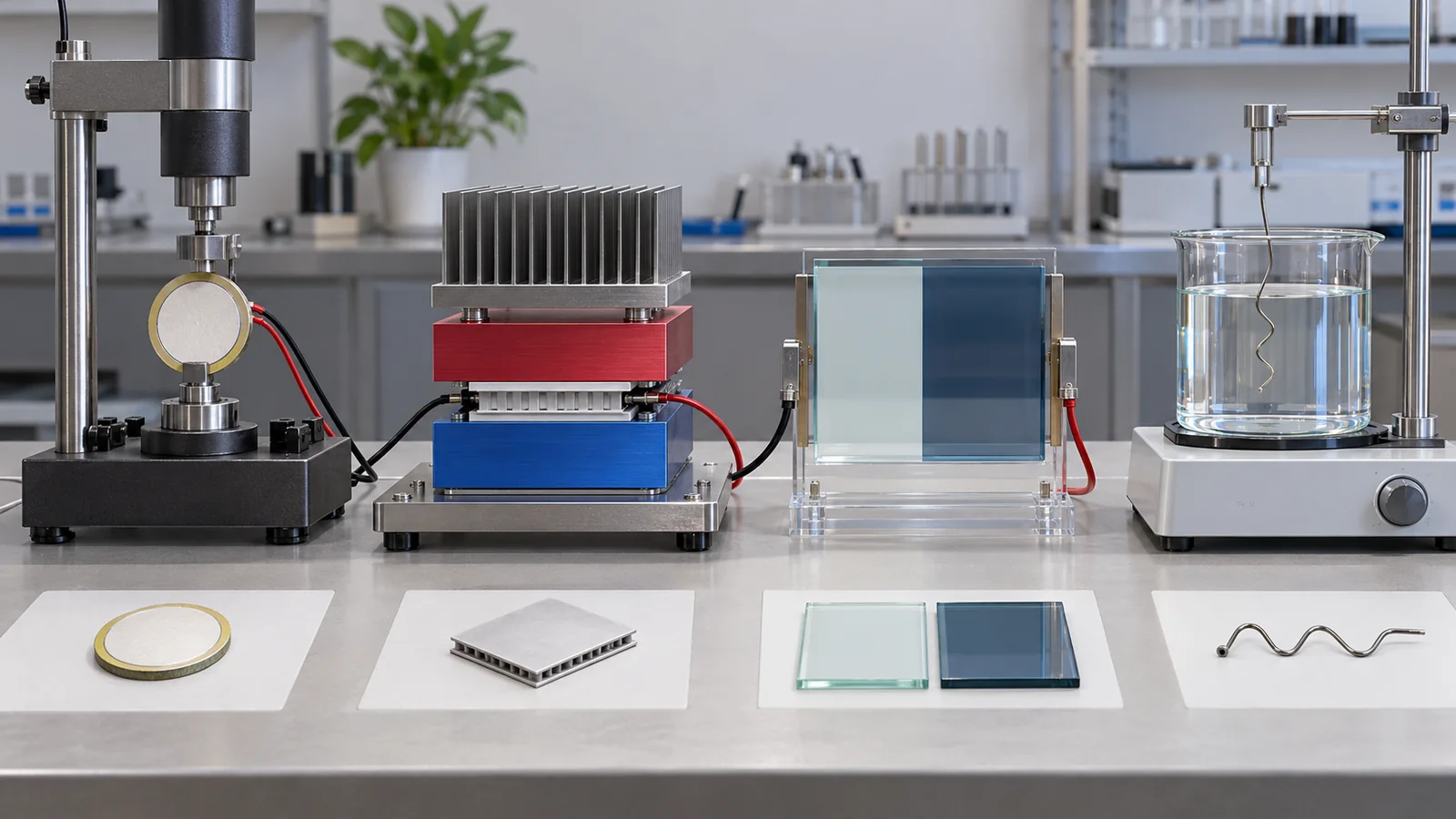
Start with four groups of actions: pass or block; convert; move or change; store. Transparent electrodes pass light while carrying current; barriers limit transport. Thermoelectrics connect temperature differences and electricity, while piezoelectrics connect force and charge. Shape-memory materials change shape under suitable conditions, and phase-change materials can store thermal energy.
These are reading aids, not mutually exclusive scientific classes. One material can perform several roles. Defining the job first makes the range easier to navigate.
02A material property is several steps away from a product
A thermally conductive material cannot remove heat from a component if contact is poor. A favourable energy-conversion property does not guarantee useful device output when electrodes or heat flow are unsuitable.
Follow microstructure, material property, component function and system role. Crystals, pores, grains and surface patterns are ways to influence behaviour. This explains overlap with nanotechnology and polymers: the useful connections matter more than rigid field boundaries.
03Account for inputs and outputs
Electricity harvested from vibration comes from the mechanical energy of that vibration. Thermoelectric generation needs a maintained temperature difference. An actuator must be judged by displacement, force, response time and repeated operation, not movement alone.
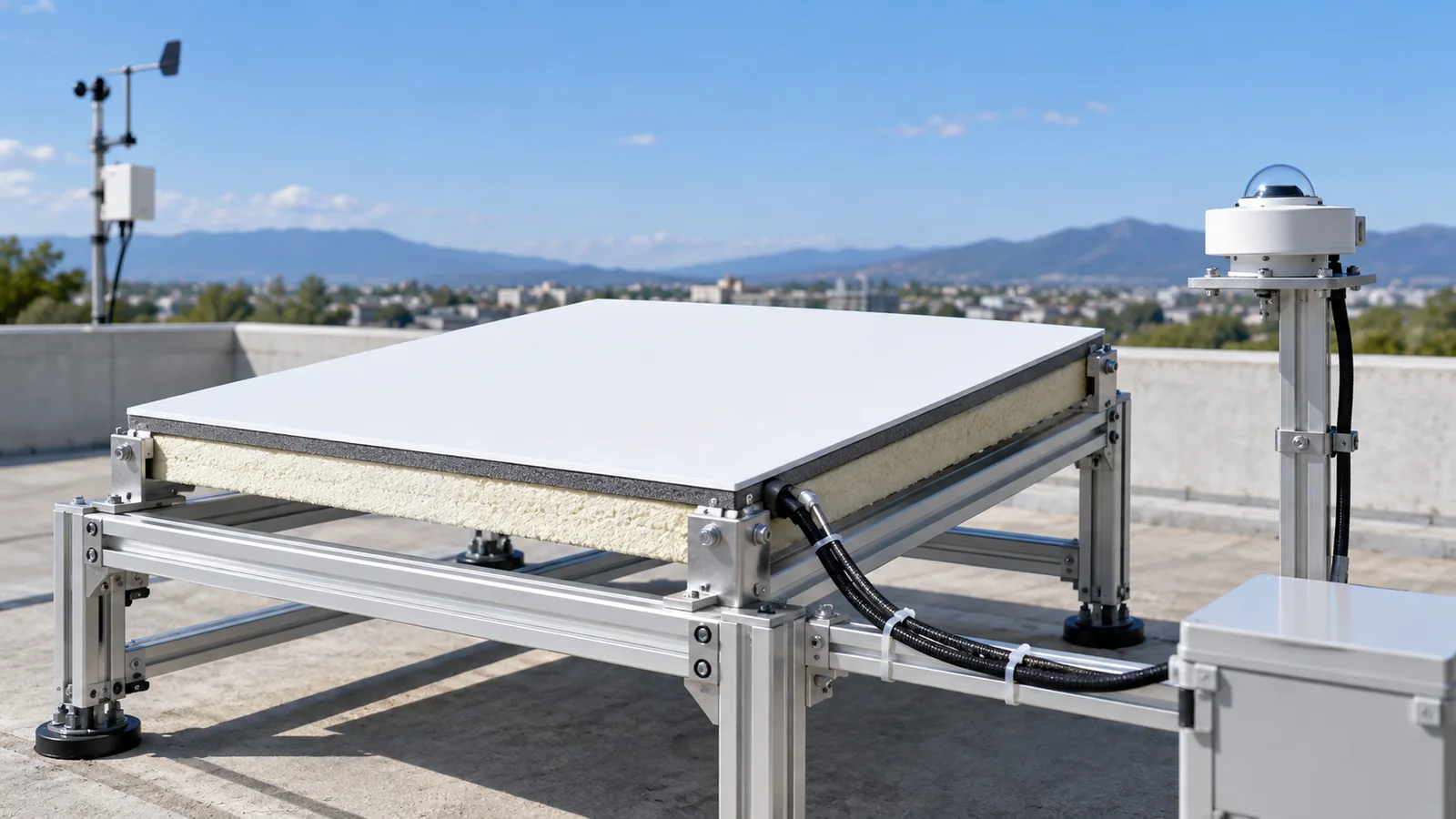
Radiative cooling uses infrared heat emission. Solar reflection, the view of the sky, atmosphere, clouds and other heat exchanges affect the result. A material label cannot guarantee cooling in every environment.
04Improving one property can change another
Adding conductive filler can change weight, transparency, compliance and processability. A magnet needs evaluation of temperature stability, corrosion and material supply as well as magnetic strength. A thin optical component has wavelength, angle and manufacturing-area constraints.
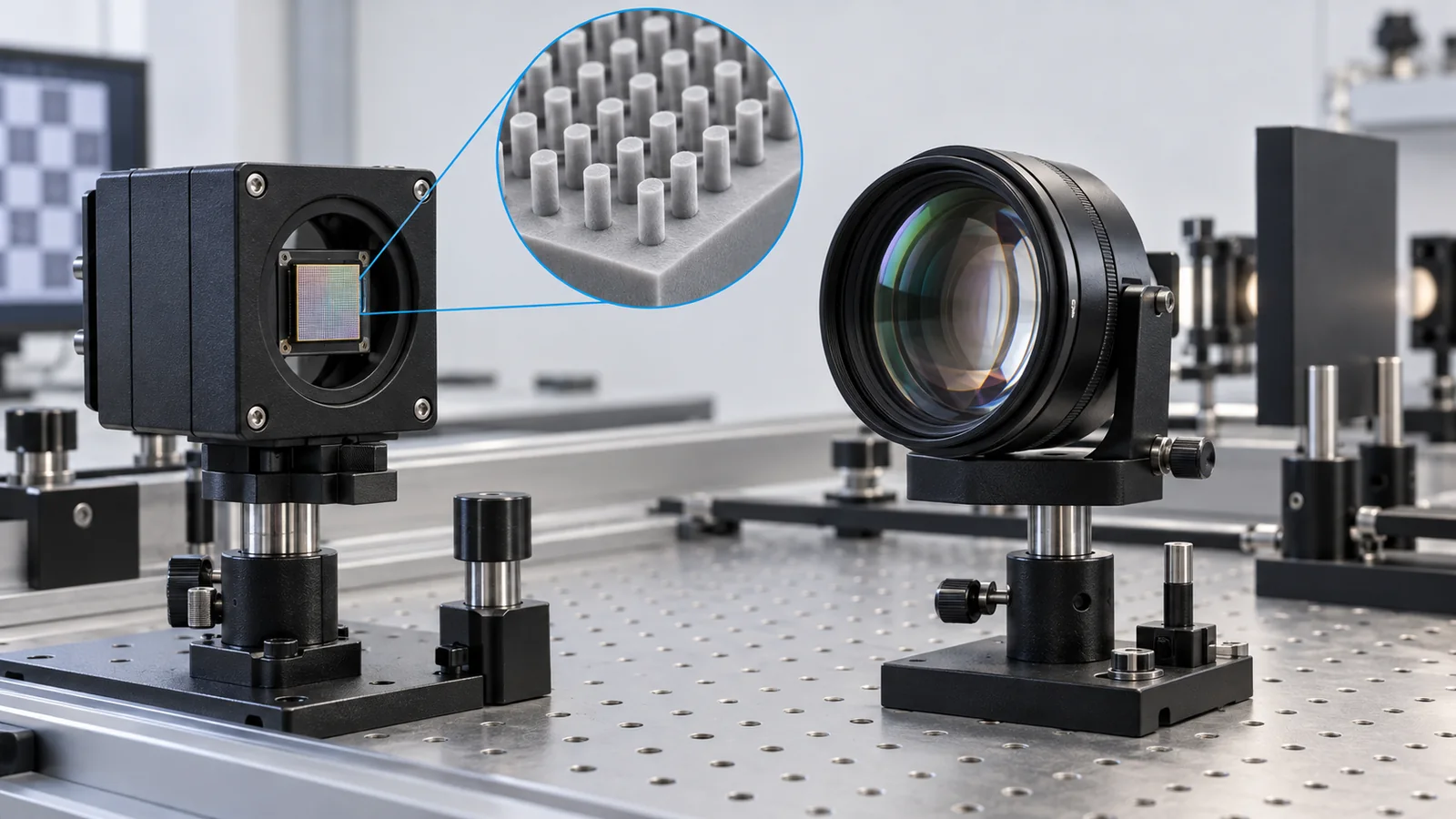
A metalens uses small structures to control light. Thinness can be valuable, but it does not mean every conventional lens can be replaced without redesign. Check each requirement imposed by the surrounding device.
Background: [3]
05Align conditions before comparing values
Temperature, sample geometry, direction, frequency and humidity can all change a measured property. An initial response differs from behaviour after repeated use. Do not compare a material value directly with component performance or whole-system efficiency.
Choose a problem before choosing a material family. The routes below start with optical, thermal, electrical or mechanical functions, then lead to the relevant materials and evaluation questions.
Connect the ideas in one situation
ILLUSTRATIVE SCENARIO — NOT A PERFORMANCE CLAIM
Suppose a window should change its glare
An electrically switchable material still needs transparent electrodes, power, control and sealing. A colour change and improved comfort or building energy use are different levels of evidence.
Assess switching time, appearance, cycling and installation conditions. Connecting a material response to a product-level job is the recurring task across functional materials.
Return to the starting idea
Function is useful behaviour under operating conditions, not just an impressive material value. Connect structure, properties, components and systems one step at a time.
You do not need to memorize every technology name. Understanding the intended improvement, the mechanism being changed and the conditions needed to demonstrate it gives you a foundation for the detailed articles. Choose one route that matches your question.
Choose your next article
Read a route from top to bottom, or select just the question you need. You do not have to read everything.
Functions and evaluation
Control light and heat
Movement, protection and materials
Browse all technical articles in this field (35)
- Resins for 3D Printing
- MXenes and Nanosheets
- Energy Harvesting
- Electrochromic Materials and Smart Windows
- Carbon Nanotubes
- Graphene
- Spintronic Materials
- Smart Textiles and Wearable Materials
- Soft Actuators and Artificial Muscles
- Nanocoatings and Thin Films
- Hydrogels and Aerogels
- Barrier Properties and Coatings
- Polyurethanes and Elastomers
- Metamaterials and Metasurfaces
- Metalenses and Flat Optics
- Rare-Earth-Free Magnets
- Titanium Dioxide and Photocatalysis
- Piezoelectric Materials and Lead-Free Alternatives
- Conductive Polymers and Ionic Conductors
- Ferroelectric and Dielectric Materials
- Shape Memory Polymers and Liquid Crystal Elastomers
- Shape Memory Alloys
- Antimicrobial and Anti-Corrosion Coatings
- Functional Materials
- Permanent Magnets and Rare Earths
- Thermal Management Materials and Radiative Cooling
- Thermoelectric Materials
- Phase Change Materials and Thermal Storage
- Magnetocaloric Effect and Magnetic Refrigeration
- Self-Healing Materials and Vitrimers
- Superhydrophobic, Anti-Icing and Anti-Fouling Coatings
- Transparent Conductive Oxides (ITO, IZO, FTO)
- Metal-Organic Frameworks (MOFs)
- High-Entropy Alloys
- High-Entropy Oxides and Ceramics
Sources and scope
This introductory synthesis connects the existing technical articles. Its grouping and design scenarios are explanatory, not standard classifications or test results. It does not catalogue current records, product availability or approvals, or forecast costs. Foundational references are below; linked articles provide more detailed technical sourcing.