FIRST READ · A BUSINESS-ORIENTED INTRODUCTION
Read First: The Space Industry Today and Its Future
From rockets to paying customers: what creates a business, and which conditions shape its future?
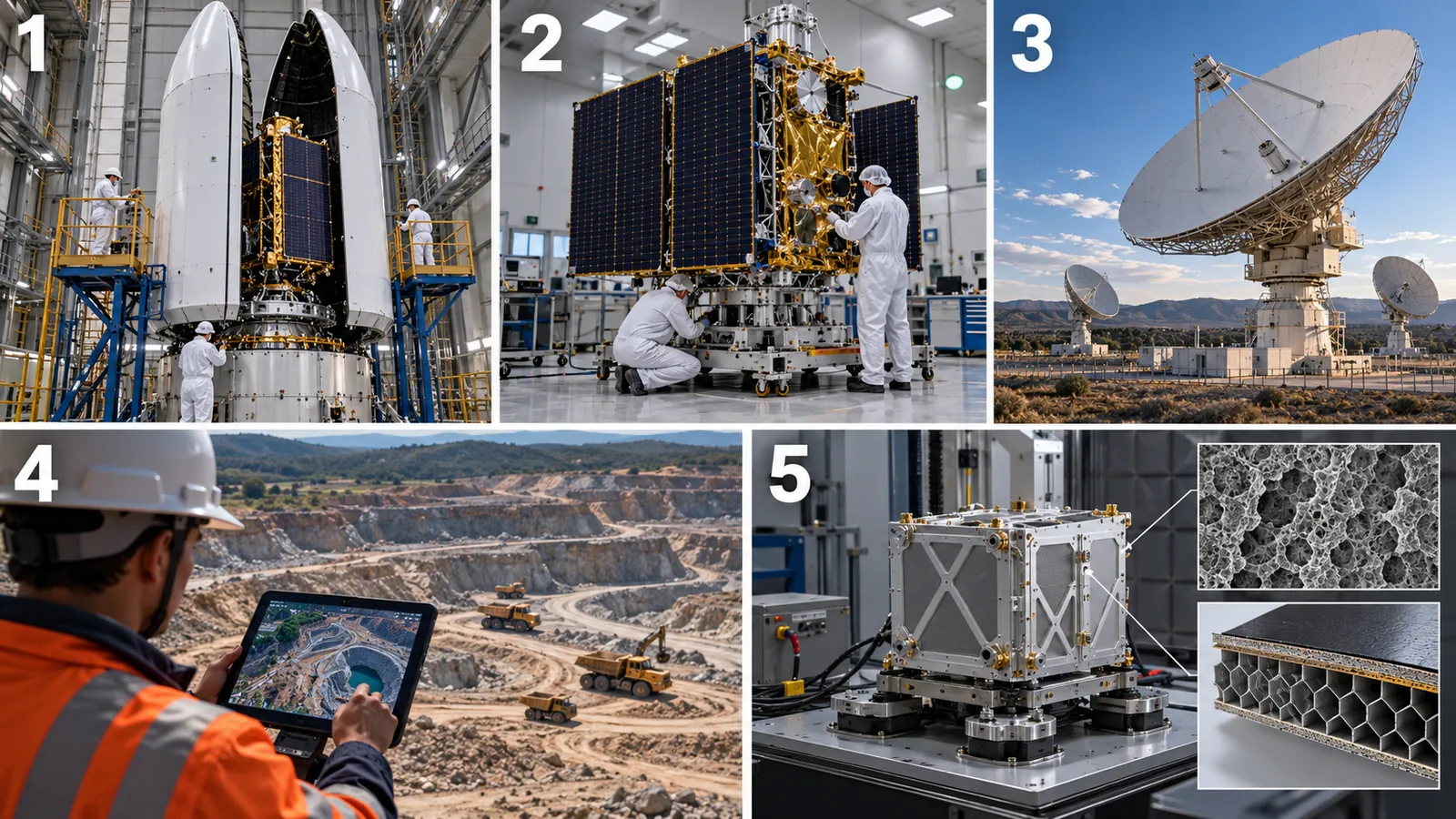
The space industry is not just rocket manufacturing. Transport, spacecraft production and operation, and useful services on Earth form a connected business system. Ask whose problem is solved, who pays, and whether delivery can be repeated.
More satellites or launches do not necessarily mean more profit for an individual company. A working technology and a sustainable business using it are different achievements.
1. Start with the customer on Earth
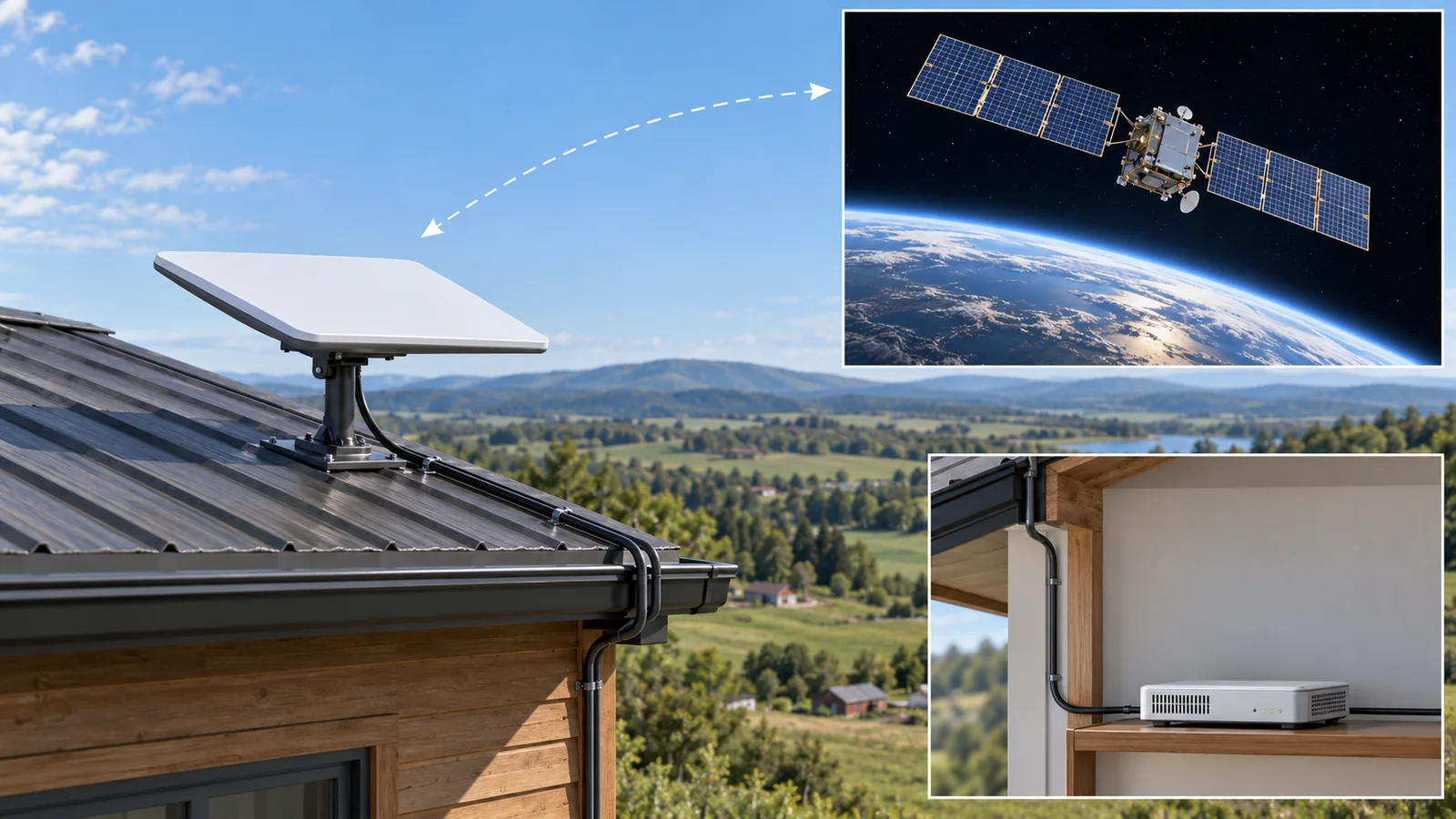
Imagine a remote construction site needing internet access. Its customer wants reliable working communications, not ownership of a satellite. Payments support terminals and service provision, spacecraft operation, hardware and components, and launch services. One company may perform several of these roles.
Flood assessment offers another example. Delivering observations can create value, but interpreting them and fitting the results into a customer’s maps and workflow may matter just as much. ESA’s Sentinel-1 is a real radar mission intended for day-and-night, all-weather surface imaging. All-weather does not mean seeing through every material. [3]
Our analysis: customers assess ease of use, delivery when needed and value compared with alternatives. Where public or free observations are available, a paid service needs to explain the additional information or processing it provides.
2. What is sold, and who pays?
This is an editorial framework, not a ranking by market size. SIA’s survey distinguishes satellite services, manufacturing, ground equipment and launch. Company accounts and contracts do not necessarily map one-to-one onto these categories. [1]
| Activity | Example of customer and deliverable | Business question |
|---|---|---|
| Transport to space | Operators or governments buy delivery to an intended orbit. | Can flights happen on time, and how many can be contracted and delivered each year? |
| Hardware and components | Manufacturers or operators buy spacecraft, power systems, materials and testing. | Is this a prototype selection or repeat order? Who funds development, testing and assurance? |
| Use space capabilities | Users, public bodies and businesses buy connectivity, data, analysis or operation. | Who actually pays, and do they renew? |
| New activities in space | Researchers and businesses buy experiments, manufacturing opportunities, stays or servicing. | Is the demonstration sponsor also a future buyer of the product? |
Governments can be customers and development sponsors as well as regulators. Grants, research contracts, product sales, profit and investment funding are different. Programme selection does not by itself demonstrate repeat purchases by commercial customers.
3. Established activities coexist with the next generation of businesses
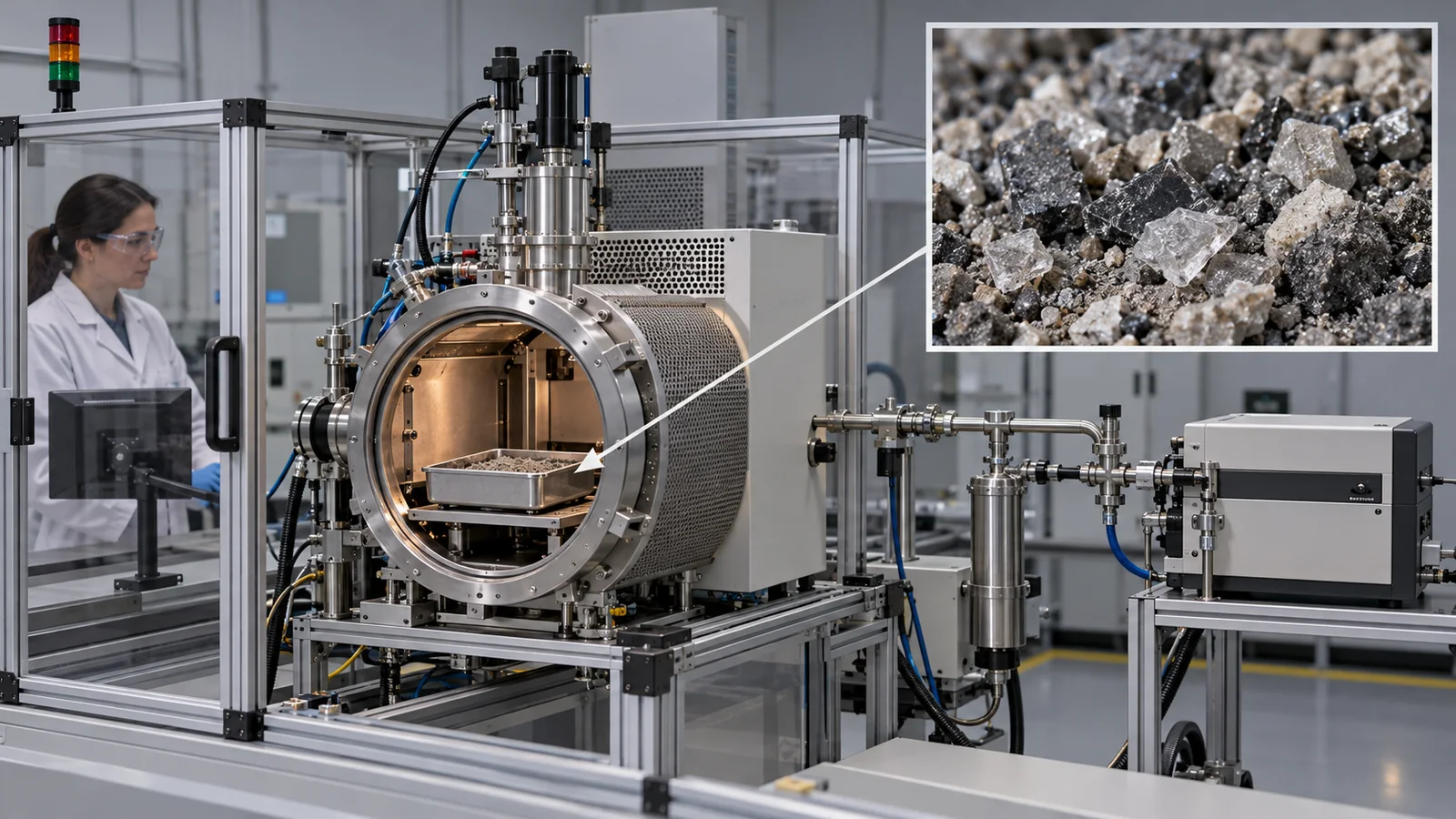
Begin with communications, observation, manufacturing and transport, then explore commercial stations, in-space production, large orbital computing systems and lunar resources. Experiments and development contracts can generate business in the latter areas without proving the size or profitability of an eventual end market.
- NASA describes developing and buying services within a commercial low-orbit economy as a policy objective, not a guarantee of success for every private venture. [4]
- NASA issued its final commercial-space-station solicitation on 9 October 2026. The release gives 8 December as the proposal deadline and expects awards in spring 2027. A published solicitation is not a completed contract award. [5]
- JAXA’s Space Strategy Fund supports multi-year technology development across transportation, satellites and exploration. Specific calls, selections and contracts still need to be connected to actual customers. [6]
Our analysis: services linked to existing needs on Earth, together with their manufacturing, operational and test supply chains, are a useful baseline for understanding the industry. New demand within space offers further opportunities, but should not automatically be treated as an established high-volume market.
4. When do reuse and smaller satellites reduce costs?
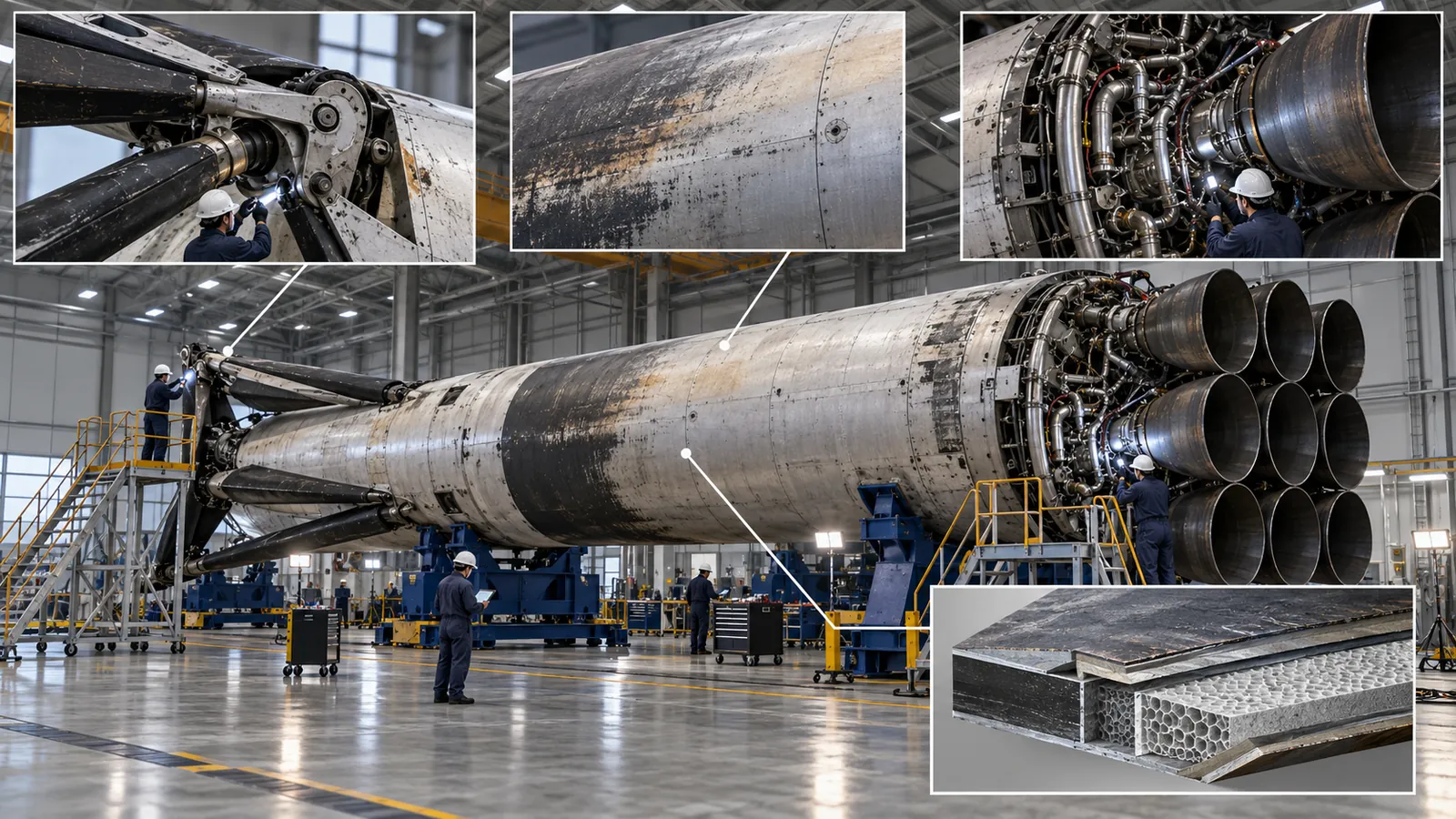
Recovering a rocket stage creates the possibility of using it again. Recovery equipment and propellant, inspection, refurbishment, transport and ground facilities also cost money. Successful recovery, rapid reuse and enough paying flights are separate conditions. This is a business reasoning framework, not an estimate of any operator’s costs.
A cheap small satellite may still require frequent replacement. Include replacement manufacturing, launch and operation in the business model. A launch price or peak communication speed alone does not tell you the cost of serving a customer.
Annual revenue can be approximated as paying users multiplied by average annual revenue per user. Expenditure also includes replacement spacecraft, launches, ground stations, terminals, operation, sales and support. Growing revenue does not ensure growing cash if replenishment and investment require even more spending. Accounting profit is not the same as cash flow.
For observation services, ask whether useful information reaches the required location and time. High image resolution alone does not establish the value of a recurring customer contract.
5. Read the future as three conditional scenarios
The following scenarios are our analysis, not a forecaster’s market projection or calculated probabilities. Rather than promise a market size or year, they identify conditions that would change the outlook.
| Scenario | Conditions | Evidence to watch first |
|---|---|---|
| More applications on Earth | Connectivity and observation become useful parts of existing workflows at acceptable cost. | Paid renewals after trials, delivery quality and stable service. |
| New demand within space | Reliable transport, power and return support products or services that customers prefer to terrestrial alternatives. | Repeated results, agreed quality and actual purchases or follow-on orders. |
| Delays and commercial selection | Failures, delays, permissions, funding constraints or weak demand and pricing combine. | Late payments, changed plans, customer concentration, replenishment costs and dependence on the next financing round. |
In-space production needs more than a successful experiment: consider quality during transport, post-return inspection, customer requirements and end-to-end cost. Lunar resources raise distinct questions: does the resource exist, can it be extracted and delivered, and who will buy it? Also distinguish replacing an Earth-based activity from creating something useful only in space.
6. Entry points for materials, component and equipment engineers
You do not need to build an entire rocket. Lightweight structures, joining, wire insulation, solar cells, batteries, heat rejection, electronics and inspection offer possible connections. However, a good terrestrial material is not automatically suitable for a spacecraft.
An adhesive may need evaluation of released material depositing on an optical surface, as well as strength and temperature cycling with its substrates. Electronics selection combines performance with radiation effects and system-level protection. Continue with The Space Environment and Its Effects on Materials — the "five enemies", by low Earth orbit, geostationary orbit and the lunar surface and Radiation and Electronic Components — kinds of space radiation, TID and SEE, how parts are tested, and the guidance (ECSS, JEDEC, ESCC) for the engineering conditions.
Our business perspective: coupon data, component evaluation and spacecraft-level evaluation are different. Separate the development and test costs needed for selection from the subsequent obligations for lot traceability, change control and long-term supply. High unit prices alone do not establish an attractive business.
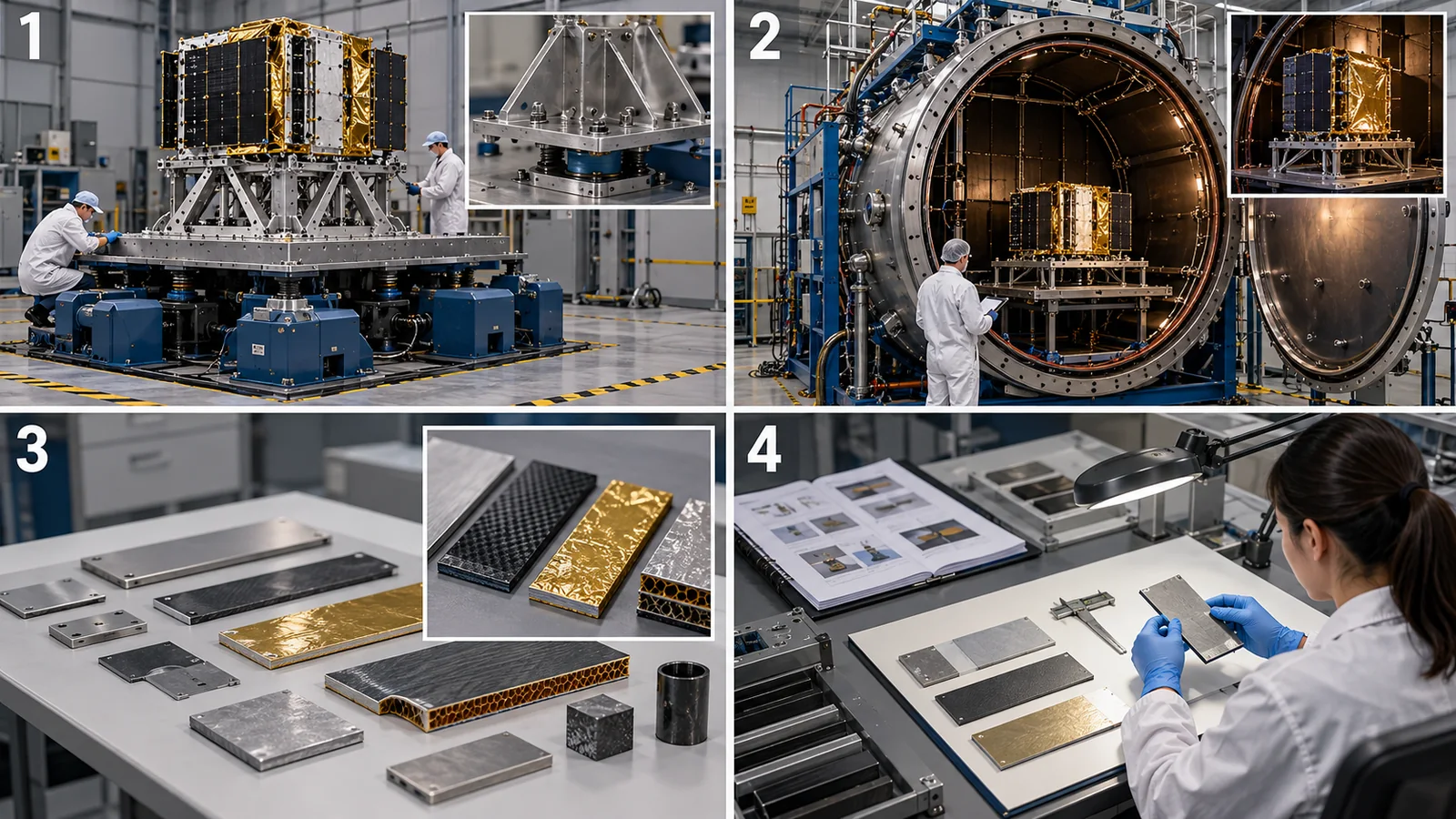
7. Reading evaluations and standards: the label “space-grade” is not enough
ECSS is a system of standards for space projects, addressing customer–supplier application and requirements. [7] For a beginner, the following reading sequence is more useful than relying on a standard number alone.
- Where and for how long? Low Earth orbit, deep space and the lunar surface have different mission assumptions.
- What was tested? A material coupon, a processed part or a representative assembly?
- Under which conditions? Read temperature, vacuum, irradiation, vibration, duration and combinations.
- What counted as passing? Retaining performance and simply surviving are different. Check sample count, variability and the failure modes the test can detect.
- Who accepted compliance with which requirements? Match the standard revision, contractual scope, tailored conditions and supporting evidence.
This sequence is our learning framework. Passing one test, acceptance on one project and assurance for every space application are not equivalent. See How to Read Evaluations of Space Materials — the yardsticks of outgassing, thermal vacuum, radiation and atomic oxygen, and where the standards fit for more detail.
Technical standards and legal permission are also distinct. FAA describes US launch, reentry and site authorizations; these do not by themselves cover every country’s spectrum, data or export requirements. Identify the relevant authority and scope for the particular activity. [8]
8. How to read a “large market” or an “order secured”
Match geography, reference year, currency, included activities and method before comparing market figures. SIA’s satellite-industry survey and BEA’s measurement of US space-related economic contributions are not the same statistic. BEA separates GDP from gross output; its current page links estimates for 2012–2023 and carries a March 2026 notice ending regular production. An old reference year must not be presented as today’s market size. [1][2]
Adding component, spacecraft and service revenues can count intermediate transactions more than once. Market revenue, economic impact, company sales and market capitalization should not be treated as interchangeable measures.
Concept or memorandum of understanding; selection for development or demonstration; contract or purchase order; delivery and acceptance; repeat purchase. Progress through these stages is not guaranteed, and a contract ceiling is not necessarily secured revenue. Restate what is confirmed and what remains conditional.
9. Where to read next
You do not need to read everything in order. Pair one application with the engineering topics that make it possible.
Value for users on Earth
Low-Earth-orbit constellations — Why many satellites are flown in low orbit, how orbits and frequencies are authorised, and what happens at end of life / Satellite remote sensing and SAR — How optical imaging and synthetic aperture radar work, how resolution is defined, and the antennas and materials / Inter-satellite optical communication — How lasers link satellites, and the materials, parts and standards behind them / Orbital computing — Processing data in space: what has been shown, and what is still a concept / Edge AI and On-Device AI — before asking "how many TOPS", ask "how many GB of memory and how many GB/s of bandwidth" / Quantum Key Distribution and Quantum Communication — what "sharing a key safely" means, and how far a key made from light can be trusted
Transport and return
Rocket Basics — the rocket equation, made easy with figures and numerical examples / Rocket Engines and Propellants — Liquid, solid and hybrid; kerosene, methane and hydrogen; and the copper alloys and superalloys inside / Reusable Rockets — ways of recovery, what changes and what does not, the track record and the challenge of refurbishment / Electric Propulsion — A small push applied for a long time: getting far on little propellant, and the materials inside ion and Hall thrusters / Thermal Protection Systems — Ablators, ceramic tiles and heat-resistant composites that carry vehicles through re-entry / Liquid Hydrogen — insulation and materials for moving and storing a 20 K liquid
A working spacecraft
Satellite Structures and Small Satellites — Bus and payload, how CubeSats think, and what decides the frame's materials / Solar Cells for Space — how to read "30% efficiency", radiation damage, deployable panels, and where new materials stand / Batteries for Space — sizing a battery to carry the eclipse, effects of vacuum and temperature, safety, and where solid-state and other next-generation cells stand / Spacecraft Thermal Control — In vacuum heat leaves only by radiation: how paint, insulation, radiators and heat pipes keep temperatures in range / Radiation and Electronic Components — kinds of space radiation, TID and SEE, how parts are tested, and the guidance (ECSS, JEDEC, ESCC) / Space-Grade Semiconductors and COTS — how to think about radiation-hardened and commercial parts, the promise and challenges of SiC and GaN, and computers that run in space
Materials and manufacturing
The Space Environment and Its Effects on Materials — the "five enemies", by low Earth orbit, geostationary orbit and the lunar surface / How to Read Evaluations of Space Materials — the yardsticks of outgassing, thermal vacuum, radiation and atomic oxygen, and where the standards fit / Lightweight Structural Materials — Aluminum-lithium, titanium and magnesium alloys that lighten rockets and spacecraft / CFRP and Composite Materials for Space — Where carbon-fiber composites are used on rockets and satellites, and what troubles them / Super Engineering Plastics for Space — What PEEK-class plastics are good and bad at in light structures, insulation and wiring / Polyimides for Space — How the gold-colored film holds up against vacuum, oxygen atoms and radiation / Additive Manufacturing for Space — Rocket-engine parts, satellite parts and printing in orbit: how far has it come?
Emerging business areas
In-orbit servicing and space debris — Life extension, refuelling and debris removal, the state of debris, and mitigation guidelines / In-Space Manufacturing and Microgravity — Starting from "it is not zero gravity," and reading the ZBLAN fiber, semiconductor crystal and alloy research / Microgravity Drug Research and Protein Crystallization — How far experiments growing crystals in space have been confirmed, and where the "not yet" begins / Lunar Exploration and Artemis — Half a century after Apollo: what has been achieved, and where the "plan" begins (checked 17 October 2026) / Lunar Resources and ISRU — What can be obtained from lunar "soil" and "water ice," and how far has it been proven / Nuclear Power for Space — how an RTG works, how its output fades, plans for fission reactors, and how to read safety rules and launch approval
Context and adjacent technologies
Introduction to the Space Industry — from "falling sideways" to how the industry is built and what materials do in it / National Space Strategies and Regulation — How to read "a space budget of X billion," "licensing" and "export control" (US, Europe, Japan, China, India and the international treaties) / Flexible Perovskite Solar Cells — light weight, paid for with limits on temperature and bending / Lithium-Ion Battery Fundamentals — six cell components, and how to read the denominator of “Wh/kg” / Thermal Management Materials and Radiative Cooling — passing, blocking, switching and sending heat to the sky, read through phonons and light / Thermal Runaway and Battery Safety — a cell that resists fire and a system that stops fire spreading are two different things / Thermoelectric Materials — what lies between the single number "ZT" and the efficiency of a real device / Shape Memory Alloys — transformation temperatures are numbers about how an alloy was made and measured, not numbers about "the material" / High-Entropy Alloys — how far "stabilised by entropy" can be said, and reading values with composition, processing and test temperature
Explore companies and institutions
Mitsubishi Heavy Industries (space business) – The prime contractor for Japan's flagship H3 rocket, still flying after two failures that have been examined in official reports / SpaceX Reusable rockets pushed up its launch count, it listed in 2026, and Starship has reached its first orbital flight / Rocket Lab Growing on its small Electron rocket and satellite parts, while the first flight of the medium-lift Neutron has slipped to 2027 / Synspective Selling data from small radar satellites that see the ground through clouds and at night. A growth stage in which investment and subsidies outweigh sales / Astroscale A company that has flown close to real space junk, and now seeks repeat orders for life extension, refuelling and removal / Redwire Built on the solar arrays and docking mechanisms that keep space stations powered and connected, and now reaching into spacecraft and microgravity work / Varda Space Industries It makes things in orbit and brings them home in its own capsules, flying both government tests and drug-crystallisation trials / ispace A Japanese company that has twice tried to deliver cargo to the Moon, and is now merging its landers and turning to lunar-orbit satellites / JAXA (Japan Aerospace Exploration Agency) Japan's implementing agency: it supports national space development with technology and hands out money through the Space Strategy Fund / NASA The U.S. exploration agency that acts as a buyer of commercial space services / European Space Agency (ESA) Pooling member states' money and steering it into European space programmes and industry contracts / Federal Aviation Administration (FAA), Office of Commercial Space Transportation The U.S. body that decides whether a rocket may fly
Takeaway: connect engineering to a customer
The industry connects transport, building and operation, and useful activities on Earth or in space. To assess its future, look beyond a dramatic rendering: check customers, contracts, repeatable results, end-to-end costs, permissions and evaluation. Individual materials and hardware articles then become easier to understand because you can see why they are needed.
This is an introduction to technology and business structures, not a recommendation to invest in any company, a guarantee of future revenue or market size, or a legal assessment of a particular venture.
Sources: facts versus analysis
External facts use primary material from the issuing bodies, mission operator and standard issuer below. Business categories, reading frameworks and scenarios are our analysis. Linked explainers provide further learning, not blanket evidence for forecasts. Checked 17 October 2026.
- SIA, State of the Satellite Industry Report (2026 release; FY2025 coverage) — Industry association’s own survey-based sector framework; not a census of every space-related business.
- BEA, Space Economy — Statistical scope, GDP and gross output; latest linked estimates cover 2012–2023. March 2026 notice says regular production will cease.
- ESA, Sentinel-1 mission — Mission operator description of radar Earth observation, including day/night and all-weather imaging.
- NASA, What is the Commercial Low Earth Orbit Economy? — NASA’s policy objective to buy services in a broader commercial low-orbit economy; not evidence that every proposed business is profitable.
- NASA, Seeks US Industry Plans for Commercial Space Stations, 9 October 2026 — Final solicitation issued; proposals due 8 December 2026 and awards expected in spring 2027. Expectations are not completed awards.
- JAXA, Space Strategy Fund: purpose and overview — JAXA’s own programme description: multi-year support across transportation, satellites and exploration; selection is not proof of market sales.
- ECSS-S-ST-00C Rev.2, 21 November 2025 — Issuer’s explanation of the ECSS system and customer–supplier application. Consult applicable documents and agreed tailoring, not a generic qualification label.
- FAA, Licenses, Permits and Approvals — Regulator’s own explanation of US launch, reentry and site authorizations. Does not constitute a complete legal checklist for a particular project.